Amazon Lets Sellers Run Their Stores From Claude
A new selling-partner plugin connects an Amazon seller account to Anthropic's Claude or Amazon Quick, so merchants can check stock, change prices and edit listings without opening Seller Central. It is in beta in the US.
Amazon has opened its seller tools to an outside AI assistant for the first time. At its Accelerate seller conference in Seattle this week, the company launched a selling-partner plugin that connects a merchant’s Amazon account to Anthropic’s Claude or to Amazon Quick, the company’s own workplace assistant. Once connected, the assistant can read the seller’s listings, inventory levels, sales analytics and performance metrics, and act on them: check stock, adjust prices and update listings without the seller ever opening Seller Central. The Claude version is in beta, in US stores only for now.
According to GeekWire, connecting Claude takes about 60 seconds and no code. Sellers choose which kinds of data the plugin may touch, every change has to be approved before it runs, and each action is logged. "Our vision was that they would never have to log into Seller Central," said Mary Beth Westmoreland, Amazon’s vice president of worldwide selling partner experience. "We would just bring it to them where they work."

The pitch to sellers is that their business data stops living in a silo. Anthropic’s field CTO, Eric Burns, said the plugin brings Amazon’s insights into a seller’s Claude account "alongside their existing accounting and supplier data connections" — so a question about margins can draw on the Amazon sales figures and the supplier invoices in the same conversation. GeekWire reports that around 90% of Amazon sellers already use some outside AI to run their operations, which until now meant exporting spreadsheets and pasting them in. "What took an afternoon now happens instantly," said James Oliver, founder of Atlas Bar, in Amazon’s announcement.
Amazon’s in-house tool, Seller Assistant, got an upgrade at the same event. It is already built on Claude models running in Amazon Bedrock, and Amazon says sellers accept its recommendations more than 90% of the time. It now keeps a persistent memory of each seller’s pricing patterns, inventory cycles and goals, and it gains background workflows that run around the clock even when the seller is logged out. A merchant can describe an automation in plain language — alert me when a top product drops below four stars, say, or reprice when a competitive opening appears — and choose whether the assistant only recommends or acts on its own after approval. There are templates for account health, order summaries, pricing and expansion, and a new canvas view for laying out analysis visually.
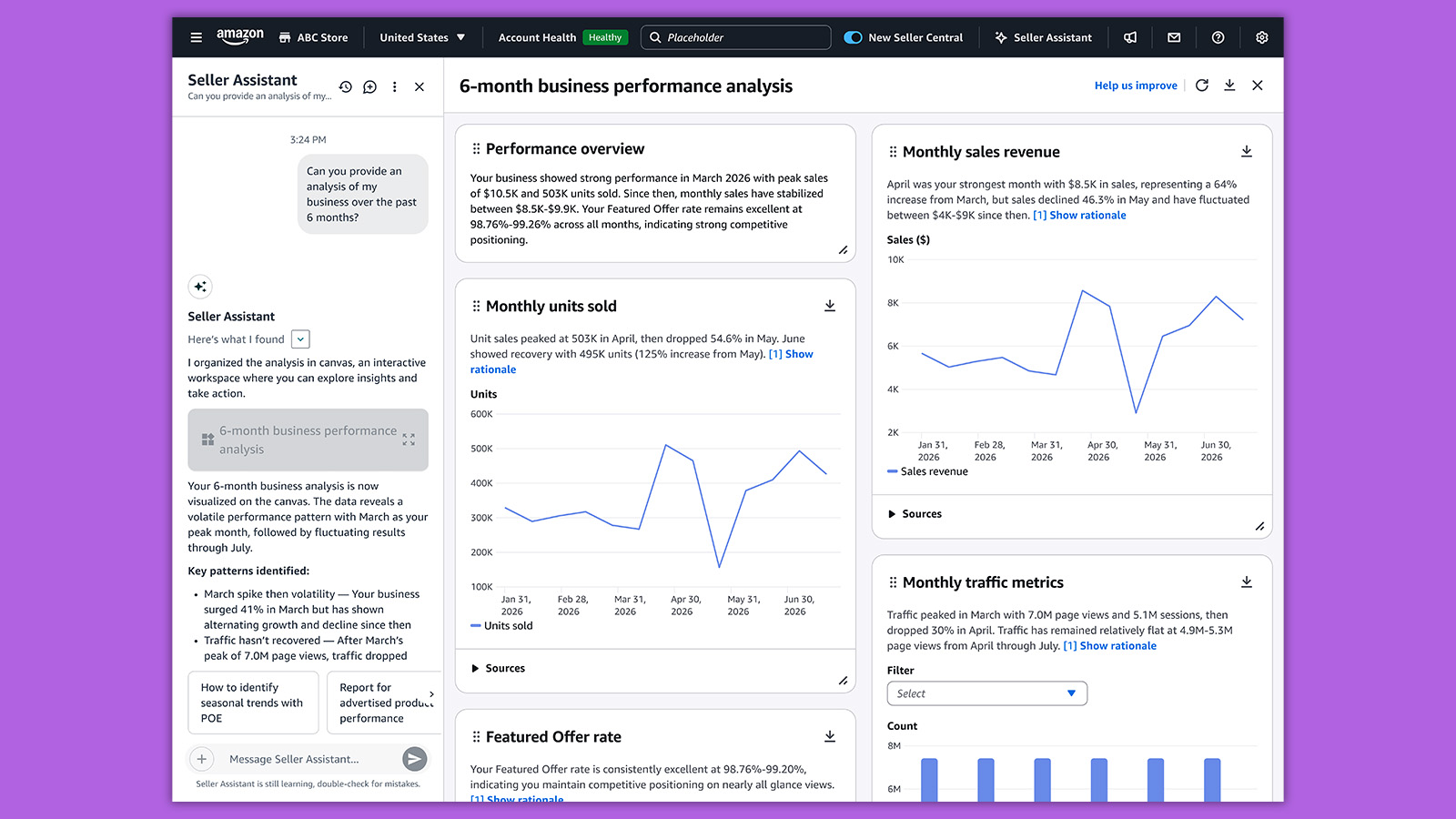
To push adoption, Amazon is giving every primary account holder worldwide 12 months of Quick Plus free, plus two free seats for co-workers, if they sign up by December 31. Seller Assistant itself is now available in sellers’ native languages to more than 90% of Amazon’s selling partners. The stakes for Amazon are large: independent sellers account for more than 60% of the units sold in its stores, and seller fees brought in $46.8 billion in the second quarter — more than AWS.
The move sits oddly beside how Amazon treats shopping agents on the buyer side. GeekWire notes that only days earlier Amazon blocked Meta’s Muse shopping agent, insisting that outside agents identify themselves and follow its rules — the same fight it has been having with Perplexity, which recently won a key round in court. The difference is who holds the keys. Here the agent works for a seller who has granted it access, inside boundaries Amazon draws. Westmoreland said the plugin architecture is "modular enough for us to continue to publish plugins," so Claude is unlikely to be the last assistant invited in — as long as it comes through Amazon’s front door.
More on Claude
Evergreen coverage we keep current — start here.
Want AI news before everyone else?
The morning's most important AI stories, straight to your inbox. No fluff.