Claude Fable 5.2 vs Fable 5.1: A Four-Hour Hill Climb
Claude Fable 5.1 built a Hill Climb game in September that looked right and hung a quarter of its coins out of reach. We gave its successor the same brief, with the same licence to run, test and fix its own work before handing it in. Both games are playable below, exactly as the models delivered them.

BitsMinds LabHow this test was run2 models · 1 brief · one attempt per model: each was required to run, exercise and fix its own build before reporting done, and the report froze the file · Both models at maximum in Claude CodeShow details
- Models
- Claude Fable 5.2 (Claude Code) · Claude Fable 5.1 (Claude Code)
- Attempts
- One attempt per model: each was required to run, exercise and fix its own build before reporting done, and the report froze the file. Fable 5.2's prompt was checked to differ from the one Fable 5.1 received on exactly two lines, both of them output paths.
- Reasoning effort
- Both models at maximum in Claude Code.
- Tools allowed
- Both were told to verify before reporting done, and both had a shell, Node and a browser to do it with, as Claude Code subagents. Earlier Hill Climb builds and the Lab's notes on them were moved out of the working directory before Fable 5.2 started; its log shows it read none of them.
- Timing
- Working time from prompt to final report: Fable 5.2 took 252 minutes 15 seconds on 10 November; Fable 5.1 took 75 minutes 38 seconds on 19 September.
- Scoring
- Four categories scored out of five: graphics, physics, sound and gameplay. Fable 5.1's build is its 19 September file, scored again alongside Fable 5.2's. Final: Fable 5.2 wins with 18 points, Fable 5.1 takes 14. No category for faithfulness to the original game and no credit for the amount of testing a model did.
- Judging
- Scored by BitsMinds from a local side-by-side comparison page of the untouched outputs. Both games were played in an ordinary browser. The measurements quoted in the article — crash distances, coin counts and fuel at fixed speeds — were taken afterwards by driving each delivered build's own physics code with the same set of automatic drivers.
- Published
- November 10, 2026
Result
| Model | Provider | Score |
|---|---|---|
| Claude Fable 5.2 | Anthropic | 18 pts |
| Claude Fable 5.1 | Anthropic | 14 pts |
Fable 5.2 wins with 18 points, Fable 5.1 takes 14. Fable 5.2 tested its level as well as its engine and shipped a game with nothing broken in it, after working more than three times as long; its course still has one easy answer, and Claude Opus 5.5's September build remains the more enjoyable Hill Climb.
The briefs — as described in the article; the exact prompt files were not published
Round 1: Hill Climb Racing (single HTML file)
The brief first run on 19 September, word for word apart from the output path: recreate Hill Climb Racing as one self-contained HTML file — everything inline, no CDN, no network, no images, all art drawn in code — surviving an iframe sandboxed with allow-scripts only. Three screens in a loop with no dead ends, a two-wheeled vehicle with suspension over hilly terrain, touch and keyboard controls, a real fail state, a restart without a reload, and physics not tied to the frame rate. Fuel and coins are deliberately not mentioned.
Result: Fable 5.2 wins with 18 points, Fable 5.1 takes 14. Every one of the 236 coins on Fable 5.2's 1,000-metre course can be collected and its fuel can end a run; 31 of the 32 coins Fable 5.1 strung over its jumps are out of reach.
Read with care
- Single run per model — a re-run could land differently.
- Fable 5.1's build was made on 19 September and is carried over rather than re-run. Beside GPT-6 Astra's game in September it was scored 4, 4, 4 and 3; it was scored again here beside Fable 5.2's.
- Neither entrant started cold: Claude Code gives a subagent this project's memory index. It contains nothing about this brief.
Part of BitsMinds Lab, our series of original hands-on tests.
In September, Claude Fable 5.1 was one of the first two models this series allowed to check its own work. The brief was to rebuild Hill Climb Racing as a single web page, and for once the model was told to run what it built, exercise it and fix it before reporting done. In that first Hill Climb round, Fable 5.1 wrote four physics harnesses, drove a real Chrome, and handed in a game in which 31 of the 32 coins strung over its jumps could not be collected.
Claude Fable 5.2, released on 9 November, has now been given the same prompt, word for word apart from the save path, at the same maximum effort. It is the second test the new model has taken here; in the first, it finished ahead of Claude Opus 5.5 and GPT-6 Astra on three animation briefs where it could not look at what it had made. This one asks something else: with the freedom its predecessor had, does it catch what its predecessor missed?
It does, and it took its time. Fable 5.2 wins with 18 points out of 20, to 14 for Fable 5.1. Every coin in its game can be collected, its fuel gauge can end a run, and nothing in it is broken. It also worked for four hours and twelve minutes, more than three times as long as Fable 5.1, and what it built is still not the best Hill Climb this series has seen.
Play them both
Both games run below exactly as the models delivered them. On a desktop, click into a game first so it receives the keys, then drive with the arrow keys or WASD. On a phone, use the on-screen pedals. Fable 5.2’s sound starts with your first key press or tap.
Peak Hour — Claude Fable 5.2, 252 minutes 15 seconds.
Ridge Runner — Claude Fable 5.1, 75 minutes 38 seconds.
The brief
The brief asks for one HTML file with everything inline: no CDN, no network requests, no images, no web fonts, all art drawn in code. It has to survive an iframe sandboxed with allow-scripts only, which means no local storage and no cookies, because that is how it is embedded on this page. Three screens are required, an opening screen, a menu and the game with one level, joined in a loop with no dead ends. The game itself is a two-wheeled vehicle on suspension over hills, with a camera that follows it, throttle and brake on the keyboard and on touch controls, a car that can leave the ground over a crest and flip on a bad landing, a fail state, a restart that does not reload the page, a HUD, an end-of-run screen, and physics that does not depend on the frame rate. Its last line asks for a game someone would actually want to play.
Fuel and coins are not mentioned anywhere, and neither is how they should behave. Those are the two places earlier entrants have come unstuck: coins that cannot be reached or cost nothing to collect, and fuel that never matters.
Peak Hour, by Claude Fable 5.2
Fable 5.2 called its game Peak Hour. It is a single 1,000-metre climb, from a meadow through pine forest and bare rock to a snowfield, and the clock in the sky moves with you: the run starts in daylight, the sun drops as you gain height, and the last stretch is driven at night on the buggy’s headlights.
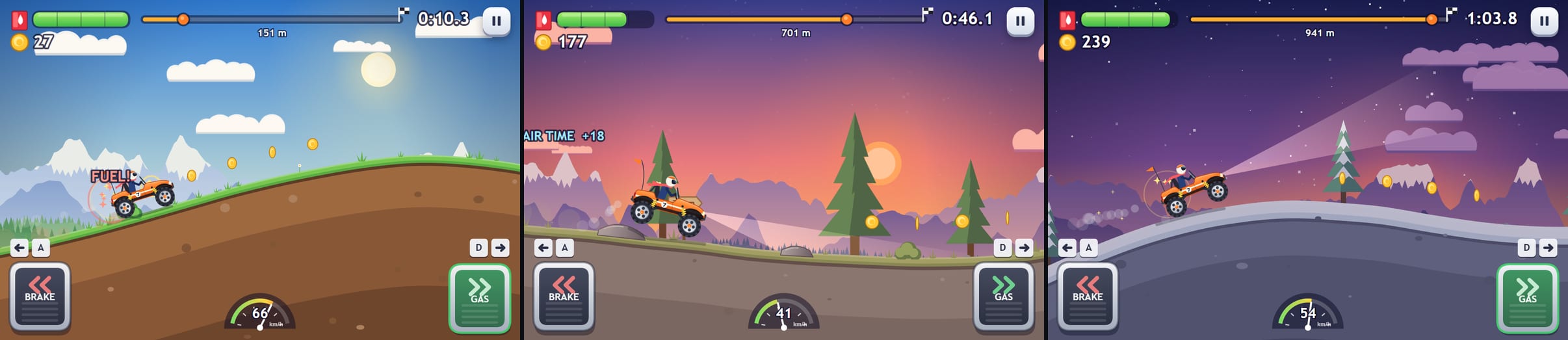
The title screen plays a demonstration run behind the logo. The menu is a garage, with five paint jobs for the buggy, a card that draws the level’s elevation profile, a sound switch and the controls, including the one that matters most: in the air, the gas pedal tilts the buggy back and the brake tilts it forward.

The course carries 236 coins, four of them gems worth five each, along with six fuel cans, thirteen boulders, a bridge and a steepest climb of 33 degrees near the 780-metre mark. The physics runs at a fixed 240 steps a second whatever the frame rate, on a 300 kg chassis with two sprung wheels. There are three ways to lose: put the driver’s helmet on the ground, run out of fuel, or leave the buggy stuck on its side. A run ends on a results card with distance, time, coins, flips, best air time, top speed and a score, and three stars to earn: finishing, finishing under 1:20, and collecting 200 coins.
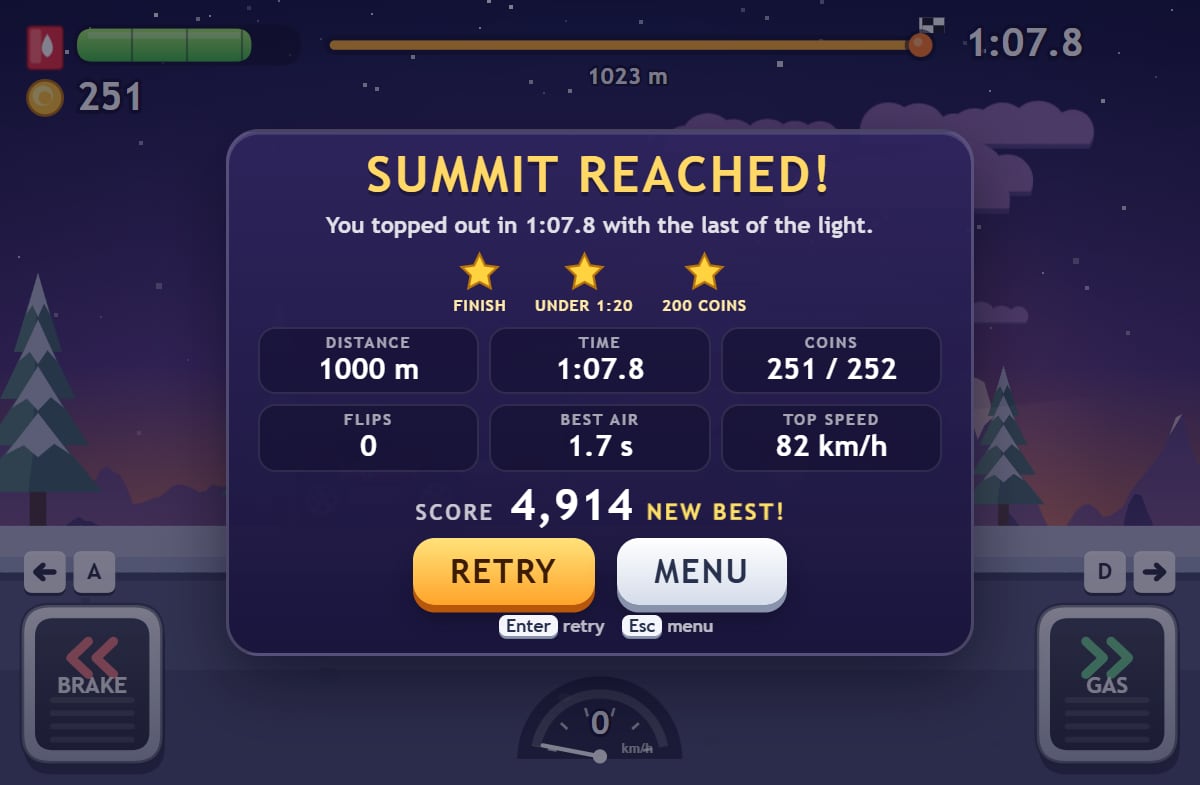
To see what the level asks of a player, we drove the delivered physics code with a set of simple automatic drivers. Every one of the 236 coins was collected by at least one of them; the highest, a gem 869 metres in, hangs 4.1 metres above the ground and takes a fast run to reach. The fuel is real: a driver that crawls at 9 km/h runs dry 113 metres in, and one that holds 14 km/h empties its tank two metres short of the fourth can and coasts into it. And a driver that simply holds the gas down the whole way is on its roof at 278 metres, because the pedal keeps tilting the buggy backwards every time it leaves the ground.
What the level does not do is make speed cost anything. The simplest policy that works, gas while a wheel is on the ground and nothing at all in the air, finished in 67.6 seconds with all 236 coins, the best run we recorded. Slower, more careful drivers finished with fewer coins, between 227 and 233, because nine of them sit too high for a slow car. One driver holding a steady 50 km/h wiped out at 600 metres where faster and slower ones did not.
Ridge Runner, by Claude Fable 5.1
Fable 5.1’s game dates from 19 September and is embedded here unchanged. It took 75 minutes 38 seconds and 81 KB. It goes for bright arcade colour: a hard sun, a chunky orange jeep, and a title screen where a bot drives the real physics behind the logo. Its course is 900 metres long, with five fuel cans and four jumps.
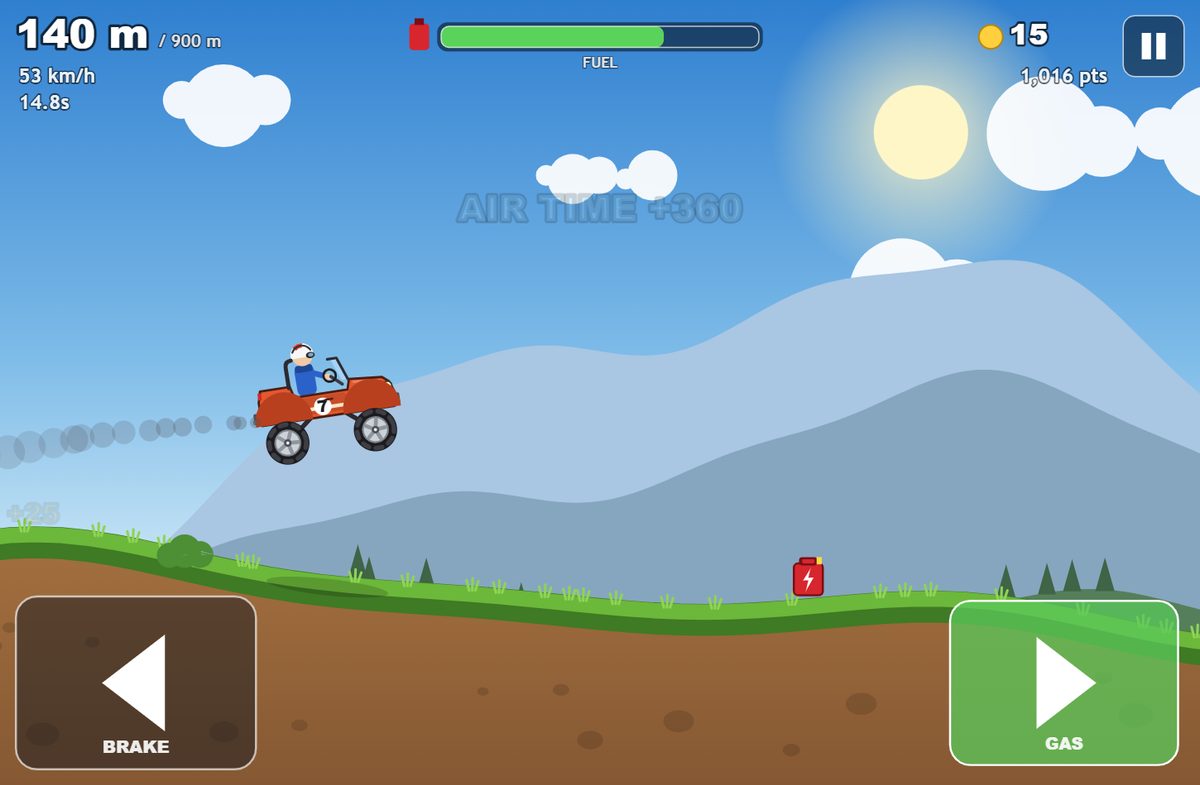
Its fault is the one that decided the September round. Of its 117 coins, 32 hang in arcs over the four jumps, and they were placed against the height of the ground where each jump starts instead of the ground beneath each coin. They sit between 2.7 and 17.6 metres up, over a car whose jumps peak at 1.9 to 4.2 metres, and 31 of the 32 cannot be collected. Fable 5.1 had written a tool that printed its own jump height and never set that number against the heights it had hung in the air. Its background has a glitch of its own: the cloud layer is tied to a camera zoom that changes with speed, and it jumps as the jeep accelerates.
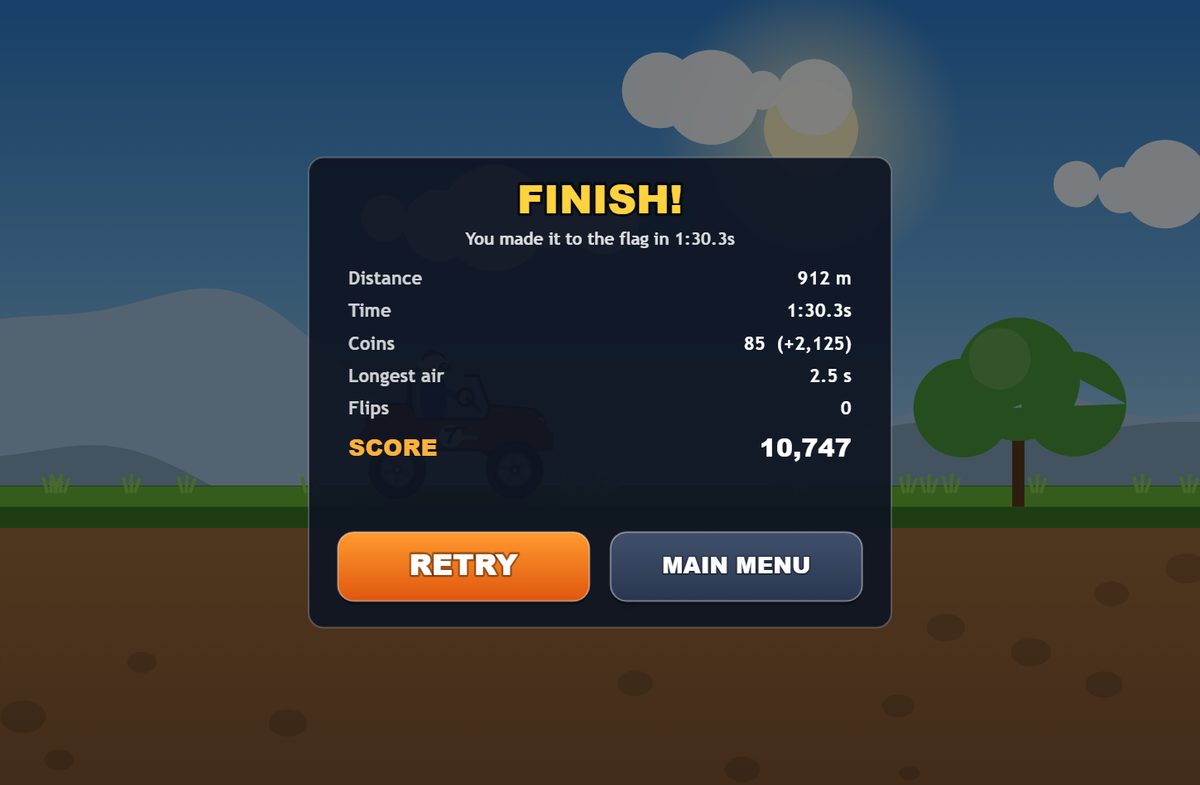
The same automatic drivers tell a mirror-image story on this course. Holding the gas down from start to flag finishes it, in 85.5 seconds with 85 coins: every coin at ground level and none from the arcs. Lifting off in the air, the habit Peak Hour rewards, ends in a crash at 642 metres. Across all of the drivers, 86 of the 117 coins were ever collected, and the fuel gauge never fell below 49%.
What four hours bought
| Fable 5.2 | Fable 5.1 | |
|---|---|---|
| Working time | 252m 15s | 75m 38s |
| Tool calls | 387 | 122 |
| File size | 162 KB | 81 KB |
| Course | 1,000 m, 6 fuel cans | 900 m, 5 fuel cans |
| Coins on the course | 236 | 117 |
| Coins a car can reach | 236 | 86 |
Fable 5.2 assembled its game from eleven source files through a build script of its own, and wrote more than two dozen test and measurement scripts around it. Its report lists a fuzz of 400 random-pedal runs, 7.4 hours of simulated driving, in which no wheel sank more than 3.7 cm into the ground; 98 checks in headless Chrome covering the whole navigation loop by mouse, keyboard and emulated touch; the same run at 30, 60, 144 and 240 frames a second with identical results; the game inside a sandboxed iframe with storage blocked; and the whole loop again in Firefox.
The part that matters is that it tested the level and not only the engine. It ran two autopilots over the whole course, confirmed that holding the gas all the way ends in a crash, and sent thirty deliberately sloppy drivers down it to see how many would finish; 24 did. In September both models verified their engines and neither checked whether the level built on top could be played as designed, and that is the gap Fable 5.1’s coins fell through.
It was also candid about what it had not done. It never heard its own audio, only measured its levels. It never ran on a real phone. It tuned the difficulty against autopilots and not against human hands. And it reported a stall of about 170 milliseconds on the first frame of a run started straight after the page loads.
The time is the other half of the result. Fable 5.2 made its last change to the game just under four hours in and spent the rest confirming it. Long stretches went on things no player will notice directly: frame pacing on a real graphics card at 1080p, behaviour in Firefox, a system that lowers the resolution on slow hosts. At list price the run comes to about $85, most of it the cost of re-reading its own growing context across 338 requests. September’s run was not metered the same way, so there is no like-for-like dollar figure for Fable 5.1; the clock says three and a third times as long.
Conditions matched where it mattered. Fable 5.2’s prompt was checked to differ from the one Fable 5.1 received on exactly two lines, both of them output paths, and both models ran as Claude Code subagents at maximum effort with a shell, Node and a browser to hand. Earlier Hill Climb builds and our notes on them were moved out of the working directory before Fable 5.2 started, and its log shows it read none of them.
Scoring
Fable 5.2 scored 5 for graphics, 5 for physics, 4 for sound and 4 for gameplay. Fable 5.1’s build, scored again beside it, took 3, 5, 3 and 3. In September, next to GPT-6 Astra’s game, the same file was given 4, 4, 4 and 3; scores in this series are set against the field on the page.
Graphics is the widest gap, two points. Peak Hour is the better-looking game throughout, and a day that turns to night over the course of one climb is its own idea. It also avoids the background glitch in Ridge Runner, whose clouds jump when the camera zooms. Physics is level at full marks: both vehicles sit on real springs and behave as they should from the first metre to the last.
Sound goes to Fable 5.2 by a point. Its engine note is deeper, three oscillators through a low-pass filter, and it runs up through four gears, dropping at each shift the way a real engine does. Gameplay goes to Fable 5.2 by a point as well. Its course is the faster of the two, with steeper climbs, boulders that break up the rhythm, and coins that can all be collected, the four gems included.
It is still not the most enjoyable Hill Climb in this series. That remains Hill Hopper, the game Claude Opus 5.5 built in September, which stays closer to the spirit of the original and is more fun to drive. The builds were scored at BitsMinds from a local side-by-side page of the untouched files, played in an ordinary browser; the measurements quoted above were taken afterwards by driving each delivered build’s own physics code.
A level that was checked
September’s round ended on a specific complaint: given the freedom to test, both models tested the engine and shipped a level nobody had driven with a critical eye. Fable 5.2 closed that gap. It put drivers on its own course, found out what crashes and what finishes, and hung no coin where a car cannot go. The result is a game with nothing broken in it, which the Fable before it could not manage.
The price was time. Four hours and twelve minutes is the longest run this series has timed, and the extra care did not buy the best game. The level it tested so thoroughly turns out to have one easy answer, foot down on the ground and off in the air, and Opus 5.5 built a more enjoyable Hill Climb in 98 minutes. Fable 5.2 got everything right that a script can check. Whether a game is fun is not one of those things, and that is where it came up short.
More on Claude
Evergreen coverage we keep current — start here.
Want AI news before everyone else?
The morning's most important AI stories, straight to your inbox. No fluff.