Genie 4: DeepMind’s World Model Gets Sound and an Agent
Google DeepMind’s Genie 4 generates explorable worlds in real time with native audio and spoken dialogue, and lets you rewrite the scene in plain language as you move through it. It is a research preview for trusted testers for now, with Google AI Ultra subscribers and early Gemini API partners next in line.
Google DeepMind has introduced Genie 4, the next version of its world model: a system that generates an interactive, explorable environment frame by frame and responds to the user as they move through it. The post, published on 27 October by Raia Hadsell, Diego Rivas and Hang Qi, says the model “unlocks unprecedented realism” and improves real-time interactive simulation. Access is narrow to begin with. Genie 4 is in a research preview for trusted testers drawn from creative industries, journalism, education, gaming and engineering, and Google says it is coming soon to Google AI Ultra subscribers in Project Genie and to early-access partners of the Gemini API and Google AI Studio. There is a waitlist.
The headline change is sound. Genie 4 is natively multimodal, and DeepMind calls it its first real-time world model to generate audio itself: music, ambient noise and dialogue with characters that adapts as the scene unfolds. Users steer with standard keyboard controls for movement and camera and with text prompts, and they can rewrite the world while they are inside it, changing the weather, moving the camera or adding people and objects. Gemini adapts each prompt to the current scene so the world keeps moving coherently between inputs. DeepMind also says the model handles physical scenarios such as aerodynamics and collisions, and that its characters move naturally and can be steered in real time.

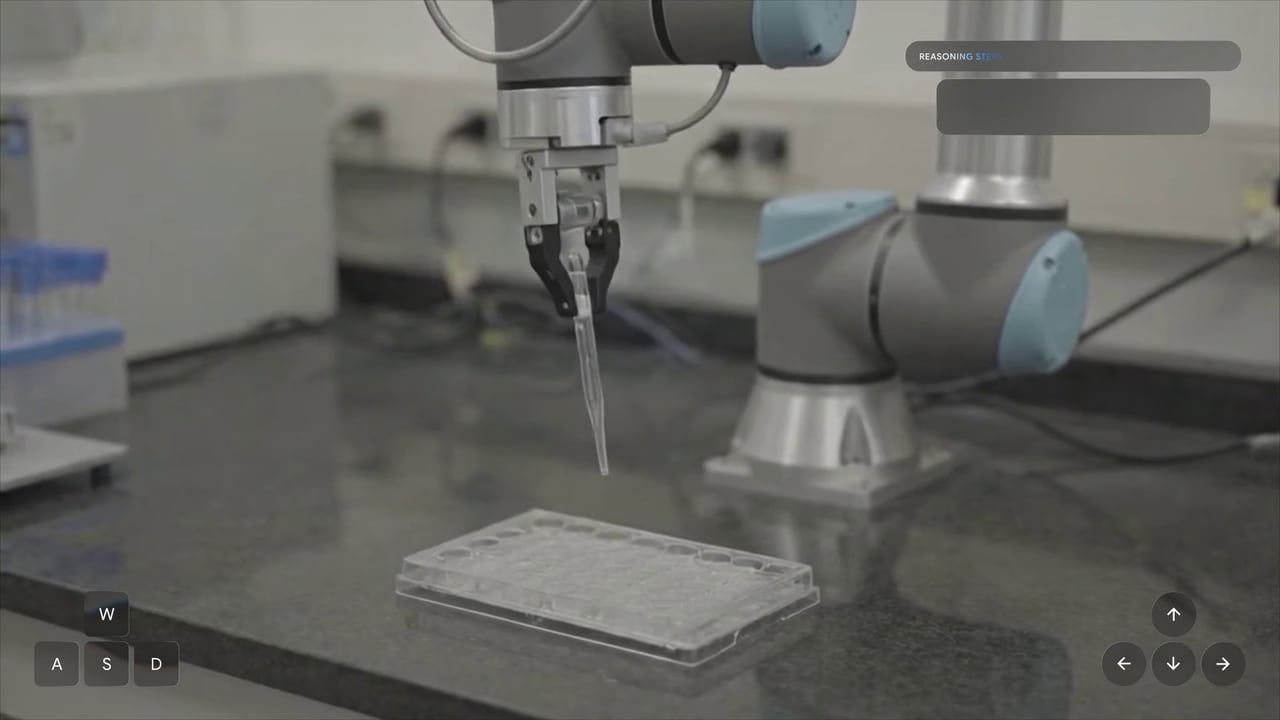
Genie 4 leans on the rest of Google’s model family. According to the post, Gemini Omni anchors the simulations in real-world appearance and behaviour, while other Gemini models handle the reasoning that keeps a world coherent over time. In agentic mode, Gemini 3.8 Flash acts as a guiding agent: it watches the scene, breaks a goal into steps, checks its progress and changes the plan when something goes wrong. DeepMind adds that it has been experimenting with Gemini 4 Argon alongside Genie 4, including a demo of Apptronik’s Apollo humanoid playing checkers, and that enterprise partners are testing the model for generating training and test scenarios from scratch. That is the practical case for world models: cheap, varied practice worlds for robots and agents before they meet the real one.
The post is open about the limits. Visual details and object permanence “can still shift or drift over time,” especially in longer sessions or after several edits, and DeepMind lists complex physical interactions, real-time audio accuracy, legible text, spatial accuracy and long-term consistency as open research problems. It says Genie 4 carries the same safety guardrails as Google’s other models, that internal safety evaluations ran before the preview, and that all generated video and audio is watermarked with SynthID. What the post does not give is just as telling: no resolution, frame rate, maximum session length or price, and no side-by-side numbers against Genie 3, which DeepMind announced in August 2025.
World models have become a crowded field. Fei-Fei Li’s World Labs unveiled its Atlas model in September, and Decart and Runway both raised money on world-model pitches in May. Genie 4’s advantage is less about any single demo than about plumbing: it plugs into Gemini for reasoning, into Google’s robotics partners for embodied tests, and soon into the Gemini API, where developers will be able to judge for themselves how long one of these worlds holds together.
Want AI news before everyone else?
The morning's most important AI stories, straight to your inbox. No fluff.