GPT-5.6 Launches After a Government Delay — and Sol Tops the Coding Charts
OpenAI shipped GPT-5.6 on July 9 as a three-tier family — Sol, Terra, Luna — after a US-government delay. Sol tops TerminalBench 2.1 at 91.9% and is ~54% more token-efficient on agentic coding, though Anthropic's Fable 5 still leads SWE-Bench Pro.
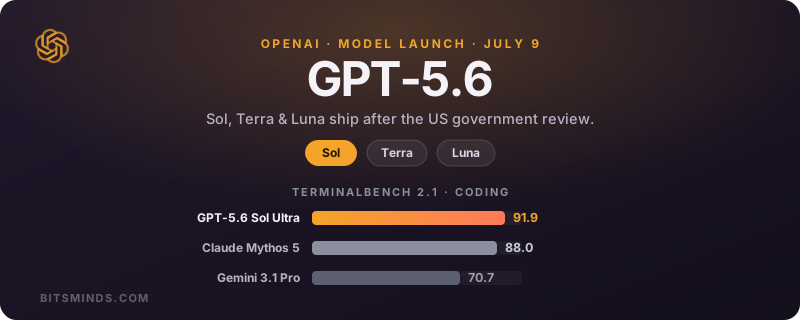
OpenAI shipped GPT-5.6 for general availability on July 9, after a limited preview — and a rare hold in which the US government asked OpenAI to delay the public rollout on national-security grounds, clearing it only once the Center for AI Standards and Innovation finished additional testing. It's live across ChatGPT, Codex, and the API, is already the preferred model in Microsoft 365 Copilot and GitHub Copilot, and launched alongside the new ChatGPT Work product.
Three tiers, one generation
The new naming separates generation from capability: "5.6" is the generation, while Sol, Terra, and Luna are durable tiers that each advance on their own cadence. All share a 1M-token context window and 128K max output. API pricing per 1M tokens:
| Tier | Input | Output | Positioning |
|---|---|---|---|
| Sol | $5 | $30 | Flagship frontier reasoner for hard agentic, scientific, and coding work |
| Terra | $2.50 | $15 | Balanced — roughly GPT-5.5-class at about half Sol's cost |
| Luna | $1 | $6 | Fastest and cheapest, for high-volume, shallow tasks |
Two effort modes sit on top: max gives the model more time to reason and self-check, while ultra coordinates four agents in parallel by default (up to 16), exposed to developers via a multi-agent beta in the Responses API.
The real pitch: performance per dollar
OpenAI's framing is "efficient by default." On the independent Artificial Analysis Coding Agent Index, GPT-5.6 Sol set a new state of the art at 80 — 2.8 points above Claude Fable 5 — while using less than half the output tokens, taking less than half the time, and costing about a third less. On OSWorld 2.0 it beats Claude Opus 4.8 while burning 85% fewer output tokens, and Sam Altman told CNBC the model is 54% more token-efficient on agentic coding than GPT-5.5. A new Programmatic Tool Calling path runs in-memory programs that coordinate tools and filter intermediate data, cutting model round-trips further.
Where GPT-5.6 leads
Sol tops the agentic, browsing, and computer-use charts (Sol's ultra multi-agent scores in parentheses):
| Benchmark | GPT-5.6 Sol | Best Claude | Gemini 3.1 Pro |
|---|---|---|---|
| AA Coding Agent Index | 80 | 77.2 (Fable 5) | 42.7 |
| Terminal-Bench 2.1 | 88.8 (91.9) | 88.0 (Mythos 5) | 70.7 |
| DeepSWE v1.1 | 72.7 | 69.7 (Fable 5) | 11.8 |
| Agents' Last Exam | 52.7 | 45.2 (Opus 4.8) | 32.1 |
| BrowseComp | 90.4 (92.2) | 88.0 (Mythos 5) | 85.9 |
| OSWorld 2.0 | 62.6 | 54.8 (Opus 4.8) | — |
Where Claude still leads
It isn't a sweep. On deep software engineering, broad intelligence, and tool use, Anthropic keeps the crown — a nuance OpenAI's own comparison table concedes:
| Benchmark | Leader | GPT-5.6 Sol | Gemini 3.1 Pro |
|---|---|---|---|
| SWE-Bench Pro | 80.3 (Mythos 5) | 64.6 | 54.2 |
| AA Intelligence Index | 59.9 (Fable 5) | 58.9 | 46.5 |
| GDPval-AA v2 (Elo) | 1,759.6 (Fable 5) | 1,747.8 | 962.3 |
| Toolathlon | 61.7 (Fable 5 / Mythos 5) | 58.0 | 48.8 |
| FrontierMath Tier 4 | 87.8 (Fable 5) | 83.0 | — |
OpenAI's counter is cost: on the intelligence index, Sol comes within a point of Fable 5 while finishing tasks in 61% less time at roughly half the estimated cost — and Terra and Luna reportedly beat Fable 5 on Agents' Last Exam at around one-sixteenth the cost.
Cyber, science, and self-improvement
OpenAI calls it its strongest cybersecurity model yet — ExploitBench jumps to 73.5% from GPT-5.5's 47.9%, and Capture-the-Flag hits 96.7% — with the most capable defensive access gated behind the Daybreak Trusted Access for Cyber program (hardware-backed passkeys required by September 1). It posts Pareto gains on genomics and life-sciences evals, and OpenAI says GPT-5.6 is its best model yet for accelerating its own research: on an aggregate recursive-self-improvement index it scores 16.2 points above GPT-5.5, and researchers' daily token usage more than doubled during internal testing.
Shipped under a government sign-off
The safety stack is the largest OpenAI has built — roughly 700,000 GPU-hours of automated red teaming, a reasoning monitor that reviews conversations, and cyber safeguards that block about 10× more potentially harmful activity than before — and OpenAI says the models don't cross its "Critical" risk threshold in biology or cybersecurity. But the headline precedent is procedural: for the first time, a frontier US model reached the public only after federal testing and approval, and OpenAI made its discomfort explicit — "We don't believe this kind of government access process should become the long-term default." GPT-5.6 tops many charts; that Washington gated its launch at all may be the more lasting story.
Want AI news before everyone else?
The morning's most important AI stories, straight to your inbox. No fluff.