OpenAI Engineer Charged Over Hidden Office Recorder
An OpenAI engineer has been charged with hiding an audio recorder, wrapped in toilet paper, behind a TV in an executive conference room. Prosecutors say chatbot prompts helped him build it; OpenAI says its own models helped trace it back to him. He faces up to five years in prison if convicted.
An OpenAI engineer has been charged with planting a hidden audio recorder in an executive conference room at the company’s San Francisco offices, the Justice Department announced on 13 October. Abdulrahman Alfozan, 35, a Saudi national who had worked at OpenAI as an engineer since July 2025, was arrested on 9 October and charged with using, or trying to use, a device to intercept oral communications. The complaint was unsealed when he made his first appearance in federal court in San Francisco. He remains in custody, and a detention hearing is set for 19 October before Magistrate Judge Alex G. Tse, the San Francisco Standard reported.
A recorder behind the TV
According to the complaint, OpenAI staff found the device on or about 30 September, plugged into a USB port on the back of a television in an executive conference room. It had been hidden in toilet paper, its contents were encrypted, and OpenAI worked out that it had been installed on or about 28 September. Security footage showed Alfozan near the room on several dates beforehand, although he had no authority to enter it or to join the meetings held there. Those meetings, prosecutors say, regularly covered highly confidential material: proprietary research, product plans, business deals, and nonpublic information about OpenAI’s technical progress, government engagements and commercial relationships.
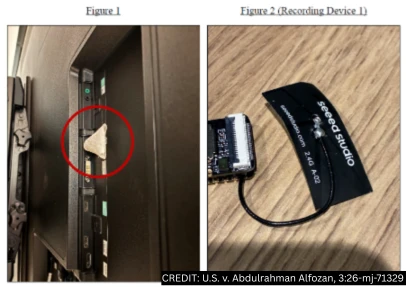
The complaint lays out how the device was allegedly put together. Before 28 September, Alfozan is said to have used a productivity tool to ask about OpenAI’s building addresses, meeting rooms and their capacities, calendars, “leadership and exec” locations and external partner meetings. Between 24 and 30 September, a chatbot account linked to his spouse, which shared several identifiers with his own account, submitted prompts about building a “continuous audio recorder”, customising its Wi-Fi connection, improving “live listening” and encrypting the SD card. On 27 and 28 September the same account asked about the specific device that was later found, including its custom header and MAC address. The release does not say which chatbot service was used.
On 5 October, prosecutors say, Alfozan went into the conference room and appeared to look behind the television. The same day he left a bag unattended in a different OpenAI building; security staff opened it and found his wallet, his ID and a second recorder similar to the first. Bloomberg reported that the complaint identifies the hardware as a Seeed Studio XIAO ESP32-S3 Sense, a thumb-sized development board with a digital microphone and a microSD slot that Seeed sells for $13.90. The antenna in the complaint’s photo carries the Seeed Studio name.
What OpenAI says
In a statement on X, OpenAI said its technical surveillance countermeasures team found the recorder during a sweep of the room, and that employees then used the company’s own AI models to identify the device and where it came from, including by analysing forensic images of its storage, before referring the case to the FBI. OpenAI called the device sophisticated, citing advanced encryption, audio monitoring and a data-transfer method designed to avoid detection, and said it has evidence that Alfozan meant to place more recorders in sensitive spaces. It began restricting his access on 30 September, placed him on leave, and fired him on the day of his arrest in coordination with the FBI. The company said it has “no indications” that he accessed or took model weights, source code or customer data, Engadget reported.
Charged as wiretapping, framed as national security
The release opens with a quote from Director of National Intelligence Jay Clayton, who said the case shows why winning “the global super intelligence race” is a matter of national security. FBI Director Kash Patel said protecting American superintelligence work is among the bureau’s highest counterintelligence priorities, and Craig Missakian, U.S. Attorney for the Northern District of California, said: “For us it is a matter of national security.” Assistant U.S. Attorney Nicolas Parker is prosecuting, with help from the National Security Division’s Counterintelligence and Export Control Section, and the Justice Department says the case supports NSPM-11, the presidential memorandum on American superiority in superintelligence. The charge itself is narrower than that framing: it is an interception offence, not theft of trade secrets or espionage, and the release does not say who, if anyone, the recordings were meant for. If convicted, Alfozan faces up to five years in prison, a $250,000 fine and three years of supervised release. The allegations have not been proven in court.
The case has an odd symmetry that both sides of it will keep pointing to. By the government’s account, a chatbot helped design the recorder and an internal productivity tool helped choose the room; by OpenAI’s, its own models helped take the device apart and name the man who placed it. How much of that holds up will be tested at the detention hearing and beyond, but the picture of a frontier lab sweeping its own boardroom for bugs is not likely to fade quickly.
Want AI news before everyone else?
The morning's most important AI stories, straight to your inbox. No fluff.