OpenAI's GPT-Live Makes ChatGPT Talk Like a Person — It Listens While It Speaks
GPT-Live replaces ChatGPT's turn-based voice with a full-duplex model that listens and speaks at once — it says "mhmm," handles interruptions, stays quiet when you think, and quietly hands hard questions to a frontier model in the background.
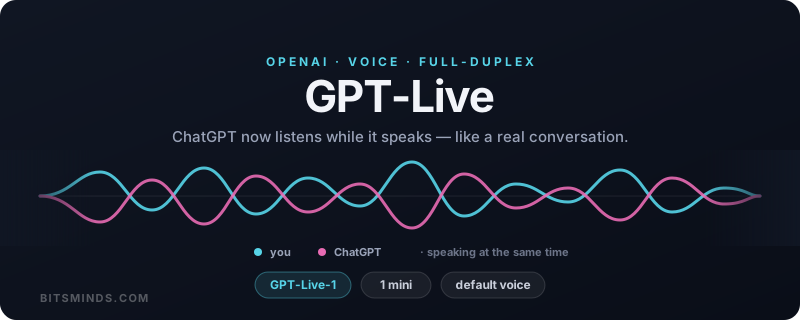
OpenAI has replaced ChatGPT's voice mode with something categorically different. GPT-Live, launched July 8, is a new generation of voice models built on a full-duplex architecture — meaning it listens and speaks at the same time, instead of the walkie-talkie turn-taking every voice assistant has used until now.
What full-duplex actually changes
Turn-based voice AI waits for you to stop, processes, then answers — and any interruption resets the dance. GPT-Live behaves like a person on a phone call: it can murmur "mhmm" or "yeah" while you talk to show it's following, handle rapid back-and-forth, yield instantly when you cut in, and — maybe hardest of all — stay quiet when you pause to think instead of rushing to fill the silence. TechCrunch and VentureBeat both describe the result as the closest a mainstream assistant has come to natural conversation.
A fast voice with a big brain behind it
GPT-Live itself is optimized for latency, not depth — so when a question needs web search, deeper reasoning, or real work, it delegates to a frontier model in the background (GPT-5.5 at launch) and folds the answer back into the conversation when it's ready. You keep talking; the heavy lifting happens off-stage. It's the same orchestration pattern the industry is converging on — a cheap fast model up front, an expensive smart one on call — applied to speech.
Rollout
Two versions are rolling out globally: GPT-Live-1 becomes the default voice for paid ChatGPT tiers (Go, Plus, Pro), while GPT-Live-1 mini serves the free tier. The launch landed one day before GPT-5.6 shipped — a two-punch week that puts OpenAI's consumer voice experience and its frontier reasoning stack on new footing simultaneously.
The competitive subtext: voice is the interface where AI feels most human, and everyone — from xAI's Grok voice to Google's Gemini Live — is chasing the same naturalness. Full-duplex is a real architectural moat, not a prompt trick. If GPT-Live delivers on the demo, "talking to ChatGPT" stops meaning dictation with extra steps — and starts meaning conversation.
More on ChatGPT
Evergreen coverage we keep current — start here.
Want AI news before everyone else?
The morning's most important AI stories, straight to your inbox. No fluff.