Positron Raises $875M for Memory-First Inference Chips
The Reno chipmaker closed $875 million across two tranches at a $5 billion post-money valuation, betting that commodity phone memory beats HBM for inference. Its next chip, Asimov, carries up to 2,304 GB and does not tape out until the end of the year.
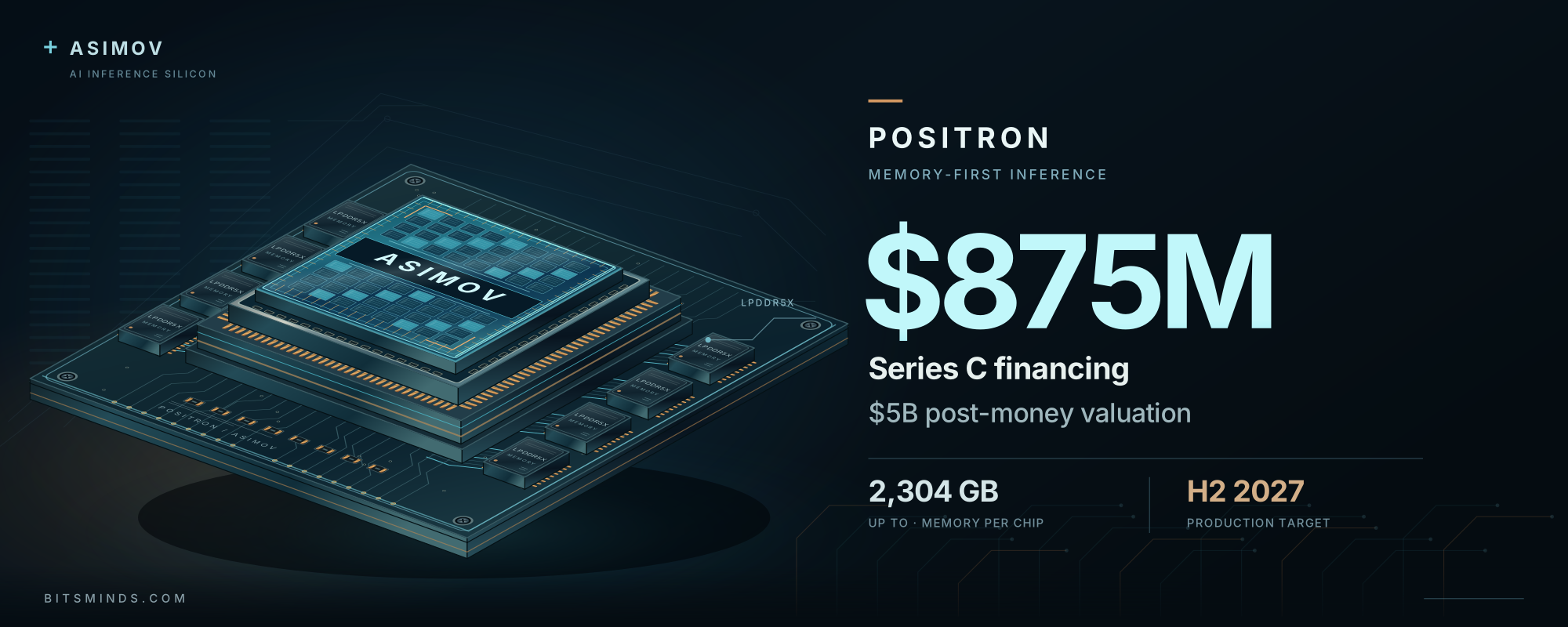
Positron AI raised $875 million on 10 September at a $5 billion post-money valuation, structured as two tranches rather than one round. A $375 million Series C priced at a $3.5 billion pre-money valuation was co-led by NEA, Andra Capital, Atreides Management, Valor Equity Partners and SemiAnalysis Capital, the fund run by analyst Dylan Patel. A follow-on Series C-1 of up to $500 million was anchored by NEA and Jim Clark, who co-founded both Silicon Graphics and Netscape. SiliconANGLE reports the valuation is roughly five times where the company sat in February.
The technical bet is unusual enough to explain the price. Conventional accelerators are built around high-bandwidth memory, the stacked, packaged DRAM that has been the industry's hardest supply constraint for two years. Positron builds around LPDDR5X instead — the commodity low-power memory in phones — and argues that utilisation beats peak specs. The company claims its hardware realises more than 90% of available memory bandwidth, against conventional accelerators it says use less than 30% of their HBM modules' bandwidth. Trading a higher theoretical ceiling for a much higher fraction of it, on parts nobody is fighting over, is the entire thesis.
It also sidesteps the two bottlenecks that have set AI hardware prices this cycle: HBM allocation and advanced packaging capacity. Memory has been the binding constraint since Micron sold out its entire 2026 output, and the squeeze has been visible downstream in a 15% jump in AI server prices. Patel put the case for the architecture in one line: "Positron's architecture addresses the real constraint, memory, without depending on HBM."
The chip the money is for does not exist yet. Asimov pairs Positron's compute — a systolic array with co-located memory for model weights, activation-function modules, and CPU cores as what the company calls a programmable escape hatch — with between 288 GB and 2,304 GB of memory per chip. It is scheduled to tape out on TSMC's N3P process at the end of 2026, with production in the second half of 2027. Titan, the system built from four to eight Asimov chips in a single node, is specified for models beyond 16 trillion parameters and context windows over 10 million tokens without leaving the node, carrying 18.4 TB of LPDDR5X at 23.68 terabits per second and scaling to thousands of nodes. Positron's simulations put Titan at 26 times better tokens-per-dollar than Nvidia's Blackwell GB300 NVL72 — a projection against unreleased silicon, not a measurement.
What is measurable is the current generation. Atlas is deployed across more than 50 racks inside Oracle Cloud Infrastructure, with Parasail reselling capacity through OCI and Jump Trading and i3d.net named as direct customers. Forest Baskett of NEA leaned on exactly that in explaining the cheque, noting that "Atlas is running at scale inside Oracle's cloud today" before describing Asimov as the boldest memory-first bet in the category. Clark was terser, calling the design's power consumption, cost and density "near ideal for inference." CEO Mitesh Agrawal framed the raise around tempo, saying the lessons from shipping Atlas were carried "directly into Asimov and Titan."
The proceeds are earmarked against a schedule rather than a runway: the Asimov tapeout, a 2-megawatt-plus engineering data centre and emulation platform, the Titan production ramp including LPDDR5X supply and integration, and commercial expansion. The strategic names on the cap table read like a customer list in waiting — VentureTech Alliance, Hudson River Trading, Cisco Investments and Naver Ventures — alongside DFJ Growth, the Qatar Investment Authority, 1517 Fund, Boardman Bay and others. Baskett, Atreides' Gavin Baker, Thomas Jermoluk of the Jim Clark Office and Patel all take board seats.
Positron is entering the part of the market where the money has actually moved. Inference-focused companies took eight of the twelve disclosed AI chip rounds between January and August this year and about two-thirds of the capital, and incumbents are converging on the same idea from the other direction — Qualcomm is building custom inference silicon for AWS, Cerebras doubled CS-4 throughput on an unchanged die, and OpenAI's own Jalapeño claims a perf-per-watt win over Blackwell.
The gap between the cheque and the product is the thing to watch. Positron has raised most of a billion dollars on simulation data and a tapeout that has not happened, in a market where the competition will ship two more generations before Asimov reaches volume in late 2027. That is not unusual for silicon — it is how silicon is financed — but it does mean the $5 billion is priced off a spreadsheet and 50 racks of the previous chip, and the LPDDR5X thesis stays a thesis until someone measures a Titan.
Want AI news before everyone else?
The morning's most important AI stories, straight to your inbox. No fluff.