
Claude Fable 5 Review: Most Capable, at a Premium
Anthropic's Claude Fable 5 is the most capable model the public can use today — topping SWE-Bench Pro and excelling at vision and long tasks. It is also the priciest major model and ships with hard safety guardrails. Our first-look verdict.
Pros
- Best agentic-coding result to date (80.3 on SWE-Bench Pro)
- State-of-the-art vision plus stronger long-horizon autonomy
- Mythos-class capability finally available to everyone
- Robust guardrails that fall back to Opus 4.8 rather than fail
Cons
- Most expensive major model at $10 in / $50 out per million tokens
- Safety classifiers can block legitimate security research
- Mandatory 30-day retention even on zero-retention plans
- Bundled free access ends June 22 then costs usage credits
A first-look review based on Anthropic's launch data, the published system card, and early third-party testing — not extended hands-on use. We will revisit it after living with the model.
Claude Fable 5, released June 9, is the first model from Anthropic's powerful "Mythos" class that anyone can actually use. It is, on paper and in early reports, the most capable generally available model on the market — and also the most expensive, hedged by some of the strictest safety guardrails any frontier lab has shipped. The result is a model that is easy to admire and harder to recommend universally.
Capabilities
On agentic coding — the workload most teams care about — Fable 5 is in a class of its own. It scores 80.3 on SWE-Bench Pro, a wide gap over Claude Opus 4.8 (69.2) and GPT-5.5 (58.6), and it is the first model to clear 90% on Hex's analytical benchmark. Anthropic also positions it as state-of-the-art for vision, and its long-horizon autonomy is real: one external researcher reproduced a frontier physics result in 36 hours using about a third of the reasoning tokens GPT-5.5 needed over four days.
Price
Capability this high is not cheap. Fable 5 lists at $10 per million input tokens and $50 per million output — less than half the old Mythos Preview price, but roughly double Opus 4.8 and the priciest of the major frontier models. For high-value, low-volume work (hard debugging, research, complex agents) the economics make sense; for high-volume chat or batch jobs, the output price adds up fast and Opus 4.8 is often the smarter default.
Safety and access
Fable is the guardrailed edition of Mythos. Three classifiers — cyber, biology and chemistry, and model distillation — block high-risk requests and quietly hand them to Opus 4.8; Anthropic says over 95% of sessions never trigger a fallback, and an external bug bounty logged 1,000+ hours without finding a universal jailbreak. The catch: a mandatory 30-day data-retention window applies to all Mythos-class traffic, even for customers on zero-retention contracts. It is available today via the Claude API as claude-fable-5 and free on Pro, Max, Team and seat-based Enterprise plans through June 22, after which it draws on usage credits.
Who it's for
Fable 5 is the obvious pick for engineering teams that want the best agentic coding available, for vision-heavy workflows, and for long, multi-step tasks where its autonomy pays for itself. It is a poor fit for offensive-security and red-team work (the guardrails are designed to stop exactly that), for organizations bound by strict zero-retention requirements, and for cost-sensitive, high-volume deployments where Opus 4.8 delivers most of the value at half the price.
Verdict
Claude Fable 5 resets the bar for what a publicly available model can do, and Anthropic deserves credit for shipping its most powerful system with the dangerous edges genuinely fenced off rather than simply withholding it. The premium price and the hard guardrails keep it from being a default for everyone — but for the work it is built for, nothing else comes close right now. An outstanding, if expensive and opinionated, release.
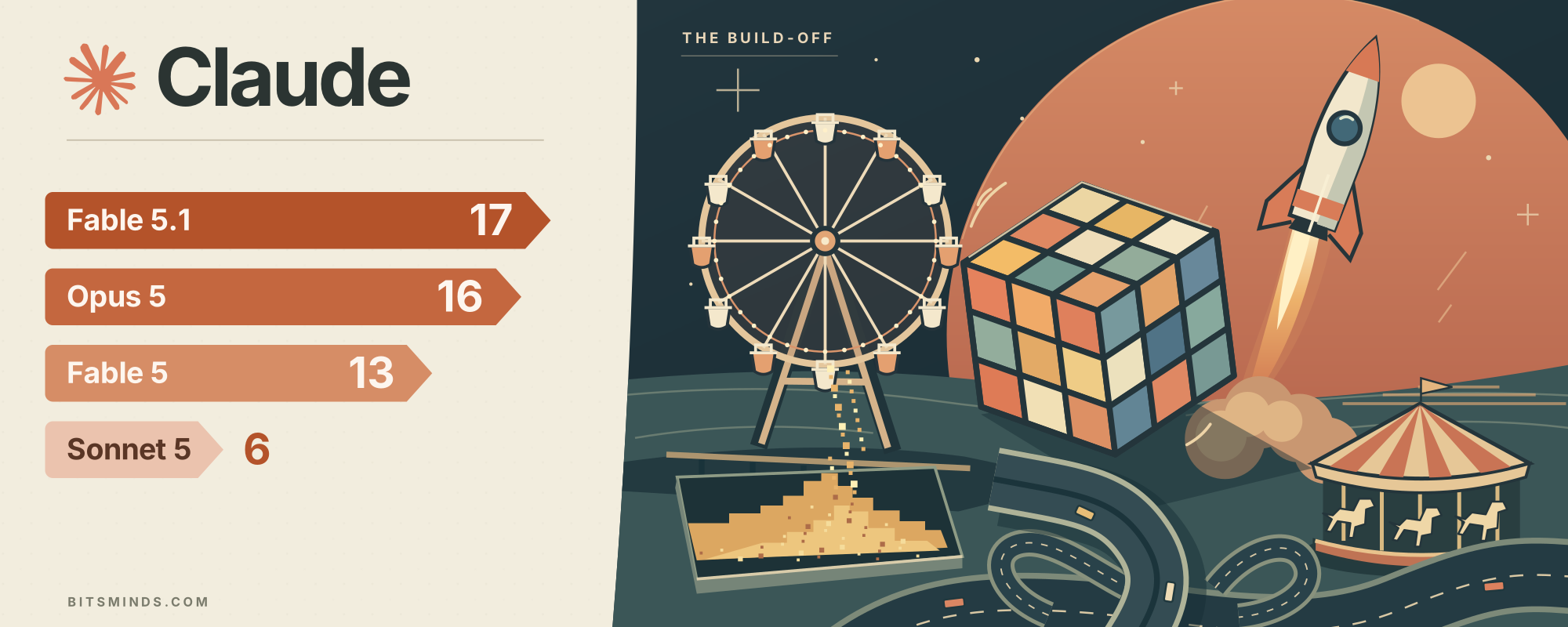
Claude Fable 5.1 vs Opus 5 vs Sonnet 5: One Point Apart
Four Anthropic models, five briefs each at maximum reasoning effort, one attempt apiece — twenty live builds and a result decided by one point. Claude Fable 5 finished third of four with 13 points.
Read the build-off →About the score. 4.6/ 5 is BitsMinds' editorial verdict from our own testing and research — not an average of user ratings, which we do not collect. Prices and plan tiers are as published by the vendor on the fact-check date shown above. How we rate →
Related Reviews
Claude Opus 5.5 Review: The New No. 1 Costs Less
Claude Opus 5.5 takes sole first place on the Artificial Analysis Intelligence Index, scoring 58 to the 53 shared by Claude Fable 5.1 and GPT-6 Astra. It lists at $4/$20, a fifth under Opus 5. The better story sits one effort level down: at high it scores 54, above every rival, for $1.82 a task. It also won our three-round build-off, and it was the slowest entrant in every round.
Claude Review 2026: Plans, Models and Verdict
Anthropic turned the lineup over again: Fable 5.1 replaced Fable 5 at the top on September 1, Opus 5 replaced Opus 4.8 at the same price, and Sonnet 5’s intro pricing has ended. Where Claude leads, where it still struggles, and whether Pro and Max are worth it in September 2026.

ChatGPT Plus & Pro Review 2026: Is It Worth $20?
ChatGPT Plus is still the best $20 in AI and Pro is still a $200 question — now with GPT-6 Astra, Sol and Luna rolling out to both tiers. What changed since our GPT-5.5 hands-on, where Claude still wins, and who actually needs Pro.
Want AI news before everyone else?
The morning's most important AI stories, straight to your inbox. No fluff.