Opus 5.5 vs GPT-6 Astra vs Grok 4.7 Build No Man's Sky
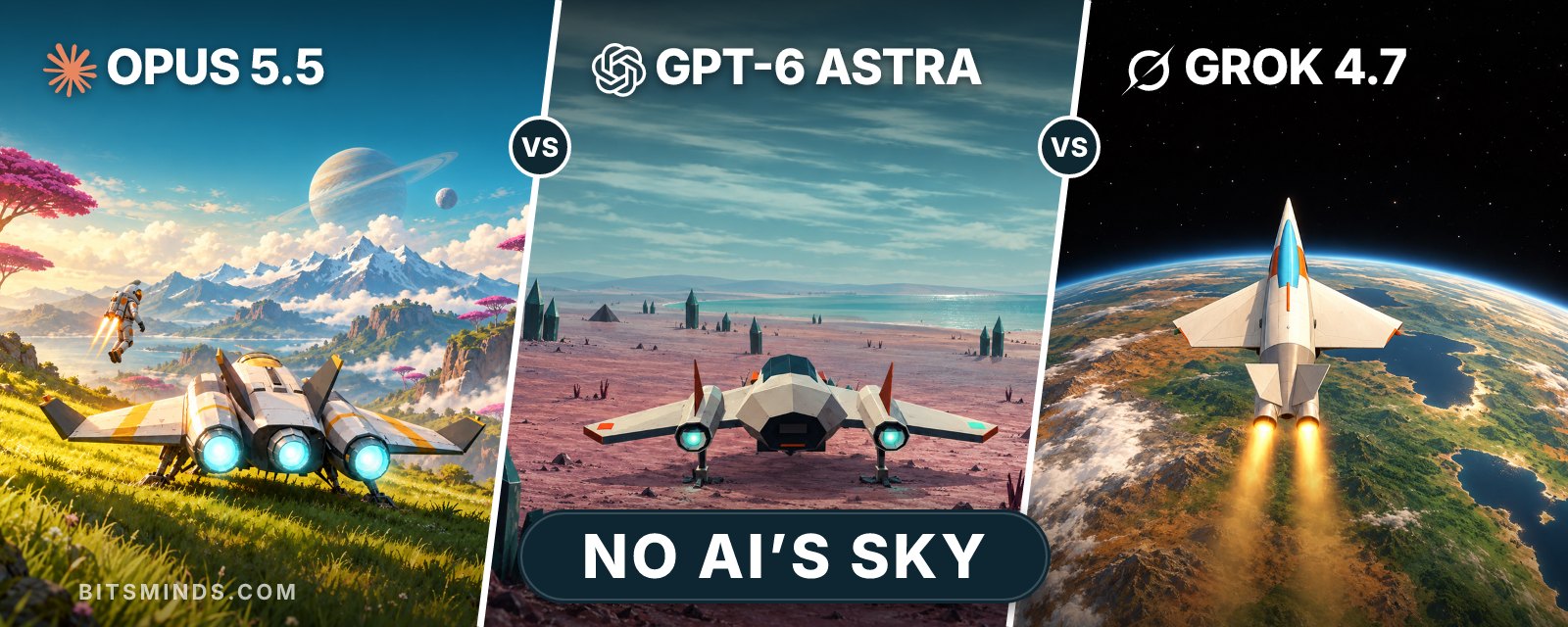
Three AI models got one prompt to rebuild the signature moment of No Man’s Sky: fly down from orbit, land by hand on a planet, then step out and walk. Claude Opus 5.5, GPT-6 Astra and Grok 4.7 had one attempt each and had to test their own game before handing it in. All three are playable here.
BitsMinds LabHow this test was run3 models · 1 brief · one attempt per model: each was required to run, exercise and fix its own build before reporting done, and the report froze the file · Claude Opus 5.5 at maximum in Claude Code; GPT-6 Astra at max in OpenAI Codex, not ultra, which adds automatic task delegation; Grok 4.7 at xhigh in Grok Build, the top of its dialShow details
- Models
- Claude Opus 5.5 (Claude Code) · GPT-6 Astra (OpenAI Codex) · Grok 4.7 (Grok Build)
- Attempts
- One attempt per model: each was required to run, exercise and fix its own build before reporting done, and the report froze the file. The three prompts were checked to differ on exactly two lines, both of them output paths.
- Reasoning effort
- Claude Opus 5.5 at maximum in Claude Code; GPT-6 Astra at max in OpenAI Codex, not ultra, which adds automatic task delegation; Grok 4.7 at xhigh in Grok Build, the top of its dial.
- Tools allowed
- All three were told to verify before reporting done, and each had a shell, Node and a browser to do it with, inside its own maker's agentic coding environment. The delivered file could use no third-party library or engine.
- Timing
- Wall-clock time from prompt to finished file: GPT-6 Astra took 59 minutes 22 seconds, Grok 4.7 took 152 minutes 35 seconds, and Claude Opus 5.5 took 193 minutes 5 seconds.
- Scoring
- Four categories scored out of five: graphics, physics, sound and gameplay. Final: Claude Opus 5.5 wins with 18 points, GPT-6 Astra takes 11, Grok 4.7 takes 7.
- Judging
- Scored by BitsMinds from a local side-by-side comparison page of the untouched outputs. No blind scoring, no automated grading. All three games were played in an ordinary browser. The measurements quoted in the article, among them the turn-back in Lacuna, the mirrored controls in Aphelion, the planet sizes and the rendering resolution, were read from each delivered file's own code and state.
- Published
- October 5, 2026
Result
| Model | Provider | Score |
|---|---|---|
| Claude Opus 5.5 | Anthropic | 18 pts |
| GPT-6 Astra | OpenAI | 11 pts |
| Grok 4.7 | SpaceXAI | 7 pts |
Claude Opus 5.5 wins with 18 points, GPT-6 Astra takes 11, Grok 4.7 takes 7. All three built the whole sequence from orbit to footfall; Opus 5.5 is the only one that turned it into a place worth staying in.
The briefs — as described in the article; the exact prompt files were not published
Round 1: Planet landing (single HTML file)
Recreate the signature moment of No Man's Sky as one self-contained HTML file, with no third-party libraries or engines, linked or pasted in: a ship that starts in space with the planet in view, flown by hand down to a real spherical planet in one continuous flight with no loading screen, cut or teleport, landed by the player, then a pilot who steps out and walks, with the ship left standing. Keyboard, mouse and on-screen touch controls, shown on screen; no popping, jitter or falling through the ground; motion not tied to the frame rate; embedded in an iframe sandboxed with allow-scripts only.
Result: Opus 5.5 wins with 18 points, GPT-6 Astra takes 11, Grok 4.7 takes 7. Opus 5.5 built a 20 km planet with clouds, vegetation, oceans, a jetpack and light that changes with where you land; Astra a handsome, compact world whose terrain reshapes on the way down and whose ship is hard to turn back once it leaves; Grok an empty planet with every sideways control mirrored and no sound.
Read with care
- Single run per model — a re-run could land differently.
- Three different harnesses (Claude Code, Codex, Grok Build) mean the environment, not just the model, was under test.
- Opus 5.5 discloses flight assists in its own report: the ship levels itself in the atmosphere when the controls are released, the gear comes down on its own below 70 m at low speed, and the descent eases near the ground. The touchdown itself is flown by the player.
Part of BitsMinds Lab, our series of original hands-on tests.
No Man’s Sky made its name on one moment: a ship drops out of space, falls through an atmosphere, touches down on a planet, and the pilot climbs out and walks on it, with no loading screen anywhere along the way. We gave that moment to three models as a single prompt. Anthropic’s Claude Opus 5.5, OpenAI’s GPT-6 Astra and xAI’s Grok 4.7 each had one attempt, inside its own maker’s coding agent, and each was told to run, test and fix its game before handing it in.
It is the hardest brief the Lab has set. There is no game engine to lean on: no libraries are allowed, so every model wrote its own 3D renderer, its own planet and its own flight model from scratch, in one web page. All three delivered the whole sequence, from orbit to footfall, and the results could hardly be further apart. Opus 5.5 wins with 18 points out of 20, GPT-6 Astra takes 11 and Grok 4.7 takes 7.
Play them all
All three run below exactly as the models delivered them, and each starts in space with the planet in view. Click into a game first so it receives the keys; on a phone, use the on-screen controls.
Landfall — Claude Opus 5.5, 193 minutes 5 seconds.
Lacuna — GPT-6 Astra, 59 minutes 22 seconds.
Aphelion — Grok 4.7, 152 minutes 35 seconds.
The brief
One HTML file with everything inline: no CDN, no network requests, no images, no web fonts, and no third-party libraries or engines, linked or pasted in. It runs inside an iframe sandboxed with allow-scripts only, which is how it sits on this page. The game opens with the ship in space and the planet in view. The player flies it by hand, can steer it anywhere, including away from the planet, and lands it by flying it down. Space to surface has to be one continuous flight, with no loading screen, cut, fade or teleport, onto a planet that is a real sphere. Once down, the player steps out and walks, with the ship standing where it landed. Every control works on a keyboard and mouse and on touch, the controls are shown on screen, nothing may pop, jitter or fall through the ground, and motion must not be tied to the frame rate. The last line asks for something someone would actually want to play.
One consequence of the sandbox is never spelled out. A frame that allows only scripts cannot lock the mouse pointer, so a mouse-look built on pointer lock works on a developer’s desktop and fails in an article. Opus 5.5 is the only one of the three whose report names the problem: it steers by pointing the mouse instead.
Landfall, by Claude Opus 5.5
Opus 5.5 spent 193 minutes 5 seconds on its build, the longest of the three, and delivered a 277 KB file of 5,181 lines, assembled from separate source files by a build script it wrote for itself. Its planet is 20 kilometres in radius, almost five times the size of the other two, with continents and oceans, ridged mountains capped with snow, mesas, a cloud deck at 2.6 kilometres and an atmosphere that glows at its rim when seen from space. A ringed gas giant and a moon hang in its sky, and both stay visible from the ground.
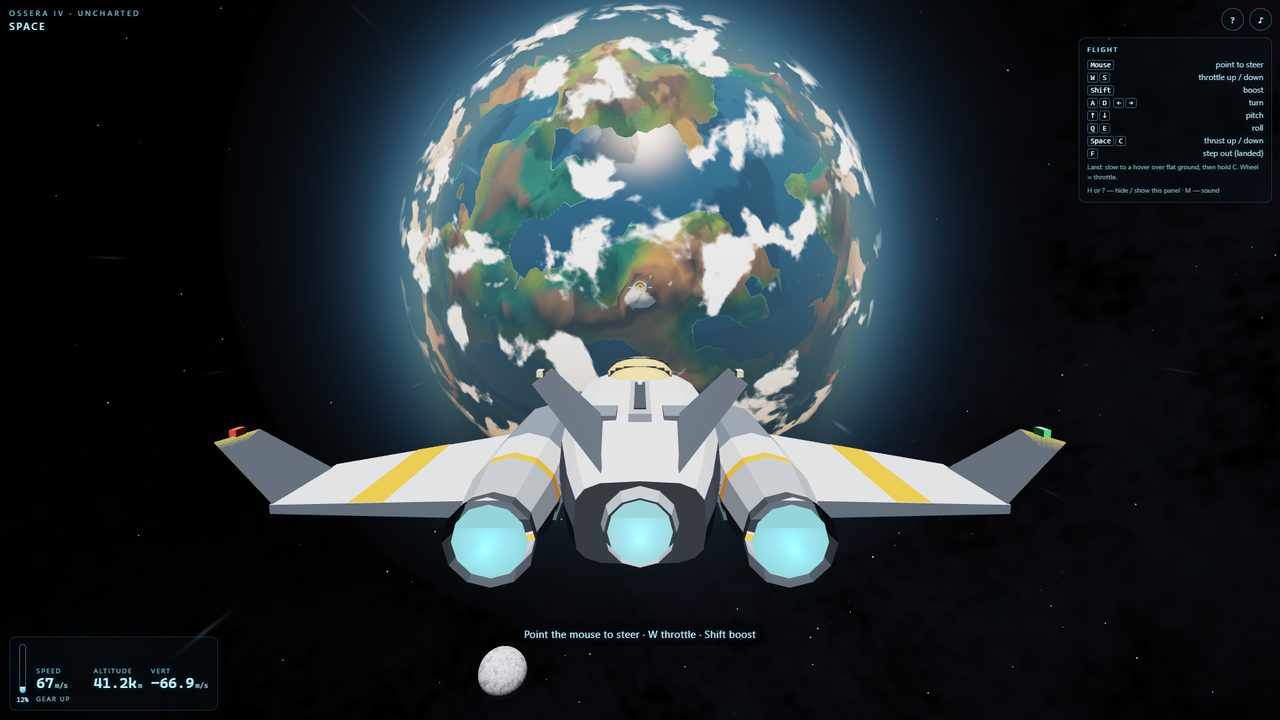
The descent is the best part. The terrain sharpens continuously as the ship comes down, from triangles a kilometre across seen from orbit to half a metre underfoot, and the levels of detail blend into one another, so the surface never visibly swaps or pops. Dive fast and the air fights back: the hull glows orange and trails fire, on the way in and again on the way out. Below the clouds the hills are covered in grass, flowers, boulders, crystals and parasol trees with pink canopies.
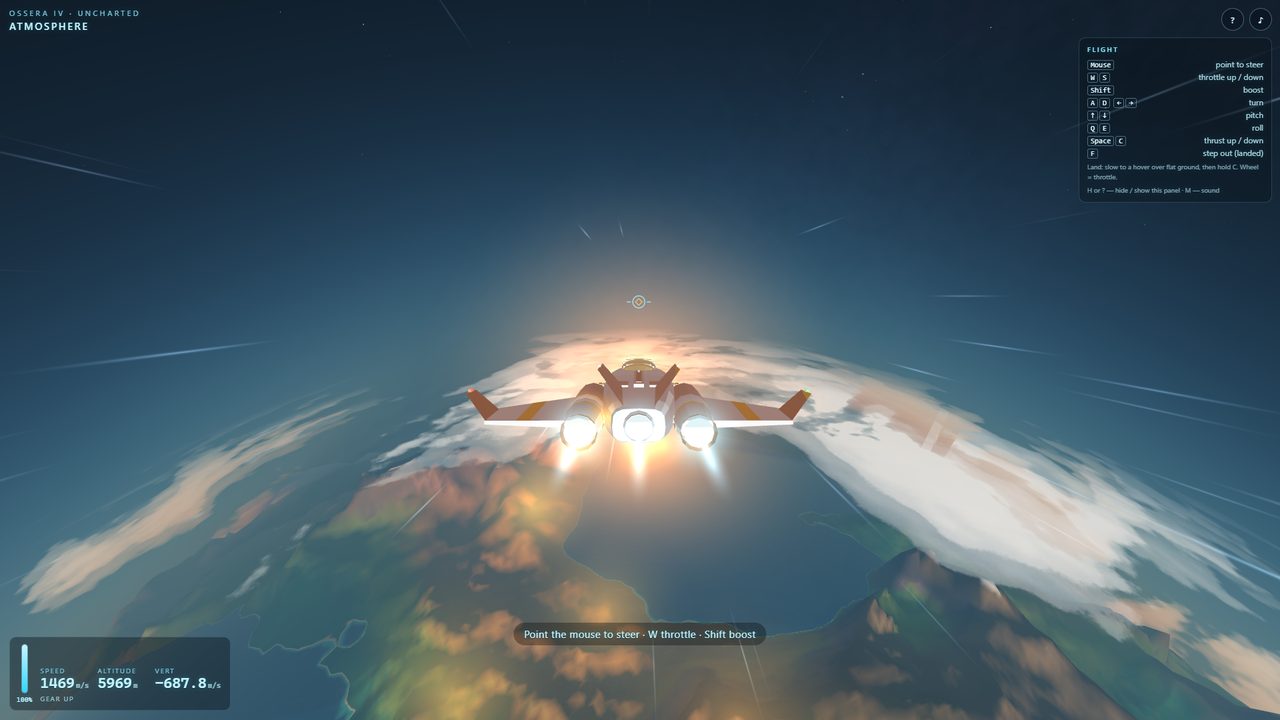
Landing is done by hand. The ship hovers, the player holds the descent key, and it settles onto three feet; slopes steeper than about 32 degrees are refused with a warning. Opus 5.5 listed its assists in its own report: in the atmosphere the ship levels itself when the controls are released, the landing gear comes down on its own below 70 metres at low speed, the descent rate eases near the ground, and after touchdown the ship takes under half a second to settle. The touchdown itself is always the player’s. The ship can land on water too.
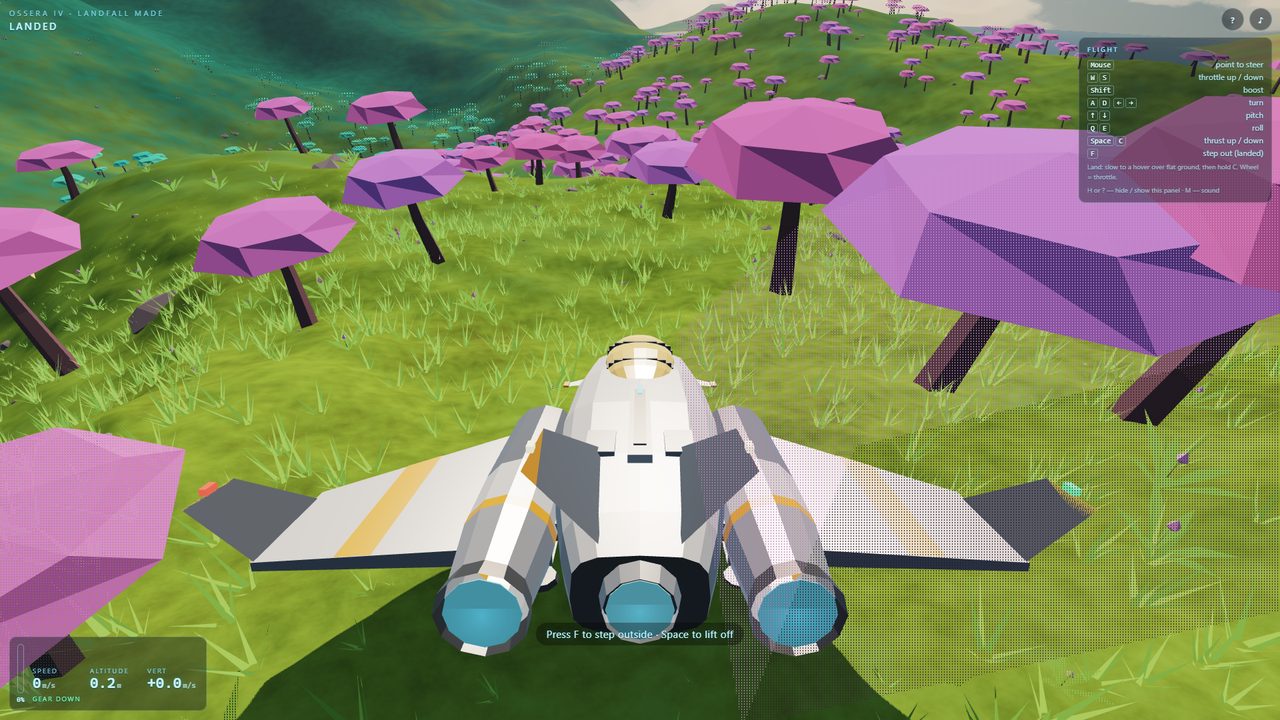
Stepping out is animated: the canopy opens, the pilot hops down, and the camera travels smoothly from the ship to the walker, in third person (V switches to first person). On foot there is a jetpack for getting about the planet, swimming in deep water, collisions with the ship, the trees and the boulders, and a marker pointing back to the ship. Walk back, press F, and it lifts off again.
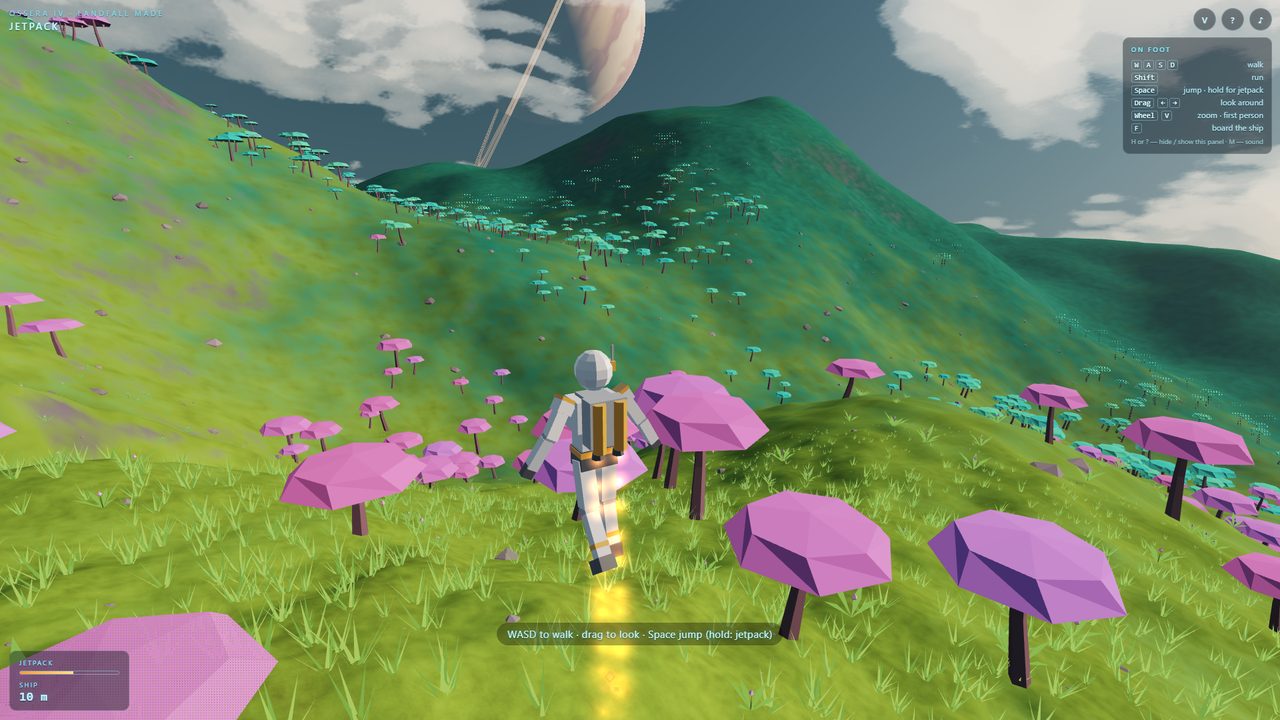
What lifts Landfall above the other two is its light. The sun is fixed in space, so it stands at a different height wherever you land: high at noon in one place, low and gold in another, below the horizon in a third, where the pilot’s helmet lamp and the ship’s landing light take over. Here is the same ship at three places on the same planet.
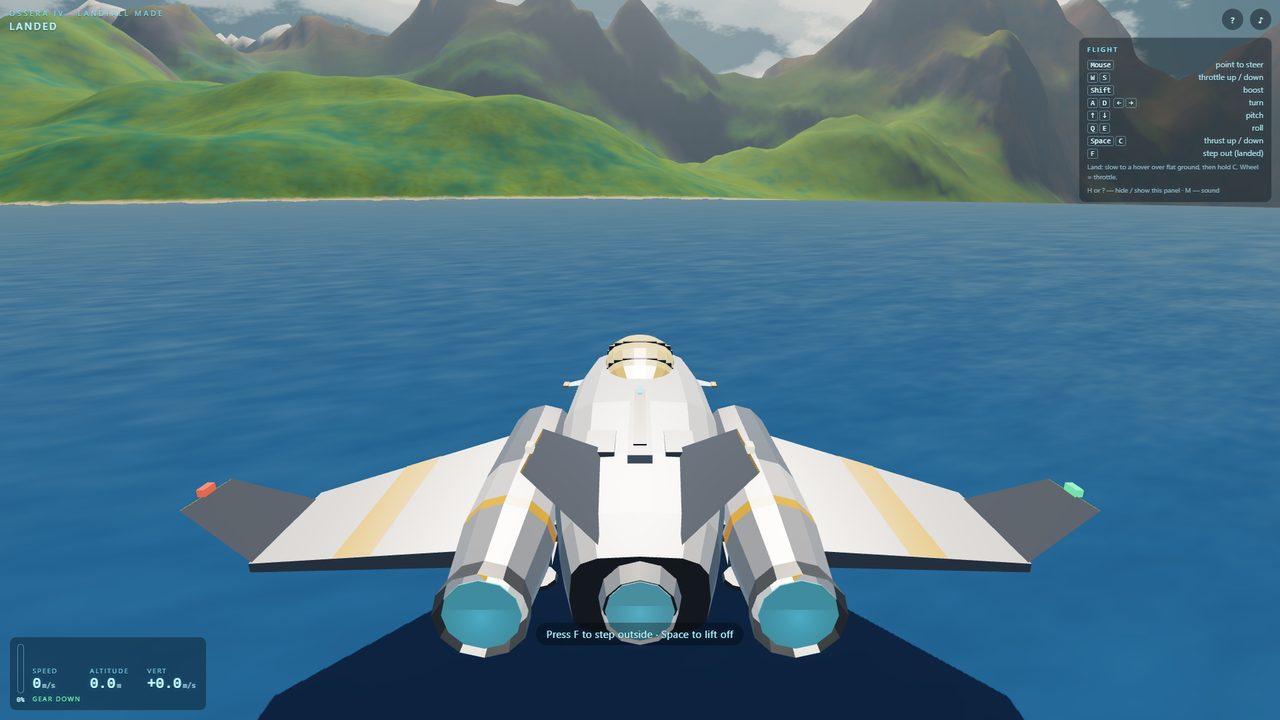
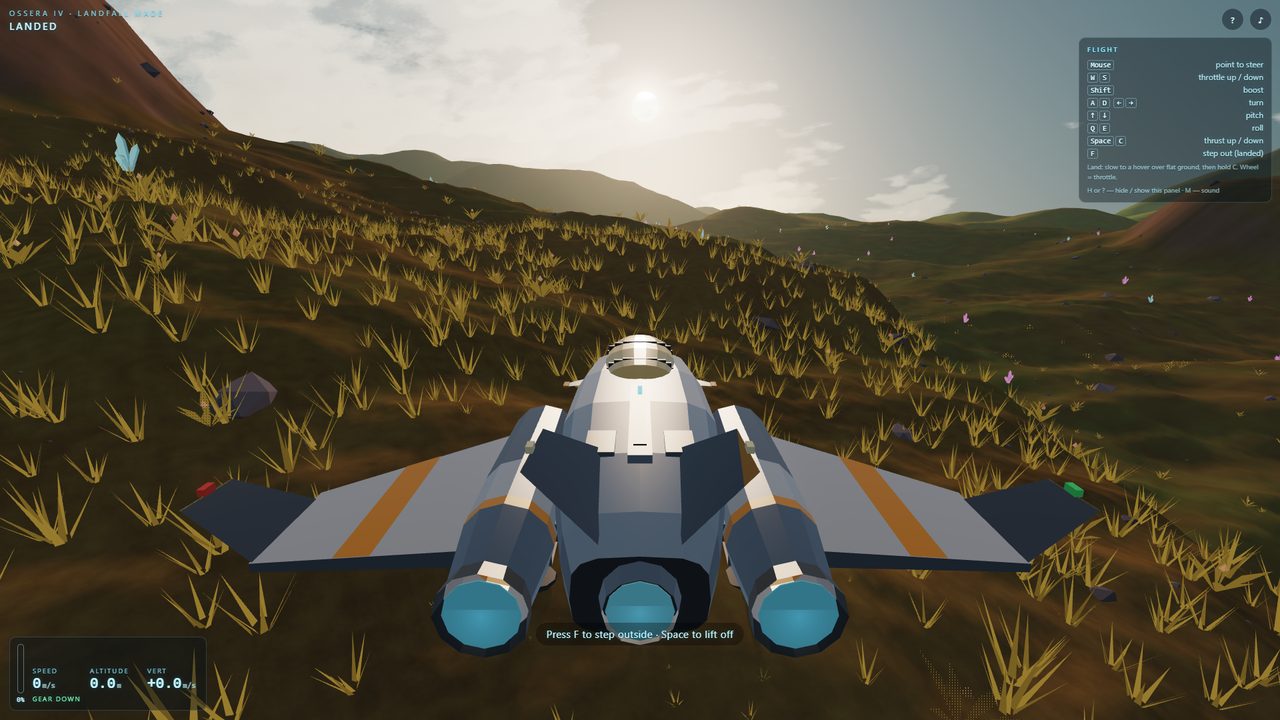
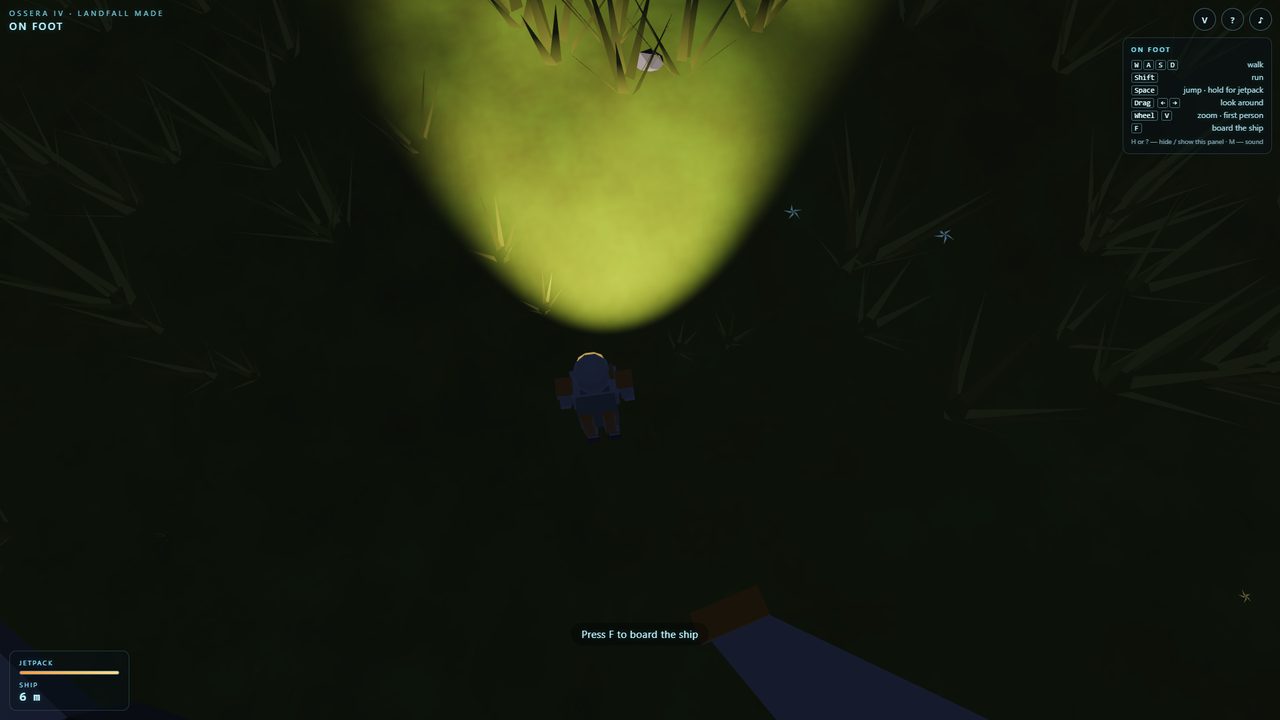
Opus 5.5 tested at length, by its own account: a scripted flight from space to touchdown, out on foot and back into orbit, random-input runs switching between 30, 45, 60 and 144 frames per second, frame-by-frame comparisons hunting for pops, phone emulation in portrait and landscape, and the sandboxed iframe this page uses. Its report is plain about what it did not cover: real phones, Firefox and Safari, and the sound itself, which it confirmed starts but never heard.
Lacuna, by GPT-6 Astra
Astra finished in 59 minutes 22 seconds, the fastest of the three by a wide margin, with a 69 KB file of 313 lines. It calls the game Lacuna and its planet Ione, and it frames the flight as a short journey with titled stages: the approach from orbit, “A new horizon” on entering the atmosphere, “Contact” at touchdown and “Hello, Ione” on the first step. Ione is 4,200 metres in radius, exactly the figure Grok 4.7 chose for its own planet, and its rust and mauve uplands are broken by teal silica seas.
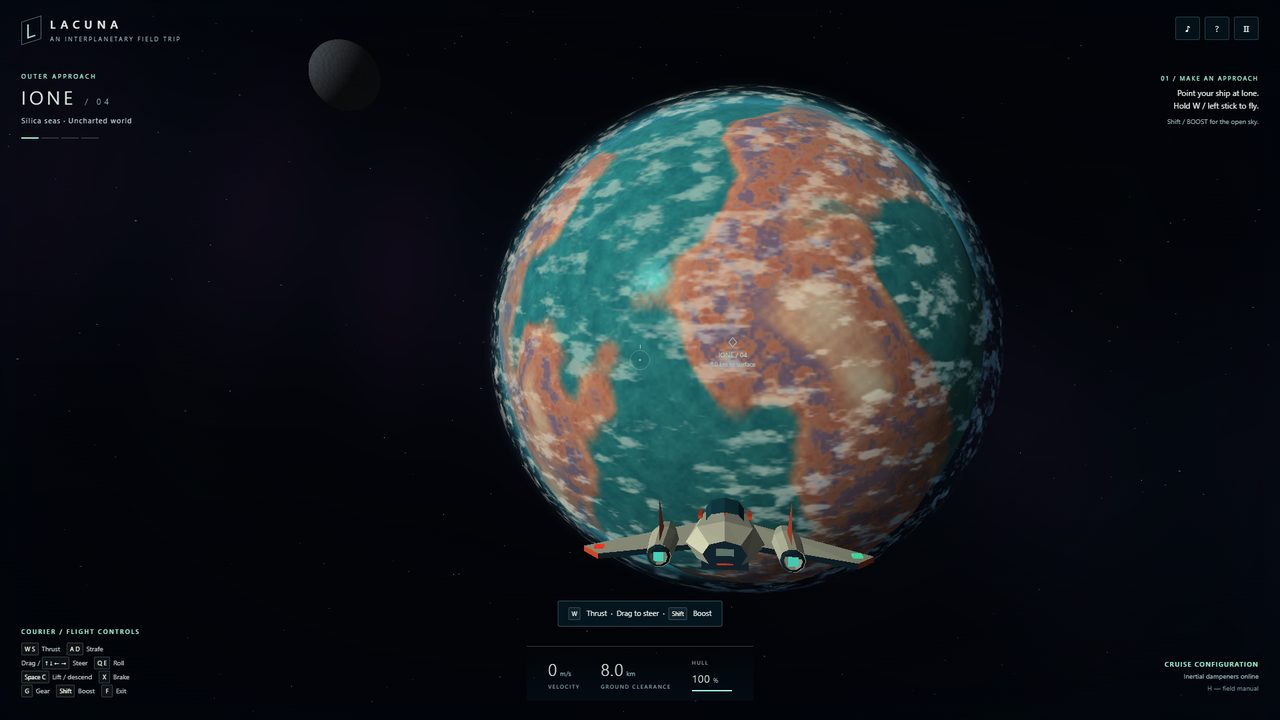
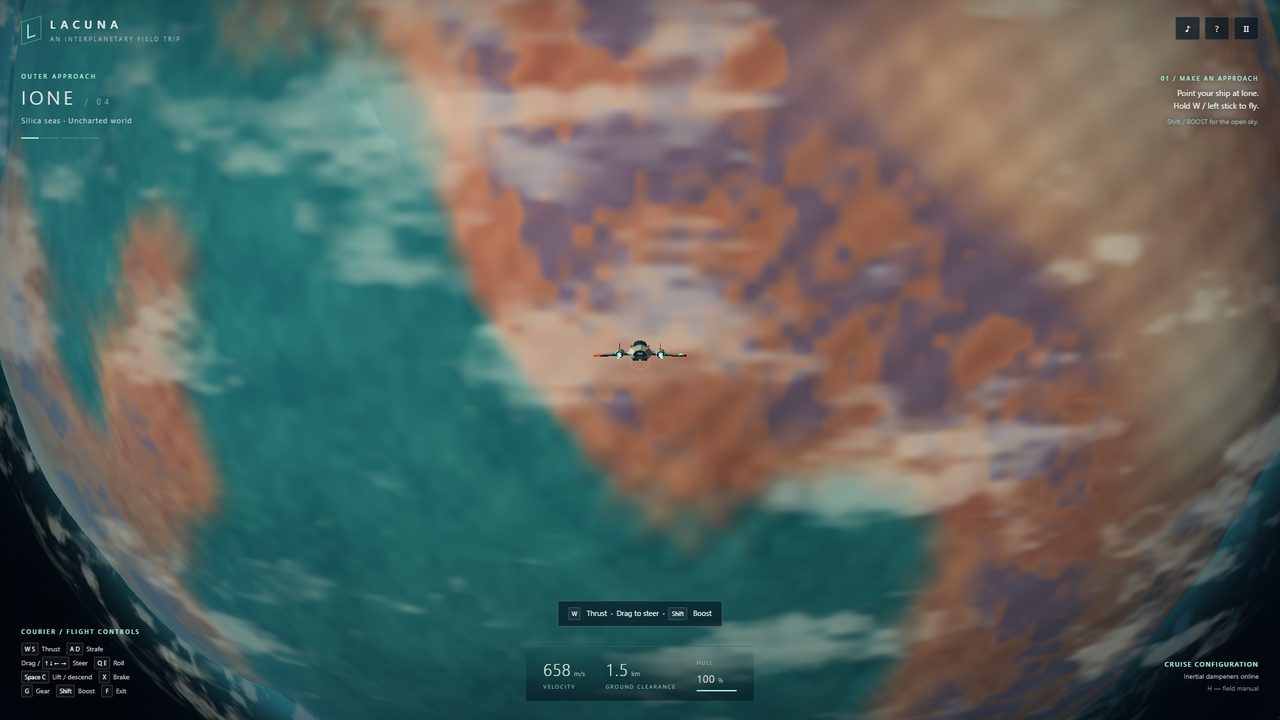
Astra solved the space-to-surface problem its own way. Its whole planet is one mesh wrapped around the sphere and centred under the camera, and as the ship descends the mesh pulls its points in beneath it. That avoids seams and swapped tiles, but the terrain heights are recalculated at the moving points on every frame, so on the way down the coastlines and hills visibly reshape themselves, and the planet seen from space gives way to the ground in front of you. It is smooth, and it is still visible.
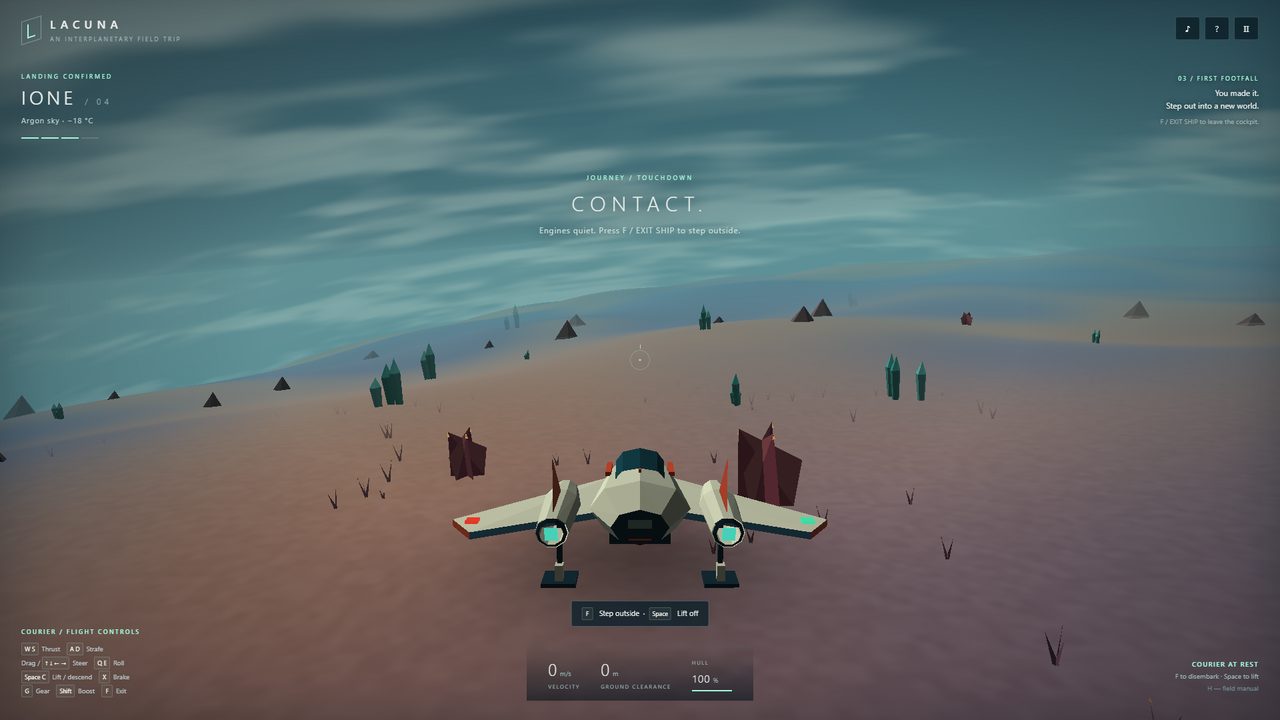
On the ground the view switches to first person. The plain is scattered with dark crystal spires and small pyramids, a field spectrometer scans the ground and reports the biome, the air and the temperature, and the ship can be boarded again and flown back to space. Near the planet it flies well. Far from it, it does not. The speed limit rises with altitude, to 680 metres a second and 1,300 on boost, while the ship turns and the chase camera follows at fixed rates. Measured on the delivered file at 15.6 kilometres, heading out at 680 metres a second, a half-turn on the arrow keys takes 2.85 seconds, and for the first 2.15 of them the ship keeps climbing, another 980 metres. The camera falls far behind and the ship shrinks to a speck.
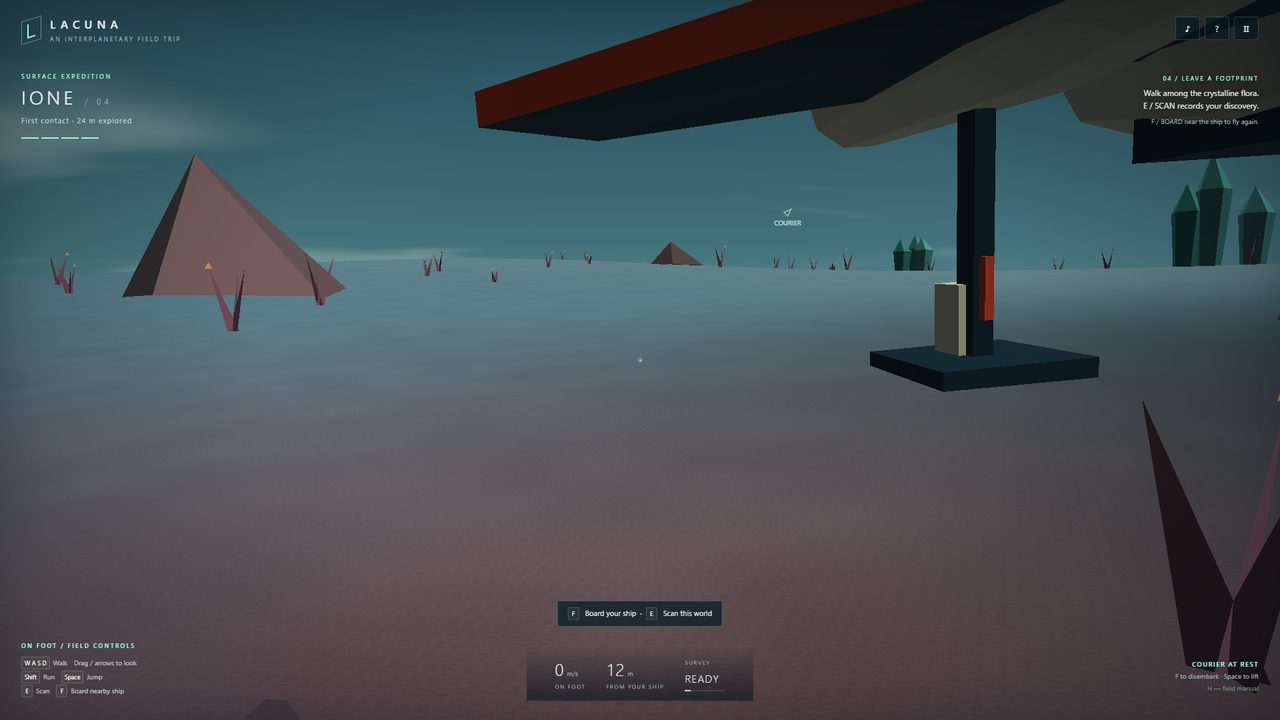
Its sound is synthesised in the page and mixed so low, at a master volume of 0.22, that it is barely audible. Astra’s report lists a full test campaign of complete flights, keyboard and mouse, emulated multitouch, desktop and phone screenshots, the sandbox restrictions, collision checks and identical results at 30, 60 and 144 frames per second, and it reports no known unfinished features.
Aphelion, by Grok 4.7
Grok 4.7 worked for 152 minutes 35 seconds in Grok Build and delivered a 92 KB file of 2,588 lines. The game, Aphelion, opens on a white delta-winged ship above a planet of green and ochre land, white patches and dark blue lakes, with a clear flight readout and the controls listed on screen.
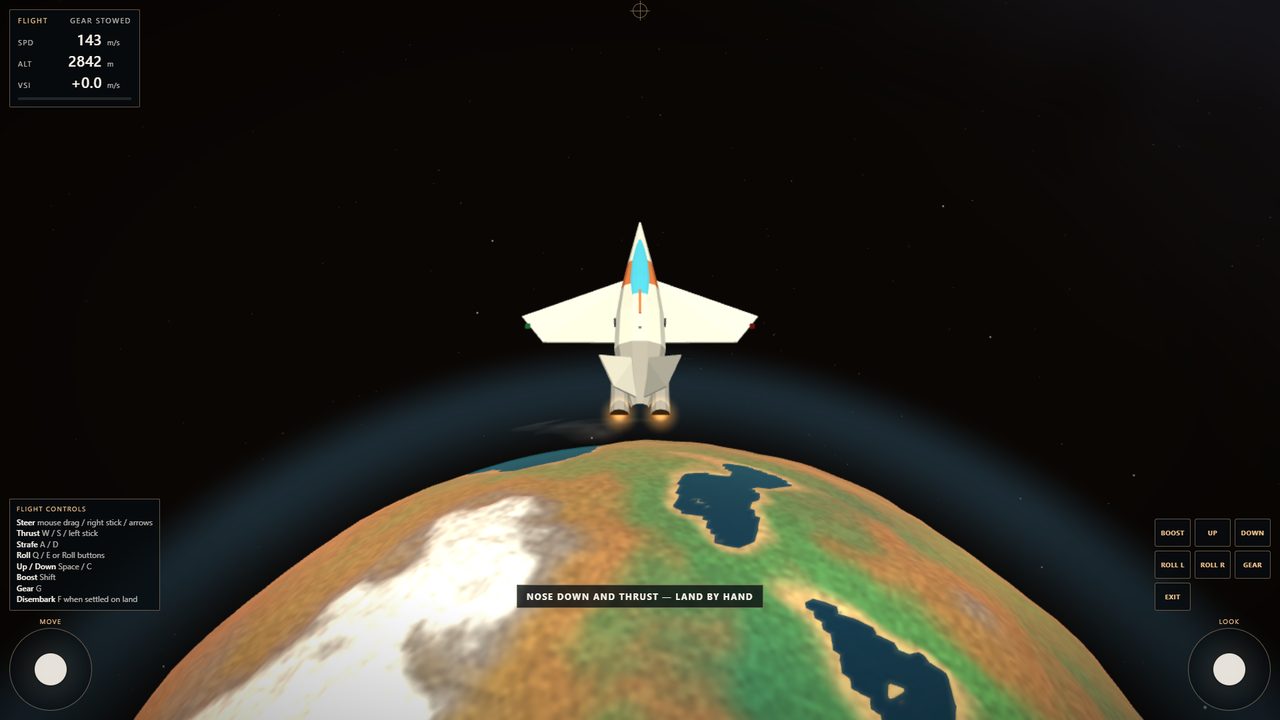
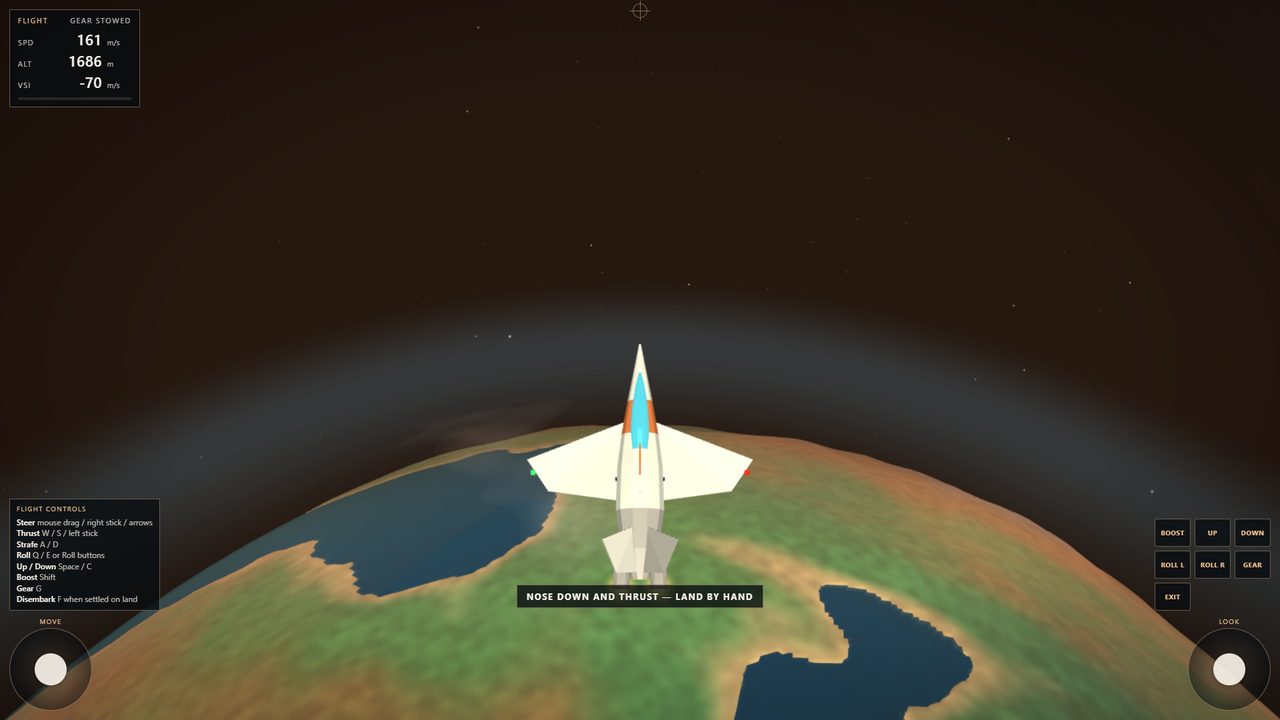
The whole sequence is there. The ship comes down through the atmosphere into a sunset sky, the gear deploys, the readout announces touchdown, and the pilot climbs out and walks in third person with the ship standing behind; it can be boarded again. But the planet is empty: green ground with no trees, plants or structures on it, and the sky does most of the work.
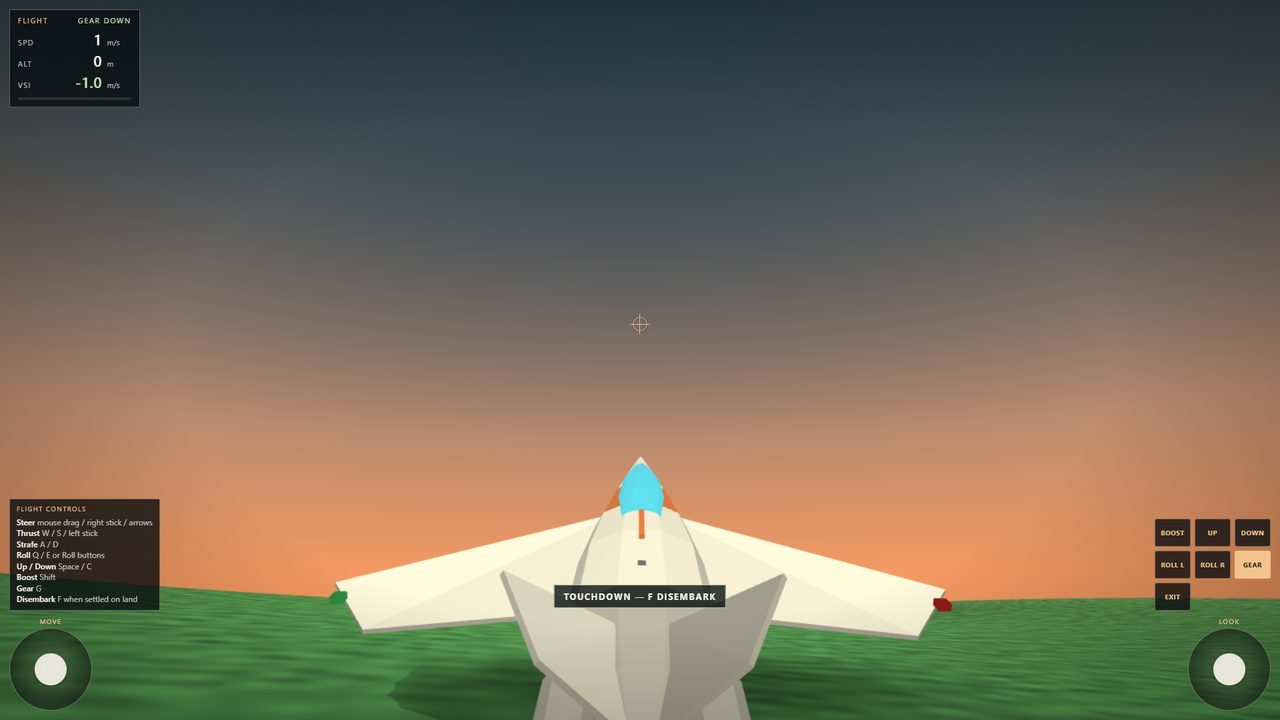
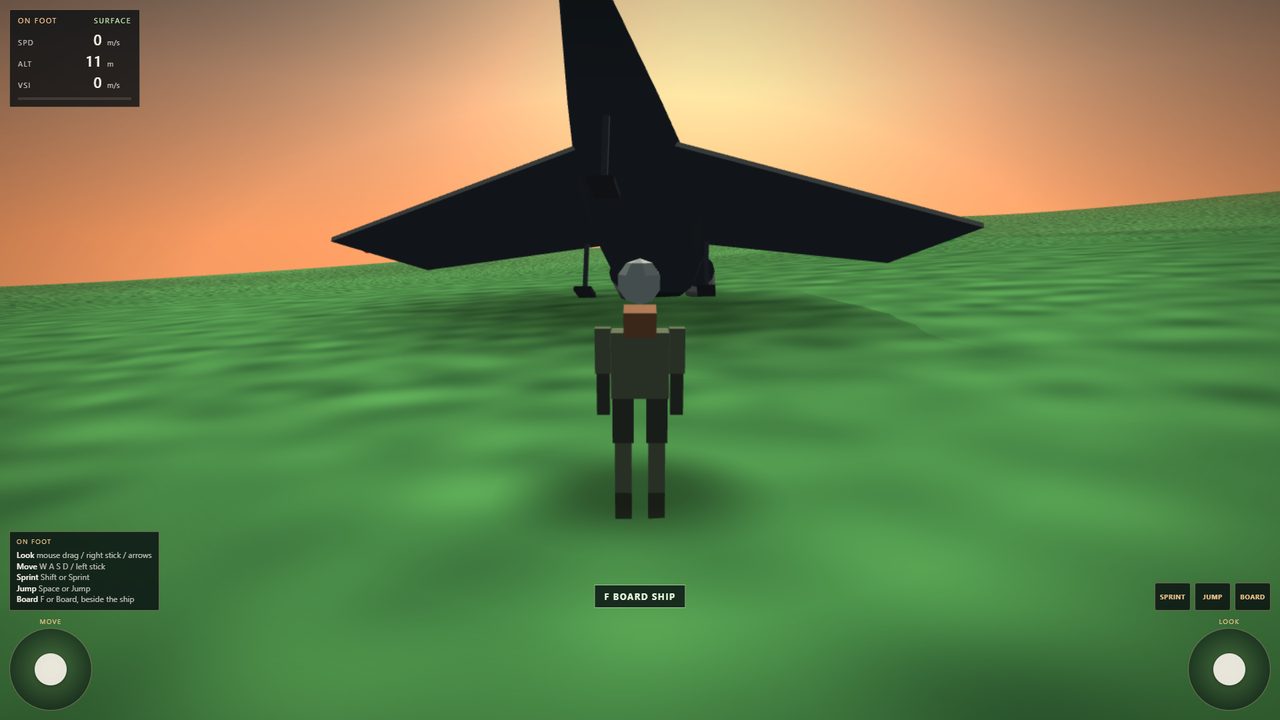
Two faults stand out. Every left and right in the game is mirrored. Turning right with the arrow keys, the mouse or the right stick swings the nose left, D slides the ship left, the roll-right key rolls it left, and on foot looking and strafing are reversed the same way. It is a single sign error: the game builds its idea of “right” one way and draws the scene the other, so every sideways input comes out backwards, while up, down, forward and back are correct. And there is no sound at all, because the file contains no audio code. It also renders at three quarters of the window’s resolution, which keeps it smooth and leaves the picture softer. Its own report lists angular coastlines from orbit, a dim night side and a simple low-poly pilot.
Time and size
| Claude Opus 5.5 | GPT-6 Astra | Grok 4.7 | |
|---|---|---|---|
| Lab | Anthropic | OpenAI | xAI |
| Environment | Claude Code | OpenAI Codex | Grok Build |
| Setting | max | max | xhigh (its ceiling) |
| Wall clock | 193 min 5 s | 59 min 22 s | 152 min 35 s |
| Delivered file | 277 KB, 5,181 lines | 69 KB, 313 lines | 92 KB, 2,588 lines |
| Planet radius | 20 km | 4.2 km | 4.2 km |
| On foot | Third person, jetpack, swimming | First person, scanner | Third person |
| Back to space | Yes | Yes | Yes |
| Sound | Synthesised | Synthesised, barely audible | None |
| Rendering | Full resolution | Full resolution | Three quarters of the window |
Astra was more than three times as quick as Opus 5.5. Grok 4.7 took more than twice Astra’s time and built the emptiest planet of the three.
Scoring
Opus 5.5 took full marks in graphics, physics and gameplay. Its world is the only one of the three with weather, vegetation and a sky worth looking at from the ground, its descent never shows a seam, and its ship handles well all the way from orbit to the grass. Sound was its weakest category. Astra placed second in graphics, sound and gameplay and drew level with Grok 4.7 on physics: Lacuna looks good and flies well near Ione, but its terrain reshapes on the way down and its ship cannot easily be turned back once it has left. Grok 4.7 scored lowest in graphics, sound and gameplay. A silent game on an empty planet, steered with every sideways control reversed, is hard to enjoy, even though every step of the brief is there.
What the round shows
None of the three skipped a step. Each built a sphere you can fly down to without a cut, a ship you land by hand, a pilot who climbs out and a way back to orbit, with no engine and no library to start from. What separates them is everything around that skeleton. Opus 5.5 spent more than three hours turning the sequence into a place, with clouds, trees, oceans, a sun that moves with you and a jetpack to cross it all, and its run ended with tests of the whole journey rather than of the parts. Astra made a handsome, compact world in an hour and stopped short of what happens once you leave it. Grok 4.7 built every part and joined none of them to a reason to stay.
How this test was run
One attempt per model, with no corrections, no hints and no clean-up: all three files are served exactly as they were delivered. The prompt was generated from one template and checked to differ between the three models on exactly two lines, both of them output paths. Its conditions are the ones the Hill Climb brief uses: each model was required to run, exercise and fix its own build before reporting done, and the report froze the file. Claude Opus 5.5 ran as a Claude Code subagent at maximum effort. GPT-6 Astra ran in OpenAI Codex at max, not ultra, which adds automatic task delegation. Grok 4.7 ran in Grok Build at xhigh, the top of its dial. While each model worked, the other builds were moved out of its reach.
Scoring was done by BitsMinds across four categories from a local side-by-side page of the untouched builds, playing all three in an ordinary browser. The measurements quoted above, among them the turn-back in Lacuna, the mirrored controls in Aphelion, the planet sizes and the rendering resolution, were taken afterwards from each delivered file’s own code and state, and the pictures were captured from the delivered files. On the laptop the games were judged on, all three held close to 60 frames a second on its NVIDIA graphics; on its integrated Intel graphics each dipped at times.
These three have met before: Opus 5.5, Astra and Fable 5.1 in the September animation briefs, and Opus 5.5 and Grok 4.7 on the Hill Climb game brief.
More on Grok
Evergreen coverage we keep current — start here.
Want AI news before everyone else?
The morning's most important AI stories, straight to your inbox. No fluff.