GPT-6.2 Astra vs Claude Fable 5.2: Down to the Launch
GPT-6.2 Astra is OpenAI’s new flagship, so we gave it the three build briefs Claude Fable 5.2 has already answered. A motorway interchange, a seaside fairground and a cinematic rocket launch, one attempt each at maximum effort, with no way to see the result. All six builds run below, untouched, so you can judge them yourself.
BitsMinds LabHow this test was run2 models · 3 briefs · one attempt per model per brief · Maximum reasoning effort for both, at the top of each one's own dial: GPT-6.2 Astra in OpenAI Codex at max, Fable 5.2 in Claude Code at maxShow details
- Models
- Claude Fable 5.2 (Claude Code) · GPT-6.2 Astra (OpenAI Codex)
- Attempts
- One attempt per model per brief. No retries, no follow-up notes, no clean-up.
- Reasoning effort
- Maximum reasoning effort for both, at the top of each one's own dial: GPT-6.2 Astra in OpenAI Codex at max, Fable 5.2 in Claude Code at max.
- Tools allowed
- Each model ran inside its own maker's agentic coding environment and wrote its files to disk: GPT-6.2 Astra in Codex, Fable 5.2 in Claude Code. Both were told not to open a browser, preview the result or run code. Astra ran no commands at all; it only wrote its files.
- Timing
- Wall-clock time from prompt to finished file: GPT-6.2 Astra took 19m 40s, 19m 23s and 21m 14s on 18 November; Fable 5.2 took 47m 17s, 41m 45s and 47m 01s on 9 November.
- Scoring
- Points out of five, set round by round on the finished artefact. Fable 5.2's are the builds it was published with on 9 November, scored again alongside Astra's. Final: Fable 5.2 wins with 12 points, GPT-6.2 Astra takes 11.
- Judging
- Scored by BitsMinds from a local side-by-side comparison page of the untouched outputs.
- Published
- November 18, 2026
Result
| Model | Provider | Score |
|---|---|---|
| Claude Fable 5.2 | Anthropic | 12 pts |
| GPT-6.2 Astra | OpenAI | 11 pts |
Fable 5.2 wins with 12 points, GPT-6.2 Astra takes 11. Astra took the interchange and drew the richer fairground in less than half Fable 5.2's time, but a canopy glitch cost it the fairground and its launch ends at the ascent.
The briefs — as described in the article; the exact prompt files were not published
Round 1: Motorway interchange (SVG)
A top-down view of a busy interchange as one self-contained SVG. Two roads crossing on different levels, connecting ramps, at least twelve vehicles following the curve of the road they are on, and correct layering so traffic on the lower road is hidden by the overpass.
Result: GPT-6.2 Astra wins with 4 points, Fable 5.2 takes 3: two full cloverleafs drawn the same way, both opening the edge line at every ramp; Astra's is the more attractive picture.
Round 2: Seaside fairground (SVG)
A seaside fairground at dusk, one SVG. A Ferris wheel with at least ten gondolas turning continuously, a spinning carousel with at least six horses rising and falling out of phase, twinkling bulbs, a reflection in the water. Each gondola must stay level with the horizon throughout the rotation.
Result: A draw, 4 points each: both carousels turn as one machine with eight horses that face their travel; Astra's scene is the richer, but in playback a stripe on its canopy flicks across and back about twice in fifteen seconds.
Round 3: Rocket launch (web page)
A self-contained web page that animates a rocket launching — countdown, ignition, liftoff and ascent — with a mission-control HUD. No library named, no 3D requested, one aesthetic instruction: make it look good.
Result: Fable 5.2 wins with 5 points, Astra takes 3: Fable 5.2 flies the whole mission to orbit with staging; Astra's handsome page ends at the ascent, with no cutoff, no booster separation and no orbit.
Read with care
- Single run per model — a re-run could land differently.
- Fable 5.2's builds are the files it was published with on 9 November, scored again here rather than re-run.
- Scored on the finished artefact only. Wall-clock time is reported but carries no points.
Part of BitsMinds Lab, our series of original hands-on tests.
OpenAI released GPT-6.2 Astra on 17 November at $8 per million input tokens and $40 per million output, 20% less than GPT-6 Astra and exactly what Claude Fable 5.2 costs. Artificial Analysis puts it at 62 on its Intelligence Index, three points behind Fable 5.2, but an index task costs about $4.00 on Astra against $26.54 on Fable 5.2. OpenAI’s pitch is exactly that: not the top of the table, but the same work in far fewer tokens. This series tests a model a different way: the same build briefs as its rival, one attempt, and the result published untouched.
Its opponent brings the builds it was published with. Claude Fable 5.2, Anthropic’s top model, built them on the day it shipped, for its 9 November round against Claude Opus 5.5 and the first GPT-6 Astra. The briefs: a motorway interchange seen from above and a seaside fairground at dusk, each as a single animated SVG file, and a cinematic rocket launch as one web page. One attempt each, maximum reasoning effort, and no opening a browser or running code to see the result. GPT-6.2 Sol ran the same three briefs on the same day, against Claude Opus 5.5, in a round of its own.
Fable 5.2 wins with 12 points and Astra takes 11. Astra took the interchange, drew the fairground with no logical mistake, and lost the round it had to win on a canopy that glitches in playback. The launch decided it: Fable 5.2 flies a whole mission to orbit, and Astra’s rocket only climbs. Astra needed an hour for its three builds; Fable 5.2 needed more than two.
Round 1: The interchange
The brief: a busy interchange seen from above, as one self-contained SVG with no text and no script. Two roads cross on different levels, ramps connect them, at least twelve vehicles follow the curves of the roads they drive on in both directions, and the layering hides the lower road’s traffic under the overpass. Two traps go unstated: whether each ramp really joins the roads at both ends, and whether traffic keeps to the right side after it merges.
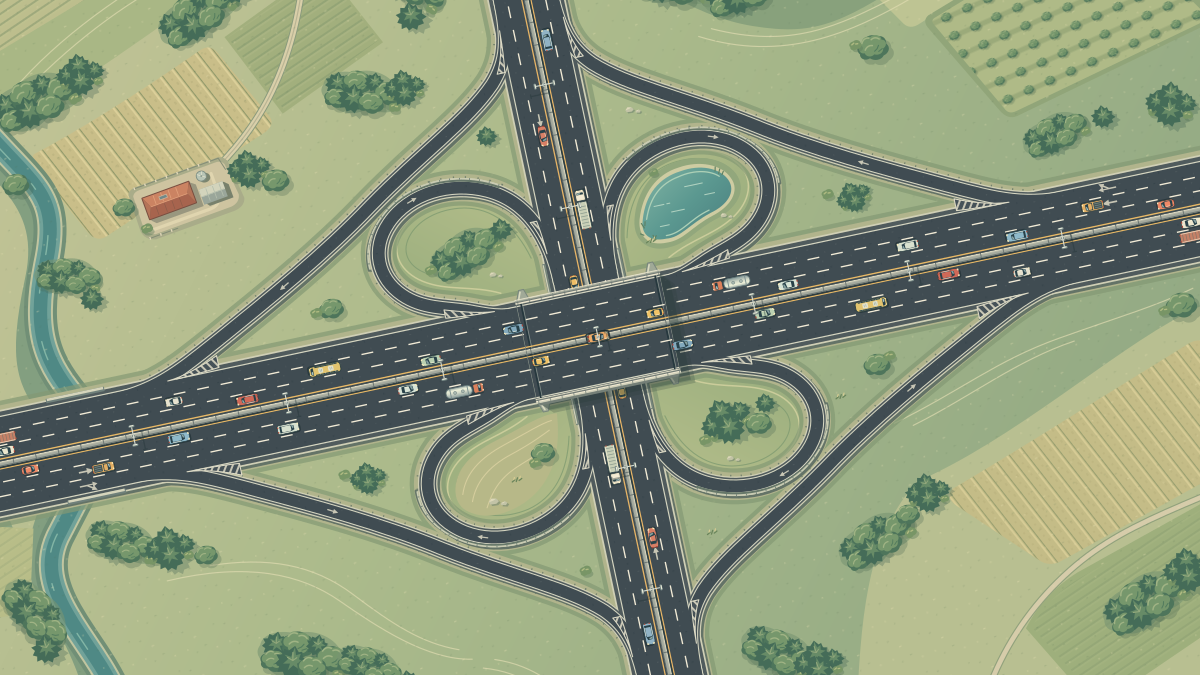
GPT-6.2 Astra built the complete junction: two highways crossing at a bridge, four outer ramps for the right turns and four loops for the left, the whole scene turned a few degrees off the grid. It is set in late-afternoon light over farmland, with a winding creek, a red-roofed farm, an orchard, striped fields and a pond inside one of the loops, and eleven lighting masts along the roads. Thirty-eight vehicles drive on it, from compacts and estates to pickups, a coach and a freight lorry.
Its markings are where most models in this series have slipped, and Astra’s are right. Where each ramp leaves or joins a highway, the edge line breaks and a hatched gore fills the wedge between the two roads, as on a real motorway. Traced across a full minute, each ramp and loop vehicle leaves the mainline, follows the curve it is drawn on and joins the other road, and none of the thirty-eight jumps anywhere in the frame. The traffic under the bridge is painted below the deck, with the bridge’s shadow falling across it, so it passes underneath and out of sight. The mainline traffic moves as strips of cars that tile exactly at the end of each 24-second run, and the loop cars ride a 36-second journey that crosses the central span twice, once on each level.
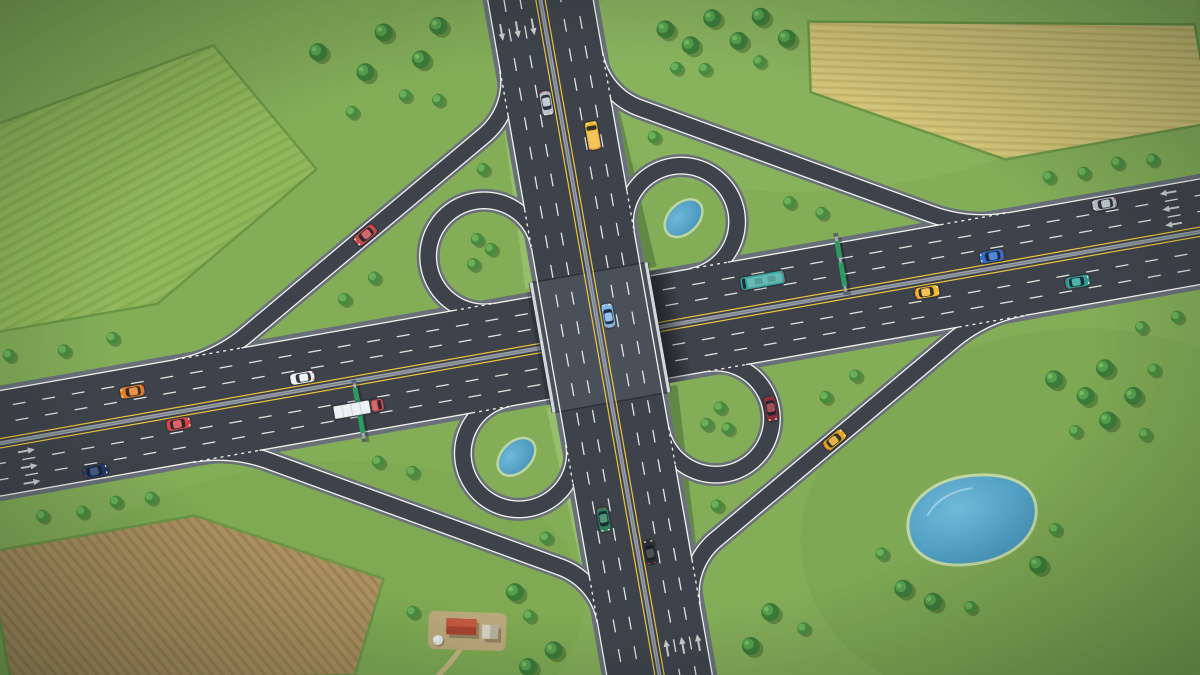
Claude Fable 5.2 built a complete cloverleaf in daylight: two six-lane highways crossing at a bridge, four outer ramps for the right turns and four 270-degree loops for the left, the whole scene turned ten degrees off the grid. Fifty vehicles drive on it, among them vans, three articulated lorries and two buses. Through traffic keeps to the two inner lanes of each carriageway and the outer lane is left to cars using a ramp, so nothing ever has to merge into a gap. Each highway’s solid white edge line stops at every ramp opening and becomes a short dashed line, at all sixteen openings. We found no fault in it in November.
The two builds are close relatives, the same junction drawn the same way and both without a mistake we could find. Round 1 goes to GPT-6.2 Astra, which takes 4 points for the more attractive picture. Fable 5.2 takes 3.
Round 2: The fairground
A seaside fairground at dusk, one SVG. A Ferris wheel with at least ten gondolas turning continuously and staying level with the horizon all the way round, a spinning carousel with at least six horses rising and falling out of phase, twinkling bulbs, lights chasing the rim of the wheel, and the whole scene reflected in water. The gondolas are the trap the brief states out loud. The carousel is the one it does not.


Astra’s fair is the prettiest it has drawn for this brief: a copper Ferris wheel and a striped carousel trimmed with shells on a long pier, a sun setting into a pink and violet sky, sailboats, a lighthouse on the far headland, a ticket kiosk, an ice-cream cart and small figures strolling along the boards, all under strings of warm bulbs. The reflection reuses the complete animated pier, so everything moves in the water as it does above it.
The wheel clears the stated trap. Twelve gondolas ride a wheel that turns once every 48 seconds; each one counter-rotates about its own suspension pin over the same 48 seconds, and rocks two or three degrees inside that level frame. The carousel, which has broken more builds in this series than anything else, works. Eight horses circle the organ once every 24 seconds on a turntable drawn as an ellipse; each one narrows to its solid edge as it passes the side of the ride and comes back mirrored, so it always faces the way it travels, and each is drawn twice, once behind the organ and once in front of it, with the two copies swapping at the side. Each rides its pole up and down on its own phase of a 4.8-second cycle.
The fault is in the canopy. In playback, every so often one of its red and white stripes flicks across from right to left for an instant and back, a glitch you catch out of the corner of your eye about twice in fifteen seconds. The canopy does not actually turn: its motion is a fan of stripes sheared from side to side on a three-second loop that starts over at the end of each sweep. Stepped through frame by frame, the loop lines up; it is in live playback that the stripe jumps.
Claude Fable 5.2’s fair has a deep violet sky over a low sun, a crescent moon, a striped stall, a ticket hut and a helter-skelter tower. Twelve gondolas ride a wheel that turns once every 36 seconds, each counter-rotating over the same 36 seconds with a sway on top, and the rim, rings and spokes all turn together. Eight horses travel round the carousel, narrowing at either end and coming back mirrored, passing behind the centre column and in front of it, while the canopy’s red gores sweep across the cone at the same rate as the horses beneath. The whole fair is mirrored in the water as a live copy.
Round 2 is a draw, 4 points each. Astra drew the richer scene with no logical mistake in it, and the canopy glitch costs it the point that would have won the round.
Round 3: The rocket launch
This brief leaves the method open. It names no library, asks for no 3D, and its only instruction on style is to make it look good. It wants a countdown, ignition, liftoff and a sustained ascent, with a mission-control HUD reporting the state of the flight.
Nightfall 01 — GPT-6.2 Astra, 21 minutes 14 seconds.
AETHER-1 — Claude Fable 5.2, 47 minutes 1 second. From the terminal count to orbit in about two minutes.
Astra’s Nightfall 01 is a handsome mission-control page. A three-core vehicle stands beside its lattice tower under a dusk sky, filmed by a pad camera, and a side panel carries the mission clock, altitude and velocity with small running charts, and an engine-throttle meter. A four-step timeline lets you jump straight to the countdown, ignition, liftoff or the ascent, and there are pause, replay, full-screen and sound controls, with sound off until you turn it on. The engines light at T−3, the vehicle clears the pad at zero, and from T+10 the feed is labelled as a second, ascent camera, tracking the rocket up past the curve of the Earth. The throttle even eases back to about 89% through the dense air around T+40, and then returns to full.
Then nothing else happens. The last step on the timeline is “Sustained ascent”, and the flight stays there: no engine cuts off, the two side boosters never separate, and there is no second stage and no orbit. Three minutes in, the HUD reads 161 km at 3.6 km/s, about half the speed an orbit at that height needs, and the rocket is still climbing at full throttle. It is the same place GPT-6 Astra’s launch stopped in September.
Fable 5.2’s AETHER-1 flies the whole mission. A terminal count opens at T−13 with a launch director’s poll of six stations, the engines light at T−3 under a sound-suppression deluge, and the vehicle throttles down through maximum dynamic pressure, cuts its main engines at T+2:30, separates three seconds later and lights the second stage at T+2:40. The fairing halves fall away at T+3:20, and at T+8:20 the second stage shuts down and the HUD confirms a 203 by 205 km orbit at 28,008 km/h. Mission time runs up to eight times faster than real time through the long burns and drops back for staging and fairing separation, so the flight reaches orbit in about two minutes, and the vehicle is on screen throughout.
Round 3 goes to Fable 5.2, which takes 5 points for the full mission, with staging, a pulled-back camera and the effects that go with it. Astra takes 3: a beautiful page and a single act. Astra, too, drew everything by hand on a 2D canvas; the library the brief allows went unused again.
Twice as fast, at the same price
| Build | GPT-6.2 Astra | Fable 5.2 |
|---|---|---|
| Interchange | 19m 40s | 47m 17s |
| Fairground | 19m 23s | 41m 45s |
| Rocket launch | 21m 14s | 47m 01s |
| All three | 60m 17s | 136m 03s |
| List price per 1M tokens (in / out) | $8 / $40 | $8 / $40 |
| Intelligence Index v5.0.1 | 62 | 65 |
| Cost per index task | $4.00 | $26.54 |
Astra needed an hour for the three builds, against two and a quarter hours for Fable 5.2, and it was more than twice as quick on every brief. The two cost the same per token, so the difference is in how many they use. By Codex’s own count Astra’s three builds took about 138,000 output tokens, roughly $7.50 at list price once the cached input is included. Fable 5.2’s took about 763,000, roughly $38. The index figures tell the same story on a larger scale: Artificial Analysis, running each model at its maximum setting, puts an index task at less than a sixth of Fable 5.2’s cost on Astra.
The conditions matched where it mattered. Astra received Fable 5.2’s prompts word for word apart from the save path, and ran in OpenAI’s Codex at max, the highest reasoning setting Codex offers, with no browser and no way to run code; its logs show nothing but its own file being written. Fable 5.2 ran in Claude Code at maximum effort under the same ban. None of Astra’s three builds was executed or tested before it was handed in.
The verdict: Fable 5.2 wins with 12 points, Astra takes 11
| Interchange | Fairground | Launch | Total | |
|---|---|---|---|---|
| Claude Fable 5.2 | 3 | 4 | 5 | 12 |
| GPT-6.2 Astra | 4 | 4 | 3 | 11 |
Points were set round by round on the finished artefact alone, out of five. Fable 5.2’s builds are the files it was published with, scored again alongside Astra’s. The builds were scored at BitsMinds from a local side-by-side page of the untouched outputs.
One act short
On the two SVG briefs Astra has caught up. Its interchange marks every ramp the way a real road does, its carousel turns as one machine with horses that face their travel, and both scenes are drawn with more care than Fable 5.2’s. The first GPT-6 Astra lost points in this series on mechanisms that were missing; this one lost a point on a stripe that flickers. Its sister model, GPT-6.2 Sol, built SVGs just as clean on the same day.
The launch is the brief OpenAI’s models keep leaving unfinished. Asked for a countdown, ignition, liftoff and a sustained ascent, Astra built exactly those four steps and stopped, in a page good enough to make the missing second act obvious. Fable 5.2 read the same words as the opening of a mission and flew it to orbit. That is the whole margin, one point, and Fable 5.2 spent more than twice the time and several times the tokens to earn it.
More on Claude
Evergreen coverage we keep current — start here.
Want AI news before everyone else?
The morning's most important AI stories, straight to your inbox. No fluff.