Microsoft MAI Code 2 Leads 7 New Models at Ignite
Microsoft AI used Ignite to launch MAI Code 2 and Code 2 Flash, a cheap security model, MAI Image 2.7 and its first speech-to-speech model. Its pitch is price: Code 2 delivers 98% of GPT-6.1 Sol’s coding score at 40% of the cost, by Microsoft’s count. Customers can also license the weights and run them in their own Azure tenancy.
Microsoft AI used its Ignite 2026 keynote on November 17 to ship a new round of in-house models, seven of them by Thurrott’s count: MAI Code 2 and MAI Code 2 Flash for programming, MAI Cyber 2 Flash for security work, MAI Image 2.7, the speech-to-speech MAI Realtime 1, a Dragon Copilot transcription model built on MAI Transcribe 2, and the routing model Decision 1.1. The common thread is price rather than raw capability. “We co-optimize quality and price together,” the keynote says, and Microsoft states plainly that it is not chasing niche abilities such as fundamental science research or very long-horizon agent work at its customers’ expense.
MAI Code 2: most of Sol’s score for less than half the bill
MAI Code 2 is aimed at everyday enterprise coding: taking code to production, deep debugging, multi-file changes, repo-wide reasoning and UI work. Averaged over four benchmarks (DeepSWE 1.1, Terminal Bench 2.1, SWE-Atlas and FrontierCode v1.1, all at maximum reasoning effort), Microsoft says it reaches 98% of GPT-6.1 Sol’s performance at 40% of the cost, and 96% of Claude Opus 5.5’s at 5% of the cost. In blind front-end comparisons, 258 annotators preferred its output over GPT-6 Sol’s 64% of the time. The smaller Code 2 Flash, built for quick edits, explanations and routine fixes, is pitched as a match for GPT-6 Luna and Claude Haiku 5.5 at 65% and 20% of their prices. Two caveats sit in the fine print: the cost comparisons use a 50% promotional price, and Microsoft says neither model is yet tuned for the hardest problems. Microsoft published no per-token list prices for either.
Both models are available now in GitHub Copilot, and Code 2 Flash is in limited-access preview in Microsoft Foundry; OpenRouter, Vercel, OpenCode, Kilo and Hermes are listed as coming soon, without dates. A variant of Code 2 Flash, MAI Work Flash, is already behind features in Excel, PowerPoint, Word and Teams, where Microsoft says it performs on par with GPT-6 Luna on Excel and PowerPoint work.
A security model at a fiftieth of the price
The sharpest number belongs to MAI Cyber 2 Flash. On CyberGym-E2E, a real-world vulnerability discovery test, Microsoft reports 92.3% against 91.5% for GPT-6 Astra, at less than 2% of the cost per task: its list price is $0.10 per million input tokens and $0.50 per million output, against $10 and $50 for Astra on Azure. On WebExploitBench it scores 40.4% to GPT-5.6 Cyber’s 38.4%. Microsoft also says it removed 92 of CyberGym’s 905 tasks for every model after finding they overlapped its training sources, which is more disclosure than most vendor benchmark posts offer. It has not yet compared the model with GPT-6 Cyber, which is limited to select customers. The model has a one-million-token context window, but it is not sold on its own: it ships only inside Microsoft’s security products, replacing the current model for eligible customers from mid-December.
Images, voice and weights you can keep
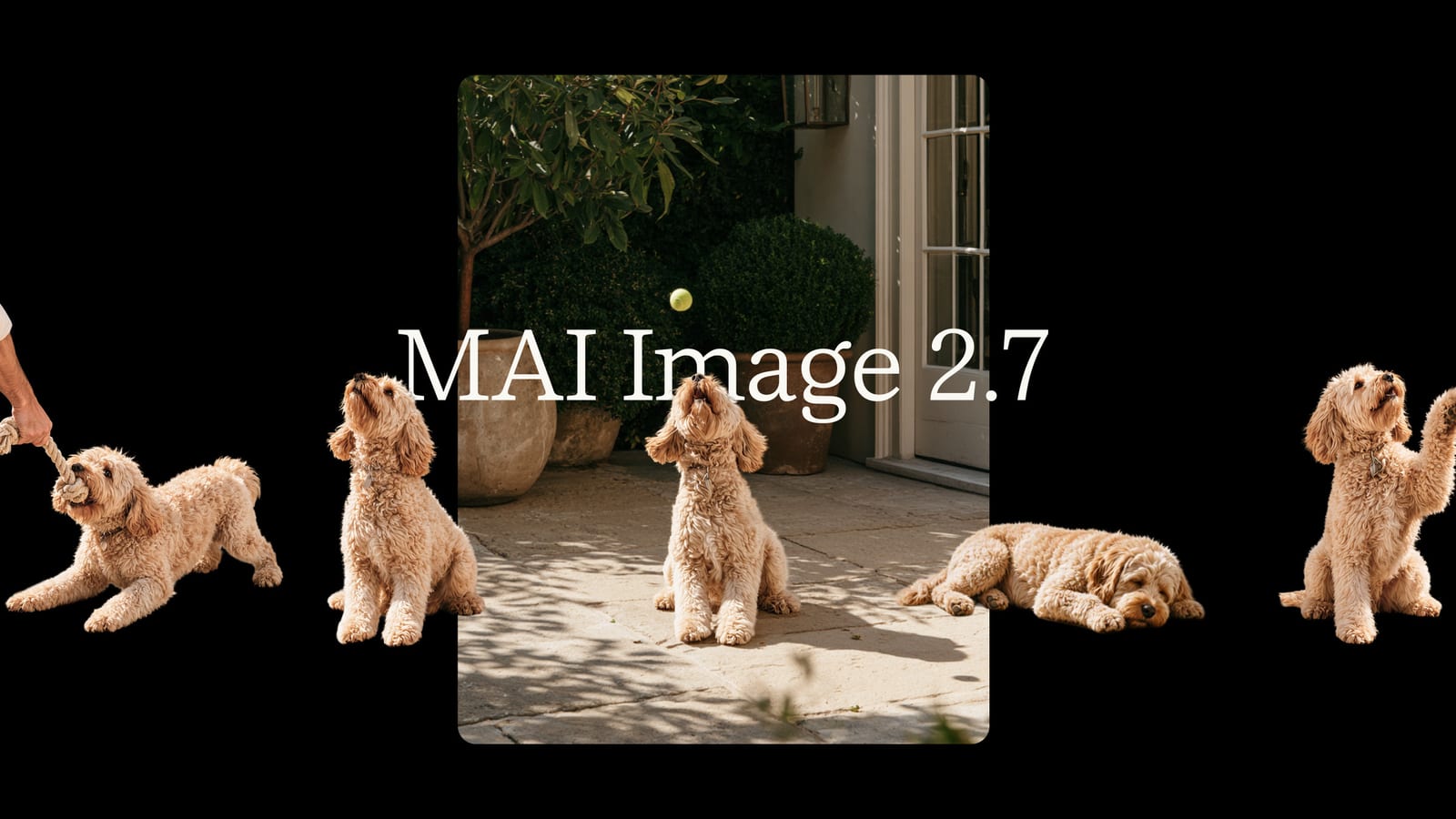
MAI Image 2.7, which Microsoft first showed in October, enters public preview in Foundry alongside a cheaper Flash variant, at roughly $35 and $10 per 1,000 images. As of November 16 it held the top spot on Artificial Analysis’s image-editing leaderboard with 1,215 Elo, four points ahead of GPT Image 2.6 Sunburst (max), which Microsoft says costs five times as much. It is also the default model family in Bing Image Creator, and Microsoft names Adobe, Figma Weave, Wirestock and Manus among its users. MAI Realtime 1, Microsoft’s first speech-to-speech model, costs $0.01 per audio minute, with reasoning billed separately at $1 and $5 per million input and output tokens; it is compatible with OpenAI’s Realtime API and can be tried in MAI Labs. BitsMinds spotted an unannounced MAI-Realtime entry in Microsoft’s playground in August.
The last piece is commercial. MAI Licensed Weights lets an organization take a Microsoft model, adapt it with its own data and run it in its own Azure environment, deciding who can use it and when it is upgraded; Microsoft says it will train on customer adaptations only with express agreement. It is “coming soon” through Microsoft’s Frontier Company programme. The early customer results are Microsoft’s own figures: AT&T says a tuned MAI model beat GPT-6.1 Sol on standard 5G network analysis at about a fiftieth of the cost, Woven by Toyota got ready-to-merge fixes in 44% of cases where frontier models needed a human, and Alaska Airlines lifted maintenance-report classification accuracy from 81.2% to 91.1%. When MAI-Base-2 finished pre-training in October, Microsoft said it would license weights to trusted partners. Ignite turns that promise into a product, and the low list prices are the way in.
Want AI news before everyone else?
The morning's most important AI stories, straight to your inbox. No fluff.