Hugging Face’s $399 Microduck Is a Robot You Train
Hugging Face opened pre-orders for Microduck, a 25-centimeter open-source biped with a camera, lidar and two IMUs that developers train in simulation and redeploy on the hardware. It ships before Christmas.
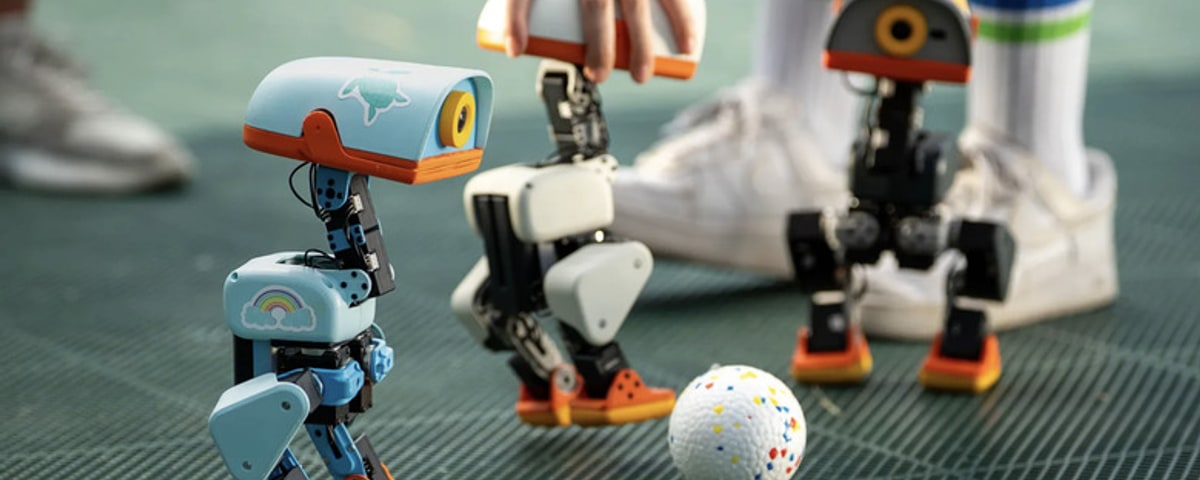
Hugging Face is now taking pre-orders for Microduck, a $399 open-source robot duck that stands about 25 centimeters tall and is meant to be retrained by whoever buys it. Deliveries are scheduled before Christmas. CEO Clem Delangue framed it as “an open-source robot you can teach new tricks with reinforcement learning” — which is a more precise description of the product than the shape suggests.
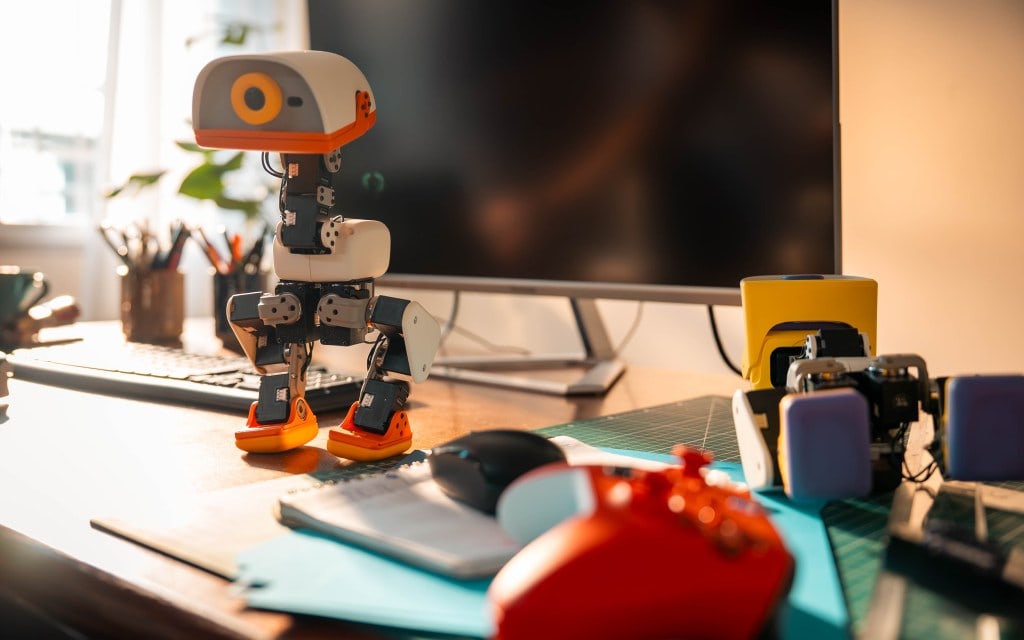
Out of the box the biped waddles, crouches, picks objects up with its beak, gets back on its feet after falling, and roller skates. It senses the world with a camera, lidar, and two inertial measurement units that track motion and orientation. None of those behaviors are the point on their own; they are the demonstration that the training loop closes on real hardware at a hobbyist price.
The spec sheet is small on purpose. Microduck stands 25 centimeters tall, weighs about 800 grams and runs 15 motors, with 32GB of storage and 1GB of onboard RAM. It sees through a single eye-like camera and a small lidar unit, keeps its balance with two inertial measurement units, and carries a speaker, a microphone, Wi-Fi and Bluetooth. Pollen Robotics lists seven trained moves in the box and a 50 Hz onboard policy loop, with the whole thing released under Apache-2.0. The box holds the robot, a battery, a cable and a controller; a $39 Accessory Pack (roller skates, laser pointer, ball, NFC materials), a $39 Charger Pack with two spare batteries and a $119 Dev Pack with spare motor parts and Hugging Face credit are sold alongside it.
That loop is the actual release. Behaviors are trained in simulation and deployed directly to the robot, and owners can fine-tune a policy, retrain it, and push it back down. The SDK, the simulation environment, and the full reinforcement-learning stack are published on GitHub, so a policy that works on someone else’s duck is a repository you can clone rather than a demo video you can watch. Sim-to-real transfer at this scale is where most cheap robot kits quit — they ship a fixed behavior tree and call it programmable.
Microduck is the third product from the robotics group Hugging Face bought when it acquired the French startup Pollen Robotics in April 2025. It follows Reachy Mini at $499 and Reachy Mini Lite at $399, both desktop units aimed at the same audience: developers who want physical hardware attached to the model ecosystem they already use, without a research-lab budget.
The timing is odd in one respect. Hugging Face is reportedly in talks to be acquired by Nvidia at a roughly $13 billion valuation, and shipping a consumer robot in the middle of that process suggests the hardware line is being treated as part of the company’s value rather than a distraction from it.
One caution travels with the form factor. Open weights and an open stack make the robot’s own behavior auditable in a way a closed consumer device never is, but the camera is still a camera: third-party applications built on top of the platform could reach it and ship frames elsewhere. Auditable firmware does not audit the app ecosystem that grows around it, and a 25-centimeter duck that follows you around the apartment is a more forgiving sensor to install than most buyers will stop to consider.
Want AI news before everyone else?
The morning's most important AI stories, straight to your inbox. No fluff.