Gemini Agent: Google’s AI Coworker Gets Its Own Email
Google’s new Gemini agent takes objectives instead of instructions, runs work in the cloud after you close your laptop, and can be hired as a “coworker” with its own Workspace account and email address. It routes jobs across Gemini and Anthropic’s Claude models, and goes to businesses before consumers.
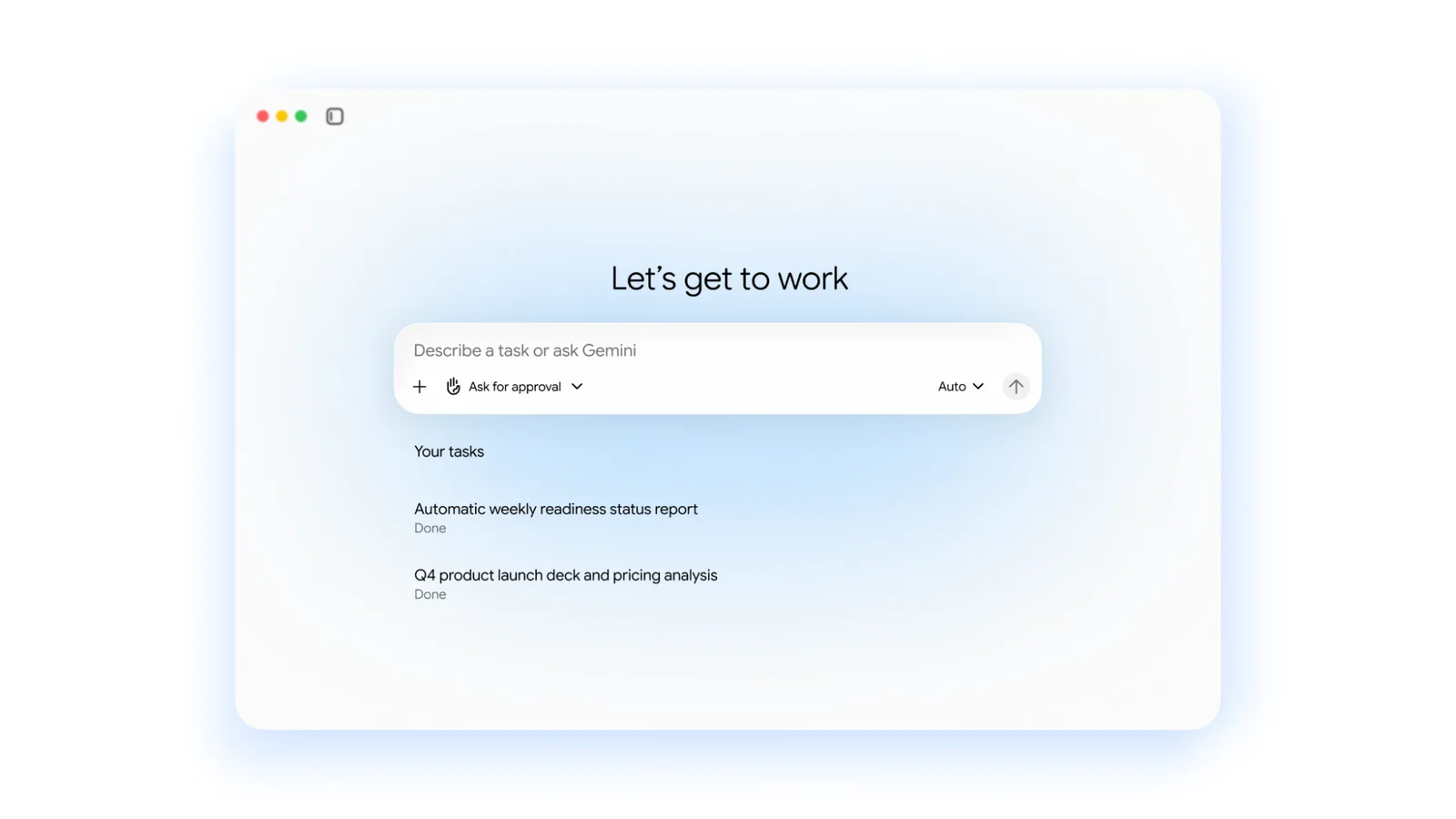
Google has folded its work assistant into a single product it calls the Gemini agent: one prompt box and one API that answers questions, does knowledge work, makes images and media, and writes and runs code. Google Cloud chief executive Thomas Kurian introduced it at the company’s Gemini at Work 2026 event on 8 October, and his post on the Google Cloud blog describes the pitch in one line: you give it objectives, not instructions.
A coworker with a login
The most unusual part of the launch is what Google calls coworker agents. You describe a role, and Gemini creates an agent for it with its own Google Workspace account: an email address on an @agents.company.com domain, a calendar, Drive storage and a place in the company directory. It acts under that identity and sees only what people share with it. Colleagues can tag it, email it or add it to group chats, and its actions show up in an audit trail under its own name, TechCrunch reports. For shorter jobs the agent spins up temporary sub-agents instead, and a tasks inbox shows its reasoning, the sub-agents it delegated to, the code it wrote and how far it has got.
The agent runs in Google’s cloud with one memory across devices, so long-running work carries on after you close your laptop. It reaches users on the web, iOS, Android, Windows and Mac, at the command line, and inside Google Workspace, Microsoft 365 and Slack, and it can also run headless. Its tool list covers Confluence, Jira, Git, Salesforce, ServiceNow, BigQuery, Databricks, Postgres, Snowflake and local desktop files, plus any Model Context Protocol server. Reusable “skills” package multi-step instructions that teams can publish to a shared registry, and third-party agents are listed in Google’s AI Solution Finder.
Claude inside Gemini
Google is explicit that the model is a separate choice from the agent. Gemini routes each job across its own Gemini models and Anthropic’s Claude models now, with “other leading private and open models in the future,” the post says. By default it picks the model itself, and users can override it. The Gemini side of that menu includes Gemini 4 Argon for frontier reasoning, Flash for speed and volume, Omni for media and the open-weight Gemma for edge work. Google’s argument is that the leading model changes every few months, so customers should not have to move their data and skills each time it does.
Cost controls are part of the pitch. A Smart Routing tool sends each workload to the model Google judges cheapest for the quality needed, and real-time spend caps, set in the Cloud Billing Console, pause a project’s agent when it hits its limit until someone resumes it. They add to flexible billing options for agents Google announced earlier. Security follows the same identity model: each agent has a cryptographically attested identity with least-privilege permissions, runs in an Agent Sandbox, and sends all its traffic through Agent Gateway, which Google describes as a network firewall for AI. Industry versions for financial services and legal work are in preview, with government, healthcare and retail listed as coming soon.
Businesses first
Consumers will have to wait. Google is starting with businesses because they force it to solve “harder problems around security, scale, and performance” first, chief executive Sundar Pichai said on stage, according to TechCrunch, which also reports his figures of more than a billion monthly Gemini users and nearly 90% of the Fortune 100 using Gemini Enterprise. Kurian’s post does not give a general-availability date or say which Workspace or Gemini Enterprise plans include the agent and its coworkers. On the consumer side, Google has been moving the other way on cost: free Gemini users drop to Flash-Lite only from 9 October.
Google lists dozens of customers, from BNP Paribas, which it says has deployed Gemini Enterprise to more than 65,000 employees, to SOMPO, which it says built over 10,000 custom agents for 34,000 staff. Those figures are the customers’ and Google’s own. The harder test is the one the coworker design invites: once an agent has an inbox, a calendar and a seat in the directory, companies will have to decide who answers for what it sends.
More on Gemini
Evergreen coverage we keep current — start here.
Want AI news before everyone else?
The morning's most important AI stories, straight to your inbox. No fluff.