Gemini Advanced Review 2026: Worth $19.99?
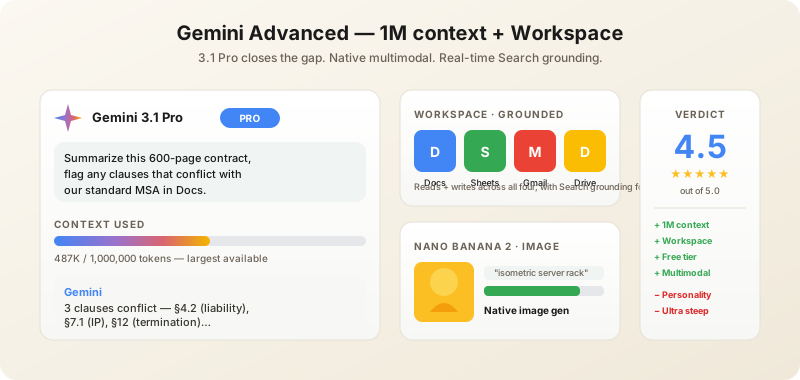
Gemini Advanced is now Google AI Pro at $19.99/month, running Gemini 3.1 Pro with a 2M-token context window plus Gemini inside Gmail, Docs and Meet. But the flagship Gemini 3.5 Pro is months late, and every upgrade since May landed in the free Flash tier.
Pros
- Gemini 3.1 Pro is genuinely competitive with Claude/GPT
- 2M token context window — the largest available
- Deep Google Workspace integration
- Free tier runs Gemini 3.7 Flash and is genuinely useful
- Multimodal across video/audio/images
- Real-time Google Search grounding
- Nano Banana 2 for image generation
- Deep Research with MCP support
Cons
- Gemini 3.5 Pro is months late — the Pro tier still runs an April model
- Every upgrade since May landed in Flash which the free tier also gets
- Google killed Project Mariner and Gemini CLI mid-stream
- Personality less polished than Claude
- Some safety filters still overly aggressive
- Ultra at $249.99 buys limits rather than a smarter model
- Gems feature less mature than Custom GPTs
The Bottom Line (August 2026)
Gemini Advanced is now sold as Google AI Pro at $19.99/month, and what you are buying is Gemini 3.1 Pro with a 2-million-token context window plus Gemini across Gmail, Docs, Sheets and Meet. It is a genuine top-tier assistant and the best value in AI if your work already lives in Google Workspace. But there is a caveat no other review is leading with: the flagship Gemini 3.5 Pro is months late, so the tier you pay for still runs an April model, while the free and cheap Flash tiers have been upgraded four times since May.
Score: 4.5/5 — held steady from our May review, but for different reasons. The ecosystem got stronger; the flagship model did not.
What $19.99 Actually Buys You
| Tier | Price | What you get |
|---|---|---|
| Free | $0 | Gemini 3.7 Flash in the app and across Google products, with usage limits. Genuinely capable — see the benchmark table below. |
| Google AI Pro | $19.99/mo | Gemini 3.1 Pro with higher limits, Gemini inside Gmail/Docs/Sheets/Meet, NotebookLM Pro, 2TB Drive. |
| Google AI Ultra | $249.99/mo | Highest limits, earliest features, Veo 3 video generation, Gemini Spark, 30TB storage. |
| Google AI Studio | Free | Developer prototyping with generous limits. |
| Vertex AI | Usage-based | Enterprise API with fine-tuning, SLA, custom data. |
The Pro tier is the one that matters for most readers, and the honest framing is that you are paying for integration and limits more than for raw model quality. The free tier already runs a very strong Flash model. What $19.99 adds is the 2M-context Pro model, the Workspace sidebars, and enough headroom that you stop hitting caps mid-task.
The Model Lineup (August 2026)
- Gemini 3.1 Pro (April 21, 2026) — Still the flagship. Launched in preview scoring a verified 77.1% on ARC-AGI-2, more than double Gemini 3 Pro, with a 2-million-token context window shared with the 3.1 Ultra variant. Read our full breakdown of the 3.1 Pro launch.
- Gemini 3.7 Flash (August 13, 2026) — The current workhorse and Google's own pick for coding and agents. Shipped three weeks after 3.6 Flash, with introductory pricing at half the previous rate.
- Gemini 3.6 Flash (July 21, 2026) — Cuts output-token usage by 17% versus 3.5 Flash on the Artificial Analysis Index. A real cost win at volume.
- Gemini 3.5 Flash-Lite (July 21, 2026) — Beats the previous Flash-Lite and even the original Gemini 3 Flash on SWE-Bench Pro and OSWorld-Verified.
- Gemini 3.5 Flash Cyber (July 21, 2026) — Security-tuned to find, validate and patch vulnerabilities. A limited pilot for governments and trusted partners via Google's CodeMender program, so not something a Pro subscriber can touch.
- Gemini 3.5 Flash (May 19, 2026) — The I/O centerpiece, now superseded. Notable because it beat 3.1 Pro on agentic benchmarks at Flash pricing.
- Nano Banana 2 — Image generation on the Gemini Flash Image line. Still the best text rendering in an image model.
- Gemini 3.5 Pro — Does not exist yet. See below.
The Gemini 3.5 Pro Problem
This is the part a buyer needs to know, and it is easy to miss because Google's release cadence looks furious from the outside.
Gemini 3.5 Pro was promised for June 2026. It slipped, then slipped again, then slipped a third time. As of Google's July 21 release — which shipped three new models — the flagship Pro tier was still nowhere to be seen, and Google confirmed it had jumped ahead to begin pretraining Gemini 4 instead.
What this means in practice: the Pro model behind your $19.99 subscription launched in April. Every upgrade since May has landed in the Flash line, which the free tier also gets. That inverts the usual logic of a paid AI subscription, where the premium tier is supposed to move fastest.
Two honest readings. The charitable one: Flash improvements are where real usage lives, and 3.7 Flash beats the old 3.1 Pro on agentic work, so subscribers benefit anyway. The skeptical one: Google has shipped six Flash variants and zero Pro upgrades in four months, which is what a company does when its top-end training run is not going well.
Benchmarks: What Actually Changed Since May
The Flash line is where all the movement is. Google's own published figures for the last two releases:
| Benchmark | 3.6 Flash (Jul 21) | 3.7 Flash (Aug 13) |
|---|---|---|
| FrontierCode 1.1 | 34.4% | 43.6% |
| DeepSWE v1.1 (long-horizon SWE) | 49.0% | 65.3% |
| WebDev Arena (Elo) | 1538 | 1588 |
| GDP.pdf (document reasoning) | 22.0% | 34.0% |
| AutomationBench (unattended workflows) | 17.0% | 30.4% |
The AutomationBench jump — near doubling on the roughest measure of whether a model can drive a multi-step workflow without hand-holding — is the number worth caring about if you are building agents. API pricing moved the right way too: $0.75 per million input tokens and $3.75 per million output, held through December 31, 2026, before reverting to $1.50 and $7.50.
For context on why the Flash tier now competes with the Pro tier: back at I/O in May, Gemini 3.5 Flash already posted 76.2% on Terminal-Bench 2.1 against 70.3% for Gemini 3.1 Pro, 83.6% on MCP Atlas against 78.2%, and 1,656 Elo on the GDPval-AA agentic benchmark where 3.1 Pro had scored 1,314. Flash passed Pro on agentic work three months ago and has been pulling away since.
The Killer Feature: 2M Token Context
Still the largest of any major model, and still the single most defensible reason to pick Gemini. Two million tokens is roughly 1,500 pages of text. In practice this enables:
- Drop entire codebases in and ask for cross-file refactors
- Feed 100+ customer interviews and ask for thematic synthesis with citations
- Submit full books, multi-document legal contracts, hours of meeting transcripts
- Work with feature-length video files, which Gemini analyzes frame by frame
The advantage compounds for research-heavy and document-heavy work. If your job involves reading more than writing, this alone can justify the subscription — no amount of retrieval plumbing on a smaller-context model feels as clean as pasting the whole thing in.
Google Workspace Integration
The strongest practical advantage, and the reason the $19.99 tier is good value rather than merely acceptable. Gemini lives inside the apps where knowledge workers already spend the day:
- Gmail — "Help me write" produces drafts that match your tone after a few corrections
- Google Docs — Sidebar generates outlines, rewrites paragraphs, answers questions about long documents
- Google Sheets — Natural-language formulas, auto-analysis, smart fills, chart suggestions
- Google Meet — Real-time captions, post-meeting summaries with action items, "take notes for me"
- NotebookLM — Source-grounded research notebooks, a separate product powered by Gemini
There is also real-time speech-to-speech translation across 70+ languages, which lands squarely in Meet's territory and has no equivalent in a ChatGPT Plus subscription.
Deep Research and Gemini Agent
Deep Research is Gemini's autonomous research agent: it plans, runs many searches, reads dozens of sources and produces a structured report. It supports MCP, so it can reach your own databases, internal docs and APIs, and it generates charts and diagrams natively.
Correction from our May review: we previously listed Project Mariner as an Ultra-tier feature. That is no longer true. Google shut Mariner down on May 4, 2026 without a public announcement, ending its 17-month run, and folded the browser-control technology into the Gemini API and the new Gemini Agent. If you subscribed to Ultra expecting Mariner, the replacement is Gemini Agent plus Gemini Spark, the 24/7 personal agent that runs on private Google Cloud infrastructure even while you are offline.
Developers should also note that Gemini CLI was retired in June in favour of the Antigravity CLI. Google's willingness to kill shipping products on short notice is a genuine planning risk, not just trivia.
Scale: One Billion Users
On August 11, Sundar Pichai said the Gemini app passed one billion monthly active users — the fourteenth Google product to reach that mark, up from roughly 950 million in July, with daily actives tripling year over year. It arrived about two months after ChatGPT crossed the same line.
Two details from that disclosure matter for a buyer. First, 63% of Gemini users talk to the assistant by voice, a far higher share than the industry assumed, which tells you where Google is putting its polish. Second, more than 100 million of those users are on Apple hardware — worth knowing given that Siri is going Gemini-powered. The caveat: the figure counts the standalone app only, not Gemini inside Search, Workspace or Android.
Where It Falls Short
The Pro tier is not where the upgrades land
Covered above, but it belongs in the cons column. If you pay for Pro specifically to be on the best model Google makes, you have been standing still since April.
Personality
Claude has a distinctive voice — thoughtful, willing to push back. ChatGPT has its own quirks. Gemini still feels comparatively bland. For drafting anything where the AI's voice leaks into the output, this is a real disadvantage.
Safety filters
Gemini still refuses legitimate requests that Claude and ChatGPT handle without complaint, particularly around health, security research and sensitive-but-not-harmful topics. Better than 2025, still a friction point.
Gems vs Custom GPTs
Gems, Gemini's custom-expert feature, works but the community library is much smaller than ChatGPT's Custom GPTs ecosystem.
Product churn
Project Mariner and Gemini CLI were both killed inside two months. If you build a workflow on a Google AI product, price in the possibility that it disappears.
Ultra pricing
$249.99/month is steep and only justified if you specifically need Veo 3 video generation, Gemini Spark and 30TB of storage. Otherwise stay on Pro.
Gemini vs Claude vs ChatGPT
| Gemini (Google AI Pro) | Claude Pro | ChatGPT Plus | |
|---|---|---|---|
| Wins on | Context window, Workspace integration, video and audio analysis, free-tier value | Writing quality, careful reasoning, code review, intellectual honesty | Agentic computer use, image generation, plugin ecosystem, voice mode |
| Context | 2M tokens | Large but smaller | Large but smaller |
| Best for | Document-heavy research inside Google Workspace | Writing and code you will ship | General-purpose plus tooling breadth |
The honest recommendation has not changed: if your work lives in Google Workspace, Gemini is now your best primary AI. If it does not, Claude or GPT is probably the better primary, with Google AI Pro as a complement you keep specifically for long-document work. That is a real recommendation to hold two subscriptions, and for anyone doing serious research it pays for itself.
Compare these side by side
Put Gemini, Claude and ChatGPT against each other on pricing, context window and capabilities in our interactive comparison tool.
Who Should Buy Google AI Pro
Buy it if: your team is on Google Workspace; you regularly work with documents, transcripts or codebases too large for other models; you want the strongest free-to-paid upgrade path in AI; or you want the best video and audio analysis available in a consumer subscription.
Skip it if: writing quality is your primary need, where Claude is better; you need a mature custom-assistant ecosystem, where ChatGPT is better; or you were specifically waiting for Gemini 3.5 Pro, in which case wait, because it is not here.
Definitely skip Ultra unless Veo 3 or Gemini Spark is load-bearing for your work. The gap between $19.99 and $249.99 buys limits and early access, not a materially smarter model.
Verdict
Gemini Advanced went from embarrassing in 2023 to legitimately top-three in 2026, and at $19.99 with Workspace integration it is the best-value AI subscription for anyone already inside Google's ecosystem. The 2M-token context window remains genuinely unmatched and is reason enough on its own for document-heavy work.
What keeps it at 4.5 rather than higher is the strange shape of Google's 2026: a furious Flash cadence, an absent flagship, and two shipped products killed mid-stream. You are buying an excellent ecosystem attached to a model that has not been upgraded since April. For most readers that is still a good trade. For anyone who bought Pro expecting to be on Google's frontier, it is not the deal it looked like in May. Score: 4.5/5.
Reviewed August 2026 against Gemini 3.1 Pro and Gemini 3.7 Flash. Tier pricing as published by Google; benchmark figures are Google's own published numbers.
Frequently Asked Questions
Is Gemini Advanced the same as Google AI Pro?
Yes. Google renamed the Gemini Advanced subscription to Google AI Pro. It costs $19.99 per month and includes Gemini 3.1 Pro with higher usage limits, Gemini inside Gmail, Docs, Sheets and Meet, NotebookLM Pro and 2TB of Drive storage.
Is Gemini Advanced worth $19.99 a month in 2026?
Yes if your work is already inside Google Workspace, or if you regularly handle documents, transcripts or codebases large enough to need the 2-million-token context window. It is harder to justify if you mainly want writing quality, where Claude is stronger, or a mature custom-assistant ecosystem, where ChatGPT is stronger.
What model does Google AI Pro run in August 2026?
Gemini 3.1 Pro, which launched in preview on April 21, 2026 with a 2-million-token context window and a verified 77.1% on the ARC-AGI-2 reasoning benchmark. Gemini 3.5 Pro was targeted for June 2026 but has slipped repeatedly and has still not shipped.
How big is Gemini's context window?
Gemini 3.1 Pro and 3.1 Ultra both have a 2-million-token context window, roughly 1,500 pages of text. It is the largest of any major model and Gemini's most defensible advantage.
Is the free version of Gemini good enough?
For many people, yes. The free tier runs Gemini 3.7 Flash, which scores 43.6% on FrontierCode 1.1 and 65.3% on DeepSWE v1.1, and beats the paid 3.1 Pro model on several agentic benchmarks. What the paid tier adds is the 2M context window, Workspace integration and much higher limits.
Gemini Advanced vs ChatGPT Plus: which should I pick?
Pick Gemini if you need a large context window, Google Workspace integration or strong video and audio analysis. Pick ChatGPT Plus if you need agentic computer use, image generation or the plugin ecosystem. Both cost about the same, so the deciding factor is which ecosystem you already work inside.
Is Google AI Ultra at $249.99 worth it?
Only if you specifically need Veo 3 video generation, Gemini Spark's always-on agent or 30TB of storage. The Ultra tier buys higher limits and earlier access rather than a materially more capable model, so most users should stay on Pro.
What happened to Project Mariner?
Google shut Project Mariner down on May 4, 2026 without a public announcement, ending a 17-month run, and folded its browser-control technology into the Gemini API and the new Gemini Agent. Ultra subscribers get Gemini Agent and Gemini Spark instead.
About the score. 4.5/ 5 is BitsMinds' editorial verdict from our own testing and research — not an average of user ratings, which we do not collect. Prices and plan tiers are as published by the vendor on the fact-check date shown above. How we rate →
Related Reviews

Anthropic turned the lineup over again: Fable 5.1 replaced Fable 5 at the top on September 1, Opus 5 replaced Opus 4.8 at the same price, and Sonnet 5’s intro pricing has ended. Where Claude leads, where it still struggles, and whether Pro and Max are worth it in September 2026.
Read review →
ChatGPT Plus is still the best $20 in AI and Pro is still a $200 question — now with GPT-6 Astra rolling out to both tiers. What changed since our GPT-5.5 hands-on, where Claude still wins, and who actually needs Pro.
Read review →Anthropic's Claude Fable 5 is the most capable model the public can use today — topping SWE-Bench Pro and excelling at vision and long tasks. It is also the priciest major model and ships with hard safety guardrails. Our first-look verdict.
Read review →Want AI news before everyone else?
The morning's most important AI stories, straight to your inbox. No fluff.