Muse Spark Open: Meta’s 816B Open-Weight Model
Muse Spark Open is an 816-billion-parameter open-weight model from Meta, built for coding and agents, with a 1M-token context and weights small enough at 4-bit to run on two paired Mac Studios. Meta calls it the most capable US open-weight model yet; its own table shows it leading on agent benchmarks and trailing the best Chinese open models on coding.
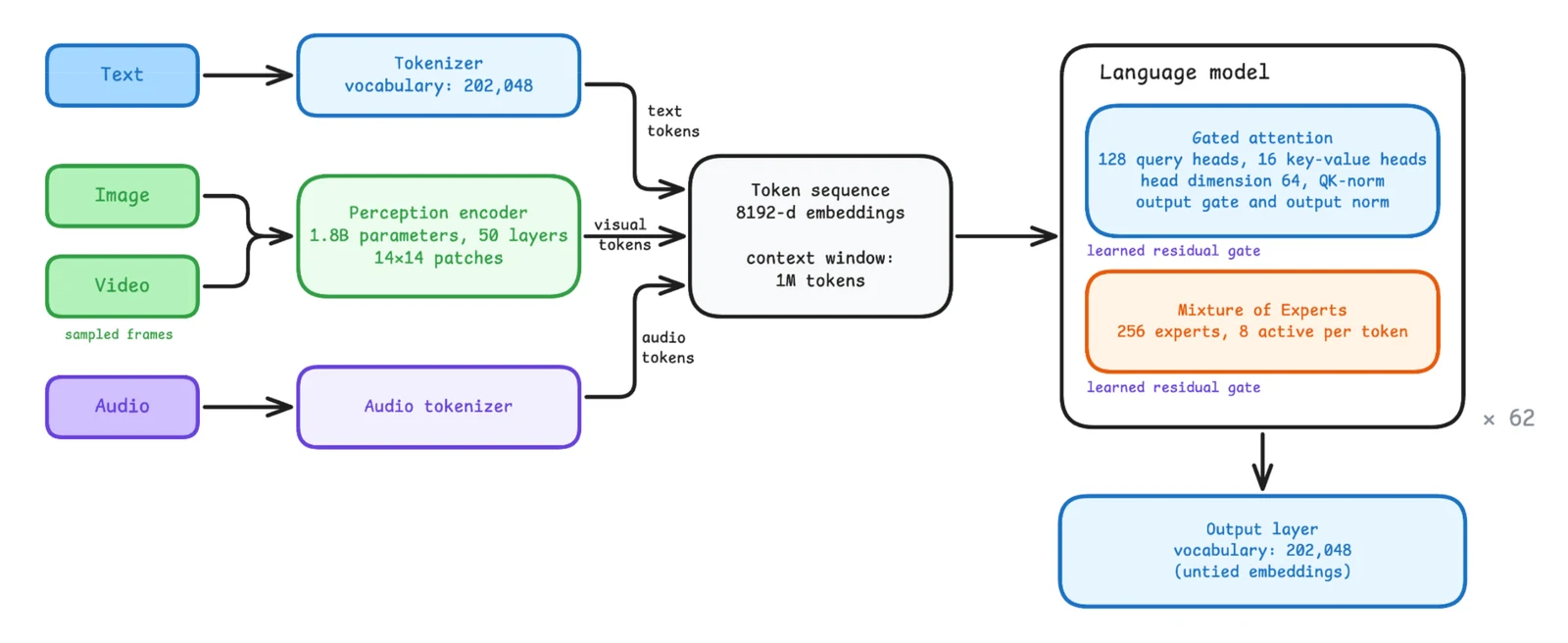
Meta has released Muse Spark Open, an open-weight version of the Muse model family that its Superintelligence Labs has so far kept behind its own apps and API. It is a mixture-of-experts model with 816 billion parameters in total, of which 42 billion are active for any one token, and it reads text, images, video and audio while writing only text. Meta calls it the most capable US open-weight model to date and pitches it at coding and long-running agent work. The weights went up on Hugging Face on 15 October.
The headline trick is where it runs. Meta says two M5 Ultra Mac Studios with 512 GB of unified memory each, linked together and running Apple’s MLX framework, behave like one machine with a terabyte of memory, enough to hold the model. It calls this the first model in its class to run on a desktop. TechCrunch, citing Engadget, puts the floor at a terabyte of RAM. The setup also comes with caveats VentureBeat spelled out: Apple’s 512 GB configuration does not ship until late October and has no announced price, and the alternative, four 256 GB machines at $10,799 each, comes to $43,196. Meta gave no figure for how fast the model generates text on that setup.
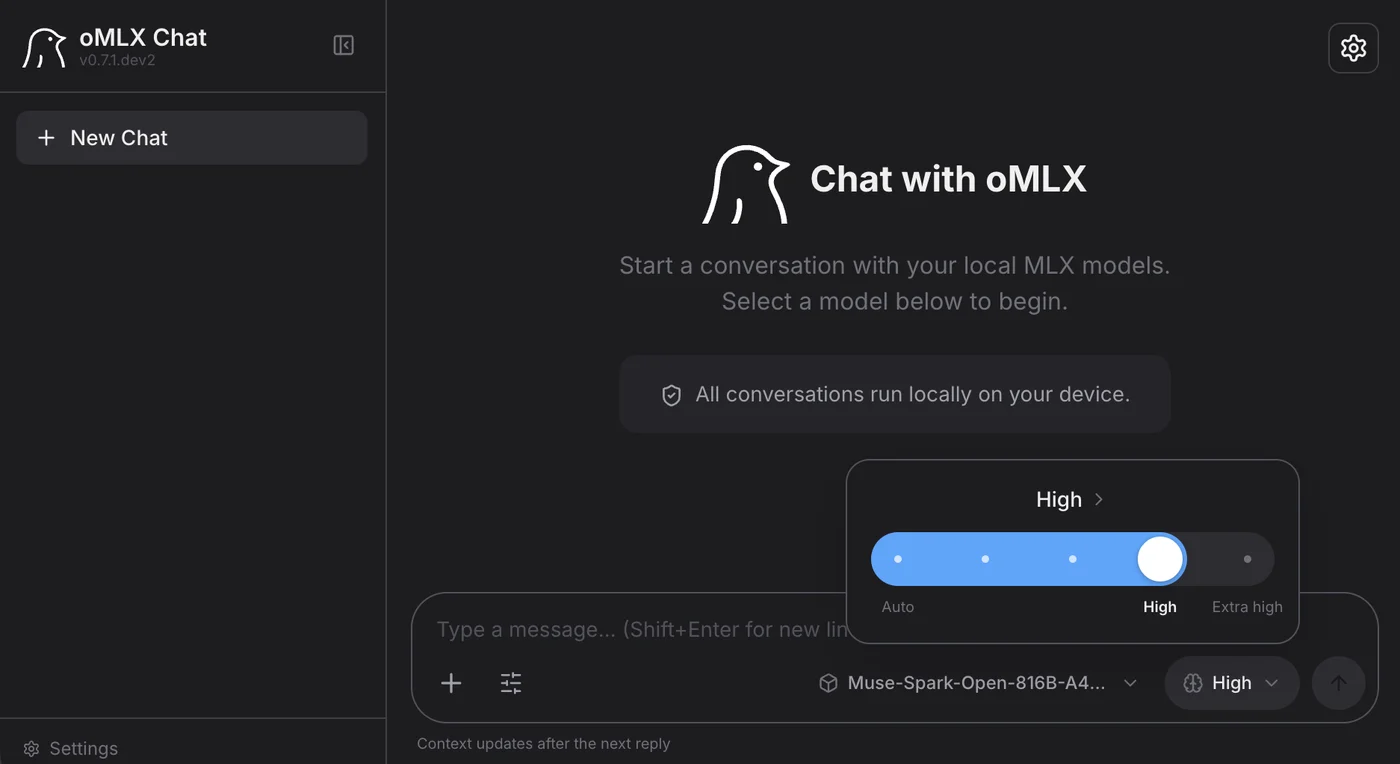
On servers the bill is larger. The model card asks for at least 700 GB of GPU memory for the NVFP4 checkpoint and about 2 TB for the full BF16 weights, which weigh in at around 1.5 TB on disk. Hugging Face’s launch post ran the BF16 model across four nodes of eight H200s and the NVFP4 build on a single B200 node, and community quantisations went further: a 2-bit version ran at 18 tokens a second in 304 GB on an M3 Ultra under llama.cpp, and the oMLX runtime generated about 21 tokens a second. Meta lists Baseten, Fireworks AI, Groq, Modal, Nebius, OpenRouter and Together AI for hosted access, and the weights on Amazon SageMaker AI, Google Cloud Model Garden and Microsoft Foundry. Together AI charges $1.25 per million input tokens and $4.25 per million output, the same as Meta’s hosted Muse Spark.
Inside the model
Each of the 62 layers routes a token to 8 of 256 experts, and those experts hold about 97% of the parameters. Images and video go through a 1.8-billion-parameter perception encoder, the same design Meta used in its 30B Muse Glimmer in August, and audio is cut into one token every 80 milliseconds. Reasoning cannot be switched off: it has four effort levels, low to xhigh, and defaults to the highest. At a full million tokens, Hugging Face puts the key-value cache at about 266 GB in BF16, on top of the weights.
Where it leads, and where it does not
Meta’s comparison table sets Muse Spark Open against seven other open models, among them Kimi K3, GLM 5.3, Qwen3.8 and Reflection’s Beam. It comes out ahead on most of the agent tests, with 89.2 on MCP-Atlas against GLM 5.3’s 84.2, and on knowledge questions, scoring 26.1 on HLE-Diamond without tools where the next best, Kimi K3, scores 22.2. Coding is the weak side, and Meta’s table shows it.
On Artificial Analysis’s Intelligence Index, the one composite in the table, Muse Spark Open scores 39. GLM 5.3 sits at 45, Kimi K3 at 44 and Qwen3.8 at 40. VentureBeat noted that the 39 is Meta’s figure, that Artificial Analysis had not published its own assessment at the time, and that six models on Artificial Analysis’s listings score higher. Meta’s closed Muse Wonder, launched three days earlier, scores 52 on the same index, which leaves the open model well short of what Meta sells.
Open, with conditions
The weights ship under a new Muse Model License, not an open-source one. Anyone may use, modify, fine-tune, distill and resell the model, but products built on it have to display “Built with Muse Spark Open”, and any company selling it as a hosted model with more than $20 million in gross revenue over 12 months has to notify Meta and sign a separate agreement. The attached usage policy bars military, weapons and espionage uses, and users under 18. Downloading requires a full legal name, date of birth and company identifiers.
Because the open model runs without Meta’s hosted guardrails, Meta says it gave it extra safety post-training. It reports refusals on 99.2% of jailbreaks on an internal cyber benchmark and more than 98% on the SecureBio BioTIER biology set, and says the model met the thresholds of its scaling framework, with a full evaluation report still to come. It also warns that downstream changes to the weights could undo some of that.
The release lands in a field Chinese labs have dominated: VentureBeat, citing Hugging Face, put Chinese models at 41% of downloads on the platform in March, and The Decoder framed the launch as Meta’s answer to Qwen, GLM and Kimi. On agent benchmarks Meta now has a US model that matches them. Whether developers switch will turn less on that than on a license with a revenue trigger and a coding score that still trails the models they already run.
Want AI news before everyone else?
The morning's most important AI stories, straight to your inbox. No fluff.