Gemini 4 Argon vs Opus 5.5, Astra and Grok: A New King?
Google’s Gemini 4 Argon takes on the three build briefs Claude Opus 5.5, GPT-6 Astra and Grok 4.7 have already answered. A motorway interchange, a seaside fairground and a cinematic rocket launch, one attempt each at the highest reasoning setting on offer, with no way to look at what it built. All twelve builds run below, untouched, so you can judge them yourself.
BitsMinds LabHow this test was run4 models · 3 briefs · each build is one attempt: no follow-up notes, no corrections, no clean-up · Argon in the Gemini app at High, the highest thinking setting it offers. Opus 5.5 in Claude Code at max, Astra in OpenAI Codex at xhigh, the highest it offered at the time, and Grok 4.7 in Grok Build at xhigh, the top of its dialShow details
- Models
- Claude Opus 5.5 (Claude Code) · GPT-6 Astra (OpenAI Codex) · Gemini 4 Argon (Gemini app) · Grok 4.7 (Grok Build)
- Attempts
- Each build is one attempt: no follow-up notes, no corrections, no clean-up.
- Reasoning effort
- Argon in the Gemini app at High, the highest thinking setting it offers. Opus 5.5 in Claude Code at max, Astra in OpenAI Codex at xhigh, the highest it offered at the time, and Grok 4.7 in Grok Build at xhigh, the top of its dial.
- Tools allowed
- Argon ran in the Gemini app as a chat with no file tools and replied with the code, which was saved untouched; the other three ran in coding agents and wrote their files to disk. All four were told not to open a browser, preview the result or run code.
- Timing
- Wall-clock time from prompt to finished file: Argon took 24m, 8m and 6m on 15 October; Opus 5.5 took 58m 49s, 62m 41s and 76m 33s on 22 September; Astra took 16m 15s, 26m 33s and 28m 00s on 6 September; Grok 4.7 took 11m 55s, 37m 46s and 50m 48s on 21 September.
- Scoring
- Points out of five, set round by round on the finished artefact. Opus 5.5, Astra and Grok 4.7 are their September builds, scored again alongside Argon's. Final: Opus 5.5 wins with 12 points, Astra 6 takes 9, Argon takes 8, Grok 4.7 takes 4.
- Judging
- Scored by BitsMinds from a local side-by-side comparison page of the untouched outputs. No blind scoring, no automated grading.
- Published
- October 15, 2026
Result
| Model | Provider | Score |
|---|---|---|
| Claude Opus 5.5 | Anthropic | 12 pts |
| GPT-6 Astra | OpenAI | 9 pts |
| Gemini 4 Argon | 8 pts | |
| Grok 4.7 | SpaceXAI | 4 pts |
Opus 5.5 wins with 12 points, Astra 6 takes 9, Argon takes 8, Grok 4.7 takes 4. Argon was by far the fastest on the fairground and the launch and staged a full launch to orbit, but its carousel never goes round and its launch scene is plain.
The briefs — as described in the article; the exact prompt files were not published
Round 1: Motorway interchange (SVG)
A top-down view of a busy interchange as one self-contained SVG. Two roads crossing on different levels, connecting ramps, at least twelve vehicles following the curve of the road they are on, and correct layering so traffic on the lower road is hidden by the overpass.
Result: Astra 6 wins with 4 points, Opus 5.5 and Argon take 3 each, Grok 4.7 takes 2: Astra draws the most impressive picture and its ramps blend into the road; Opus 5.5's leave as cleanly, Argon adds a second set of loops but its outer ramps turn off at right angles, and in all four the road's edge runs on across an exit.
Round 2: Seaside fairground (SVG)
A seaside fairground at dusk, one SVG. A Ferris wheel with at least ten gondolas turning continuously, a spinning carousel with at least six horses rising and falling out of phase, twinkling bulbs, a reflection in the water. Each gondola must stay level with the horizon throughout the rotation.
Result: Opus 5.5 wins with 4 points, Astra 6 takes 3, Argon takes 2, Grok 4.7 takes 1: all four wheels keep their cabins level, but only Opus 5.5's horses travel round the ride facing the way they go; Argon's carousel is a flat picture whose roof stripes jump every two seconds over horses that bob in place.
Round 3: Rocket launch (web page)
A self-contained web page that animates a rocket launching — countdown, ignition, liftoff and ascent — with a mission-control HUD. No library named, no 3D requested, one aesthetic instruction: make it look good.
Result: Opus 5.5 wins with 5 points, Argon takes 3, Astra 6 takes 2, Grok 4.7 takes 1: Opus 5.5 flies to a real orbit on camera; Argon stages like a real launch and films it from several angles, in a very plain scene; Astra stops at the ascent and Grok's camera loses the rocket before it separates.
Read with care
- Opus 5.5, Astra and Grok 4.7's builds are the files they were published with in September, scored again here rather than re-run.
- Argon ran in a chat app rather than a coding agent and replied with its file instead of writing it to disk; the brief was otherwise word for word the same.
- Scored on the finished artefact only. Wall-clock time is reported but carries no points, and a chat reply and an agent run are not timed the same way.
Part of BitsMinds Lab, our series of original hands-on tests.
Google launched Gemini 4 Argon on 30 September with a benchmark table it led on 13 of 19 tests. Those are Google’s numbers. This series runs a different test: hand each frontier model the same build briefs, one attempt apiece, and publish whatever comes back without touching it.
Argon’s opponents are the three models that have already answered these briefs: Anthropic’s Claude Opus 5.5, OpenAI’s GPT-6 Astra and xAI’s Grok 4.7. It is Google’s first appearance in the series, and the first time four labs have shared one page. The briefs: a top-down motorway interchange and a seaside fairground, each a single animated SVG file, and a cinematic rocket launch as one web page. One attempt each, the highest reasoning setting each model offers, and no opening a browser to check the result.
Argon was quick. It handed in the fairground in eight minutes and the rocket launch in six, faster than any of the other three on either brief, and nothing it built was broken in the way that sinks a round outright: no blank page, no missing stage, no camera that loses its subject. Where it fell short was the ride that has decided the fairground round in every article this series has run.
Round 1: The interchange
The brief: a busy interchange seen from above, as one self-contained SVG. Two roads crossing on different levels, ramps connecting them, at least twelve vehicles that follow the curve of the road they are on, and layering that hides the lower road’s traffic under the overpass. Two traps go unstated: whether the ramps genuinely join the roads, and whether traffic runs the right way after it merges.
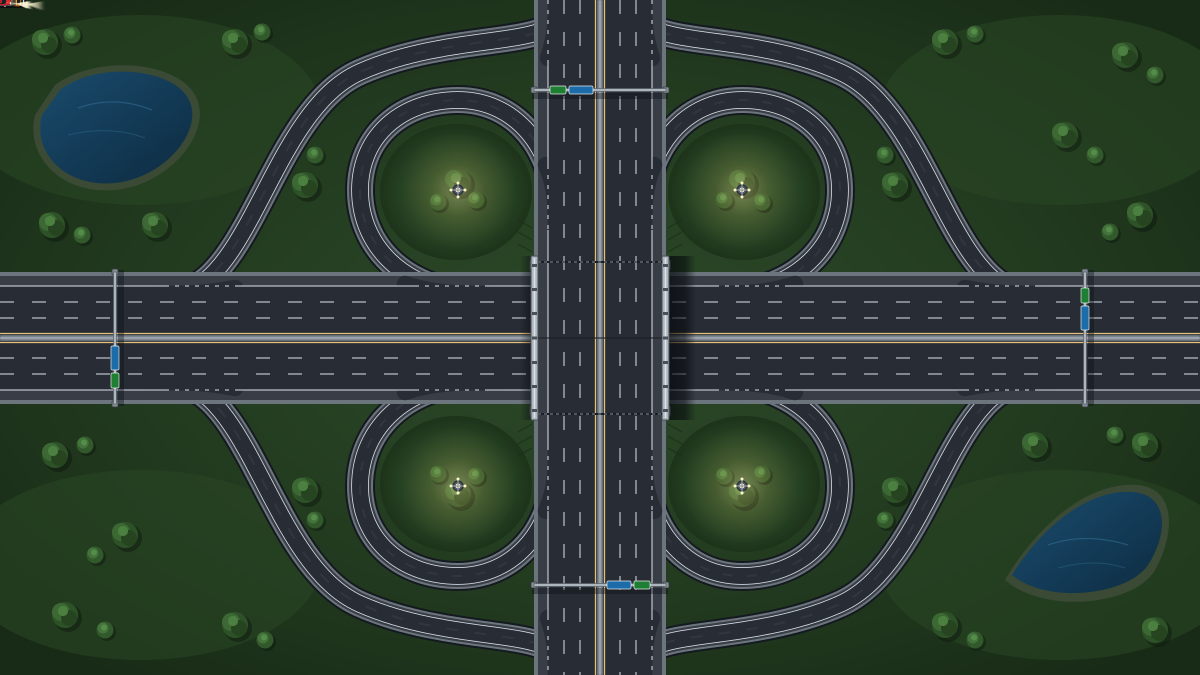
Gemini 4 Argon built a complete cloverleaf: two six-lane highways, four outer ramps for the right turns and four 270-degree loops for the left. Thirty-six vehicles run on it, from coupes and SUVs to a cargo van, a coach and an articulated lorry, each throwing a pair of headlight beams onto the road ahead. The scene around it is landscaped: a grassy island with trees and a floodlight mast inside each loop, two stormwater ponds, sign gantries over all four approaches, and a bridge with parapets, posts, expansion joints and a shadow laid across the road below. Every path starts and ends off-screen, so no car appears out of nowhere.
The loop ramps are where it did its real thinking. A loop car starts on the lower road and finishes on the upper one, so it has to change levels somewhere. Argon draws each of those cars twice, once beneath the bridge deck and once above it, and switches from one copy to the other partway round. It put the switch out on the loop itself, on open ground well away from the bridge, so the swap can never be seen.
Where the ramps meet the road, it falls apart. The right-hand shoulder of each highway carries straight on past every exit, as if there were no interchange there at all; the thin painted line beside it does break into dots at each opening, but the grey shoulder band, the edge a viewer actually reads as the side of the road, never parts. And the outer ramps leave at a right angle. At the top of the picture, a ramp comes off the north-south highway and turns west almost on the spot, a ninety-degree corner where a real slip road peels away in a long, shallow curve.
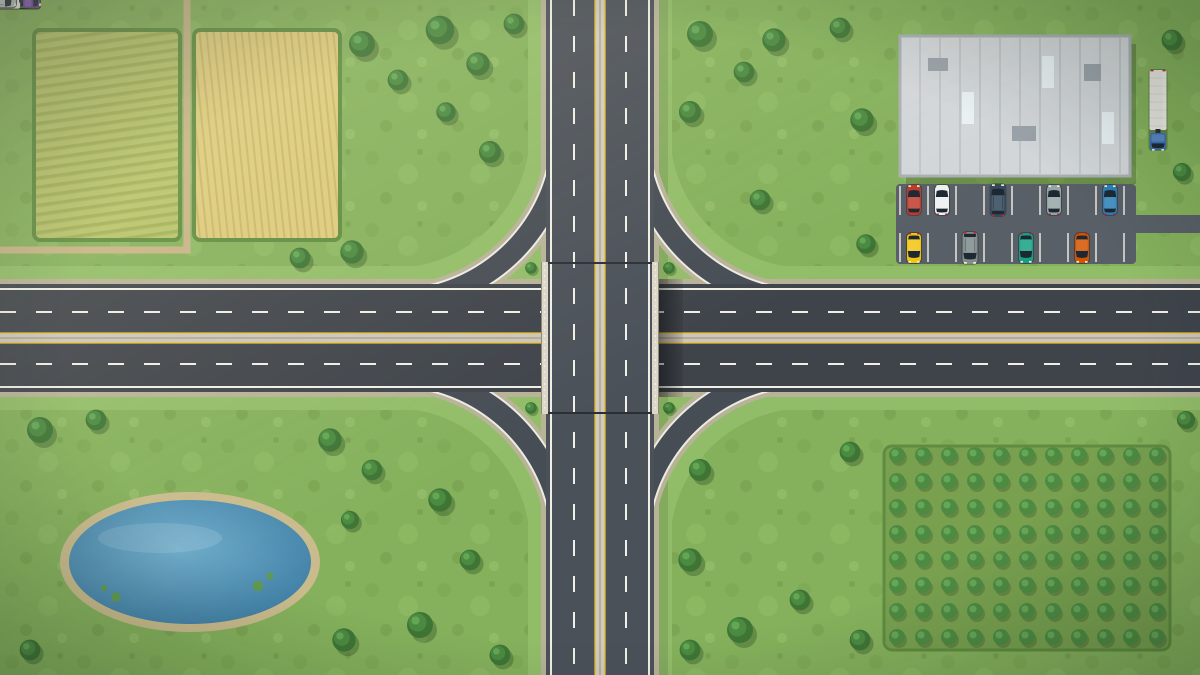
Claude Opus 5.5 planned its traffic down to the merge. In 58 minutes 49 seconds it built four right-turn ramps, one in each quadrant, each leaving from the outer lane of one road and joining the outer lane of the other, with right-hand traffic staying on the correct side after every merge. Every path in the file begins and ends off-screen. The ramp routes are cut to exactly the length of a through lane, so ramp cars keep the lane’s speed, and their start times are staggered so each merge lands in a gap: across all four ramps, no car that takes one comes closer than about 145 pixels, centre to centre, to the traffic on either road it uses. Nobody asked for turn signals, and every ramp car has them, right indicator on the approach to the exit and left indicator as it merges. The bridge has parapets, an expansion joint at each end of the deck and a shadow on the road beneath, and the ramps peel away from the carriageway in smooth curves rather than turning off it. Its fault is a painted line: the ramps are drawn underneath the carriageways, and each carriageway’s solid white edge line runs straight across the point where a ramp leaves or joins it, at all eight ramp ends, so each ramp appears to slide out from under the road.
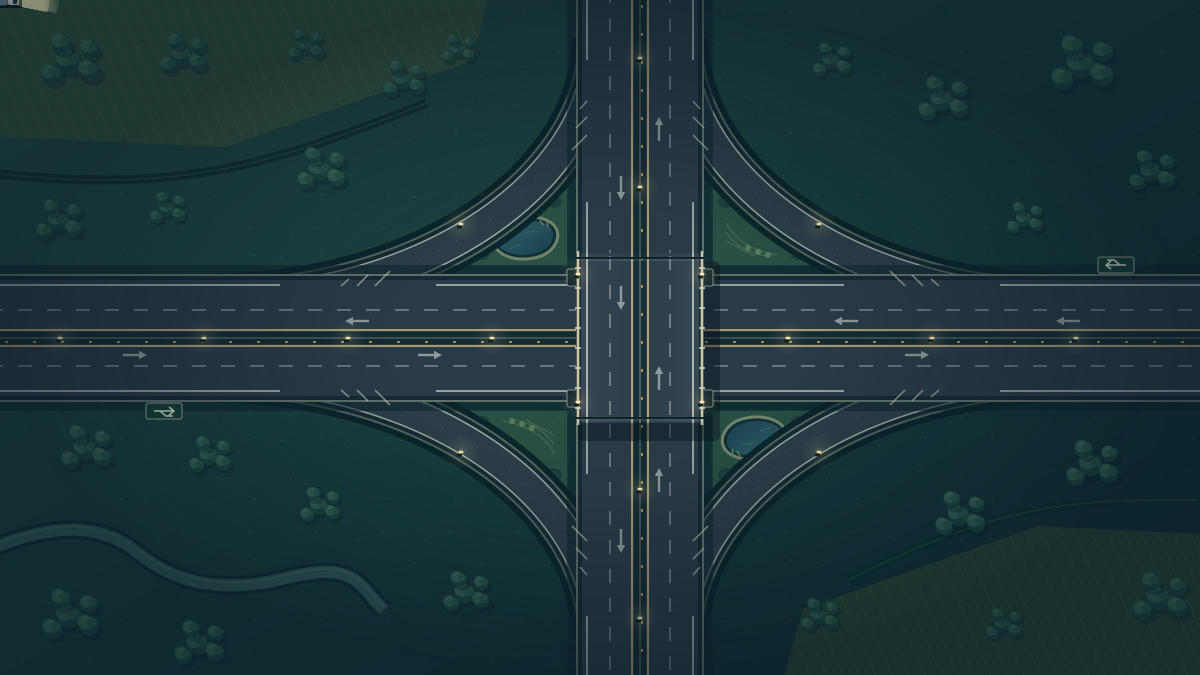
GPT-6 Astra built the busiest interchange this series has seen, in 16 minutes 15 seconds. Forty-eight vehicles, the most of any entry, run along eight routes, four straight through-lanes and four curving ramps. Every one throws a headlight cone onto the road ahead, and direction arrows are painted on the asphalt, which makes the traffic-direction trap checkable by eye. There is street lighting down the median, road signs, two ponds and a river. Its bridge is a real structure, with a shadow beneath the deck, parapets on both sides, bearings at all four corners and lower-road lane markings that stop cleanly at the deck’s edge, and the occlusion works mid-crossing: an articulated truck enters from the west with its cab already hidden under the parapet while its trailer is still in the open. Its road edge is drawn as two lines, and only one of them is wrong: the thicker outer edge stops where each ramp leaves, while the thin white shoulder line inside it runs straight on through the exit. And its ramps join the road in long, elegant curves, never at an angle.
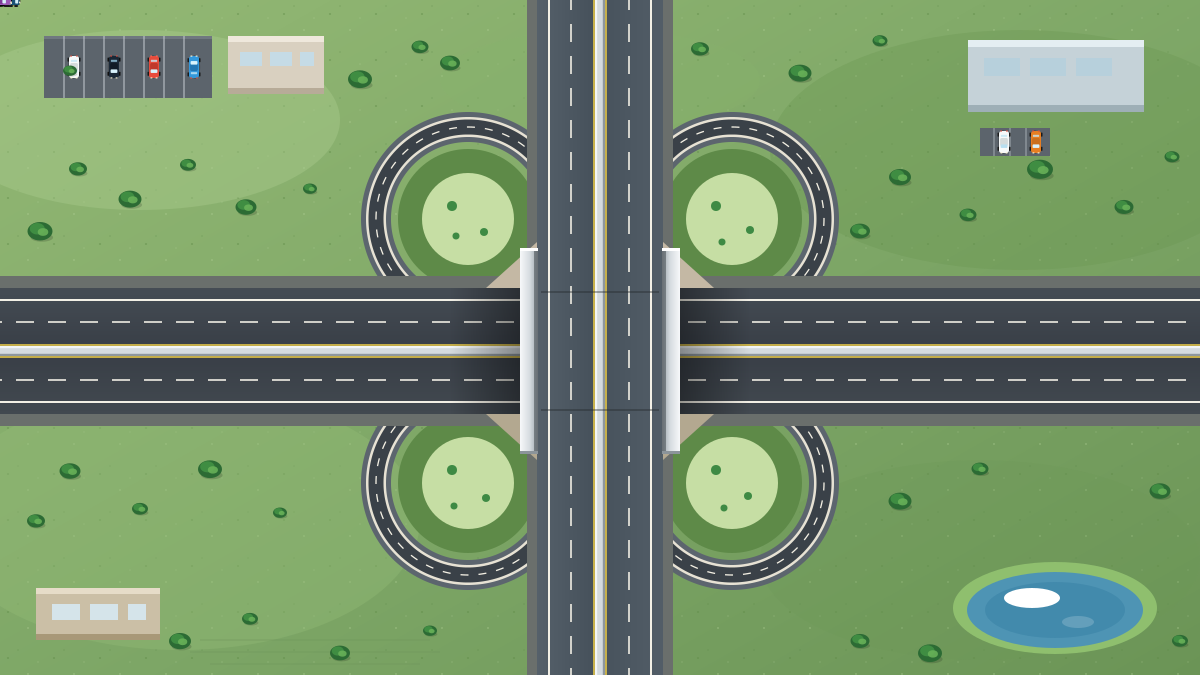
Grok 4.7 was the fastest of the four, at 11 minutes 55 seconds, and built a full cloverleaf of its own: four through movements and four 270-degree loops, thirty vehicles, every ramp leaving from the outer right-hand lane and arriving in the outer right-hand lane of the road it joins. Its bridge carries expansion joints exactly where it spans the road below. It solved the level change the same way Argon did, by drawing every ramp car twice, but with a 72-millisecond crossfade timed to the exact point where each ramp crosses the deck: 60% of the way along the climbing ramps, 47% along the descending ones. It is the most carefully wired mechanism anyone has submitted to this brief. And then the road is painted over it: the carriageway’s edge line is a single unbroken line drawn on top of the ramps, so every exit passes under a line that never parts.
Round 1 goes to GPT-6 Astra, which takes 4 points: the most impressive picture of the four, and ramps that blend into the road where Argon’s turn off it. Opus 5.5 and Argon take 3 each. Opus 5.5’s ramps leave the road as cleanly as Astra’s; Argon built a second set of interchanges, the four inner loops, that Opus 5.5 never attempted, and that evens them out. Grok 4.7 takes 2. None of the four opened the road’s edge cleanly where a ramp leaves it; in this series, only Claude Fable 5.1 has ever got that part right.
Round 2: The fairground
A seaside fairground at dusk, one SVG. A Ferris wheel with at least ten gondolas turning continuously and staying level with the horizon all the way round, a spinning carousel with at least six horses rising and falling out of phase, twinkling bulbs, lights chasing the rim of the wheel, and the whole scene reflected in water. The gondolas are the trap the brief states out loud. The carousel is the one it does not.




Argon’s scene is the fullest of the four. A purple-to-gold sky with stars, a crescent moon and a low sun, a lighthouse on the headland sweeping its beam, a roller coaster in silhouette, a helter-skelter, a ticket booth, a game tent, a popcorn cart and an arcade pavilion along the pier, a couple and a parent with a child holding a bobbing balloon. Its reflection is the cleverest in the round: instead of drawing a second, simpler scene in the water, it re-uses the whole fairground, flipped and squashed to half height, and runs it through a moving ripple filter, so the wheel and the bulbs in the water turn and twinkle with the ones above. Every animation in the file runs on a period that divides evenly into 24 seconds, so the scene loops without a seam.
The wheel clears the stated trap exactly. Twelve gondolas ride a wheel that turns once every 24 seconds, each counter-rotating over the same 24 seconds so the two cancel, with a gentle sway of four and a half degrees on top at alternating periods and staggered starts. The rim, the inner rings and all 72 chasing bulbs sit inside the rotating group, so the whole wheel turns as one, the part Grok 4.7 left standing still.
The carousel is a flat picture of a carousel, made to look busy. It is drawn face-on, and its turning is done by sliding things sideways: the red stripes on the roof, the scalloped valance and the panels round the base all scroll left and loop back every two seconds. On the valance and the base that loop is invisible. On the roof it is not, because the stripes are drawn as a fan from the peak, and the slide carries the peak with it, 48 pixels to the left and back again, so every two seconds the stripes jump. The six horses are fixed in a row. Each one rises and falls 15 pixels on its pole, out of phase with its neighbours as the brief asks, and drifts four or five pixels left and right, but none of them ever travels round the ride, and all six face the same way the whole time.
Claude Opus 5.5’s scene, built in 62 minutes 41 seconds, is a full one too: a purple-to-amber sky, a crescent moon and a low sun on the water, a striped tower, strings of bulbs, booths along the pier, and all of it mirrored in rippling water. Its wheel clears the stated trap the same way: twelve gondolas on a wheel that turns once every 24 seconds, each counter-rotating from its own starting angle, with a four-degree sway on top at twelve different offsets so no two cabins swing together, and the rim and its 36 bulbs turning with the spokes. The carousel is where it pulls away. It is drawn from the side, and Opus 5.5 made it behave like a solid object in perspective: the six horses travel round an ellipse in exactly the proportions of the roof’s rim, each one narrowing as it swings round the side and coming back mirrored, so it always faces the way it is moving. The ones going round the back pass behind the centre column and the ones coming round the front pass in front of it. The roof’s stripes slide round the cone at exactly the horses’ speed, one revolution every twelve seconds, so roof and riders turn together as one machine.
GPT-6 Astra’s is the best-drawn of the four, in 26 minutes 33 seconds: a pastel dusk with a lighthouse and a sailboat, and carousel horses with jewelled saddle blankets, bridles and flowing manes, the finest drawing anyone has submitted to this brief. Its Ferris wheel turns a full circle every 48 seconds while each gondola counter-rotates 360 degrees over the same 48 seconds, with a gentle sway on top. Its carousel turns, and that is where it goes wrong. The six horses circle the column once every 12 seconds, rising and falling on their poles, but none of them ever turns to face the way it is going: every horse points right for the whole revolution, so across the front of the ride they travel tail-first. The canopy above them turns the opposite way.
Grok 4.7’s scene, in 37 minutes 46 seconds, is genuinely attractive: a graded dusk sky, a low sun on the water, string lights between the promenade poles, silhouetted figures, balloons and birds, all mirrored in the water. Its gondolas cancel exactly, twelve of them on a 22-second wheel. But its wheel’s rim was drawn outside the rotating group, so the spokes turn inside a hoop that stands still. Its carousel’s rotation is applied to eight flat wedges of the roof while the cone, the rim and the platform stay put, and its six horses rise and fall in place at the same six positions, to the decimal, through a full turn of the canopy.
Round 2 goes to Opus 5.5, which takes 4 points. Astra 6 takes 3, Argon takes 2 and Grok 4.7 takes 1. Four models have now drawn this carousel for the same page, and only one of them made it go round.
Round 3: The rocket launch
This brief leaves the method open. It names no library, asks for no 3D, and its only instruction on style is to make it look good. It wants a countdown, ignition, liftoff and a sustained ascent, with a mission-control HUD reporting the state of the flight.
HELIOS-IX — Gemini 4 Argon, 6 minutes. From countdown to orbit in about 100 seconds; the timeline along the top jumps to any stage.
HALCYON-3 — Claude Opus 5.5, 76 minutes 33 seconds. The whole flight takes about two minutes and ten seconds to play; stay for orbit.
GPT-6 Astra, 28 minutes.
LYRA-1 — Grok 4.7, 50 minutes 48 seconds. Watch the clock at T+35.
Gemini 4 Argon’s HELIOS-IX flies the whole mission, and fast: it plays from T−10 to orbit in about a hundred seconds. A water deluge floods the pad at T−6, nine engines light at T−3.2 and the umbilical arms swing away at liftoff. It goes supersonic at T+15, throttles down to about three-quarters through maximum aerodynamic pressure at T+24, cuts its first stage at T+50, separates it at T+52 and lights the second stage two seconds later. The spent booster drifts away with its grid fins opening, the fairing splits in two at T+64 and exposes a gold-foiled satellite, and the second stage shuts down at T+90 at 27,600 km/h. That is a real launch sequence, staged the way a real one is, and an automatic director cuts between four camera angles to follow it, from a wide shot of the pad to a close-up of the flame trench at ignition to a tracking shot through the ascent. The HUD around it is the busiest in the round: two dials, an engine-cluster diagram whose nine nozzles light and go dark, propellant gauges for both stages, an altitude-against-downrange plot drawn as it flies and an event log, with sound you can switch on.
The picture inside all that is plain. The pad is a few dark shapes and a lattice tower, the sky a flat gradient, the rocket a small white cylinder, and the clouds and the curve of the Earth are soft blurs. Next to the scenes Opus 5.5 and Astra drew for this brief, there is very little to look at.
Underneath, though, the flight is scripted rather than simulated: altitude, speed and pitch are curves drawn as a function of the clock, picked to pass through the right milestones. It shows in the numbers. The HUD promises an apogee of 412 km while the vehicle tops out at 218, still climbing for ten seconds after its engine has shut down, and the perigee readout starts at minus 6,371 km, the radius of the Earth, and climbs from there.
Claude Opus 5.5 flies the entire mission too, in 76 minutes 33 seconds. A terminal count with a go/no-go poll of every station, ignition at T−3, liftoff, the pitch program, a throttle-down through peak aerodynamic pressure, main-engine cutoff at T+2:00, stage separation three seconds later, second-stage ignition at T+2:10, the spent booster’s flip, fairing separation, the Kármán line, and at T+7:53 the second stage shuts down and the HUD reports a 203 by 207 km orbit. Mission time runs faster than real time through the long burn and slows back down for every event, so the whole thing plays in about two minutes. The ending is real: when the engine cuts off, the velocity holds at 28,024 km/h at 205 km, within a few km/h of what a circular orbit at that height requires. And it is shot like a film, launching in twilight, cutting between angles, pushing in on the engines at ignition and pulling back as the vehicle climbs. Sampled at twenty moments from the countdown to orbit, the vehicle is on screen every time.
GPT-6 Astra built a polished product and the shortest flight, in 28 minutes: a three-core vehicle rendered with real care, enormous editorial typography, the curvature of the Earth below, a flight-sequence timeline, a zoom control and a playback-speed multiplier nobody asked for. Its ascent physics are modelled rather than decorative: 38.5 km at 1,003 metres per second by T+1:39 tracks a real ascent closely, and its g-load climbs from 2.13 to 3.29 as the propellant burns away. And then it stops. Its sequence reads countdown, ignition, liftoff, max-Q, ascent, with no main-engine cutoff, no stage separation, no second stage and no orbit; the throttle stays at 100% until the animation runs out.
Grok 4.7’s LYRA-1, built in 50 minutes 48 seconds, has a flight profile as complete as any here: a pitch program, Mach 1, booster cutoff and stage separation at T+41, second-stage ignition, and a spent booster simulated as a separate body that tumbles away on its own. None of which you will see. Its camera follows the rocket vertically with a limit on how far it may fall behind, and horizontally with no limit at all, so as the vehicle builds downrange speed it drifts towards the right-hand edge and is gone by T+35. The separation happens outside the frame, and the upper stage is never seen. The flight also never ends: the throttle stays pinned at 100% and the orbital insertion the header announces never happens.
Round 3 goes to Opus 5.5, which takes 5 points. Argon takes 3, for a launch that stages like a real one and is filmed from several angles, held back by how little it draws. Astra 6 takes 2 and Grok 4.7 takes 1. Argon, too, drew everything by hand on a 2D canvas; the 3D library the brief allows went unused again.
The clock
| Build | Gemini 4 Argon | Opus 5.5 | GPT-6 Astra | Grok 4.7 |
|---|---|---|---|---|
| Interchange | 24m | 58m 49s | 16m 15s | 11m 55s |
| Fairground | 8m | 62m 41s | 26m 33s | 37m 46s |
| Rocket launch | 6m | 76m 33s | 28m 00s | 50m 48s |
On the interchange Argon took longer than Astra and Grok 4.7, though less than half Opus 5.5’s time. On the last two briefs it was faster than all three by a wide margin: eight minutes for the fairground against Astra’s 27, six for the launch against Astra’s 28. Opus 5.5 was the slowest on all three and the winner on two.
The setups were not identical, and the difference is worth stating plainly. Opus 5.5 ran as a Claude Code agent at maximum effort, Astra in OpenAI’s Codex at its highest setting at the time, and Grok 4.7 in xAI’s Grok Build at xhigh, the top of its dial. Each of those wrote its file to disk. Argon ran in the Gemini app at its highest thinking setting and replied with the code in a single message, which we saved as it came. All four got the same brief word for word, and the same instructions around it: no browser, no preview, no running the code, no questions. Argon’s only change was the last line, which asked for the file in its reply instead of at a path on disk.
The verdict: Opus 5.5 wins with 12 points, Astra 6 takes 9, Argon takes 8, Grok 4.7 takes 4
| Interchange | Fairground | Launch | Total | |
|---|---|---|---|---|
| Claude Opus 5.5 | 3 | 4 | 5 | 12 |
| GPT-6 Astra | 4 | 3 | 2 | 9 |
| Gemini 4 Argon | 3 | 2 | 3 | 8 |
| Grok 4.7 | 2 | 1 | 1 | 4 |
Each round is scored out of five on the finished artefact alone. Opus 5.5, Astra and Grok 4.7 are the same builds they handed in on these briefs in September, scored again alongside Argon’s. The builds were scored at BitsMinds from a local side-by-side page of the untouched outputs, with no blind scoring and no automated grading.
Sliding, not turning
Set Argon’s three builds side by side and the same habit shows in each. When a thing has to turn, Argon makes it look as if it turns. The carousel roof is stripes sliding across a flat triangle; the horses bob on the spot; the rocket’s altitude and speed are curves chosen to pass through the right numbers at the right moments. It is the oldest trick in 2D animation, and in a still frame it is indistinguishable from the real thing. In motion it gives itself away, in a roof that jumps every two seconds and a ride that never goes anywhere.
The interchange is the exception, and the most telling of the three. There Argon did the hard version: a full cloverleaf with a second set of loops, and cars drawn twice and swapped between levels at a point chosen so the swap can never be seen. It spent 24 minutes on that brief and six on the rocket. Whatever it decides to think about, it thinks about properly. On the fairground and the launch, eight and six minutes were enough to produce something that looks finished, and not enough to make it work like the thing it is drawing.
More on Gemini
Evergreen coverage we keep current — start here.
Want AI news before everyone else?
The morning's most important AI stories, straight to your inbox. No fluff.