GPT-6 Astra vs Claude Fable 5.1: There Can Be Only One
OpenAI’s GPT-6 Astra and Anthropic’s Claude Fable 5.1 got the same three build briefs — a motorway interchange, a seaside fairground and a cinematic rocket launch — one attempt each, at maximum reasoning effort, and neither could open a browser to check its own work. All six builds run live inside the article, faults and all: a bridge that hides a truck mid-crossing, a carousel that is not doing what it looks like it is doing, and two rockets with very different ideas of what a launch is. Score it yourself.
BitsMinds LabHow this test was run2 models · 3 briefs · one attempt per model per brief · Maximum reasoning effort for both modelsShow details
- Models
- Claude Fable 5.1 (Claude Code) · GPT-6 Astra (OpenAI Codex)
- Attempts
- One attempt per model per brief. No retries, no follow-up notes, no cleanup.
- Reasoning effort
- Maximum reasoning effort for both models.
- Tools allowed
- Each model ran inside its own maker's agentic coding environment — Fable 5.1 in Claude Code, Astra in Codex — with the same ban on opening a browser.
- Timing
- Wall-clock time from prompt to finished file, measured for every round (Astra was faster on all three).
- Scoring
- 4 points for a round win, scored on the finished artefact. Final: Fable 5.1 wins with 10 points, Astra takes 9.
- Judging
- Scored by BitsMinds from a local side-by-side comparison page of the untouched outputs. No blind scoring, no automated grading.
- Published
- September 6, 2026
Result
| Model | Provider | Score |
|---|---|---|
| Claude Fable 5.1 | Anthropic | 10 pts |
| GPT-6 Astra | OpenAI | 9 pts |
10–9 to Fable 5.1 on the artefact. Weight the same rounds for cost and speed and it inverts to 10–9 Astra.
The briefs — as described in the article; the exact prompt files were not published
Round 1: Motorway interchange (SVG)
A top-down view of a busy interchange as one self-contained SVG. Two roads crossing on different levels, connecting ramps, at least twelve vehicles following the curve of the road they are on, and correct layering so traffic on the lower road is hidden by the overpass.
Result: Astra wins it 4–2: faster, denser and more inventive, with one small fault.
Round 2: Seaside fairground (SVG)
A seaside fairground at dusk, one SVG. A Ferris wheel with at least ten gondolas turning continuously, a spinning carousel with at least six horses rising and falling out of phase, twinkling bulbs, a reflection in the water. Each gondola must stay level with the horizon throughout the rotation.
Result: Fable 5.1 wins it 4–3: Astra's carousel horses never turn to face the way they travel, under a canopy that turns the other way.
Round 3: Rocket launch (web page)
A self-contained web page that animates a rocket launching — countdown, ignition, liftoff and ascent — with a mission-control HUD. No library named, no 3D requested, one aesthetic instruction: make it look good.
Result: Fable 5.1 wins it 4–2: the less striking image and the more complete flight.
Read with care
- Single run per model — a re-run could land differently.
- Scored on the finished artefact only; the article itself notes that weighting cost and speed reverses the result.
- Different harnesses (Claude Code vs Codex) mean the environment, not just the model, was under test.
Part of BitsMinds Lab, our series of original hands-on tests.
Since June this series has handed the same build briefs to frontier models and published whatever came back, untouched, and until now every entrant has been a Claude model. This time we ran the same tasks against OpenAI's GPT-6 Astra, released on 3 September, and put it directly against the winner of our four-model Claude run, Anthropic's Claude Fable 5.1.
Three briefs: a top-down motorway interchange and a seaside fairground, both as single animated SVG files, and a cinematic rocket launch as one web page. One attempt each, maximum reasoning effort, and neither model was allowed to open a browser to check its own work. All six builds run live below.
Astra was faster on all three rounds, by a wide margin every time. It lost 10–9.
Both models worked inside their own maker’s agentic coding environment — Fable 5.1 in Claude Code, Astra in Codex — from the same prompt, with one attempt and the same ban on opening a browser.
Round 1: The interchange
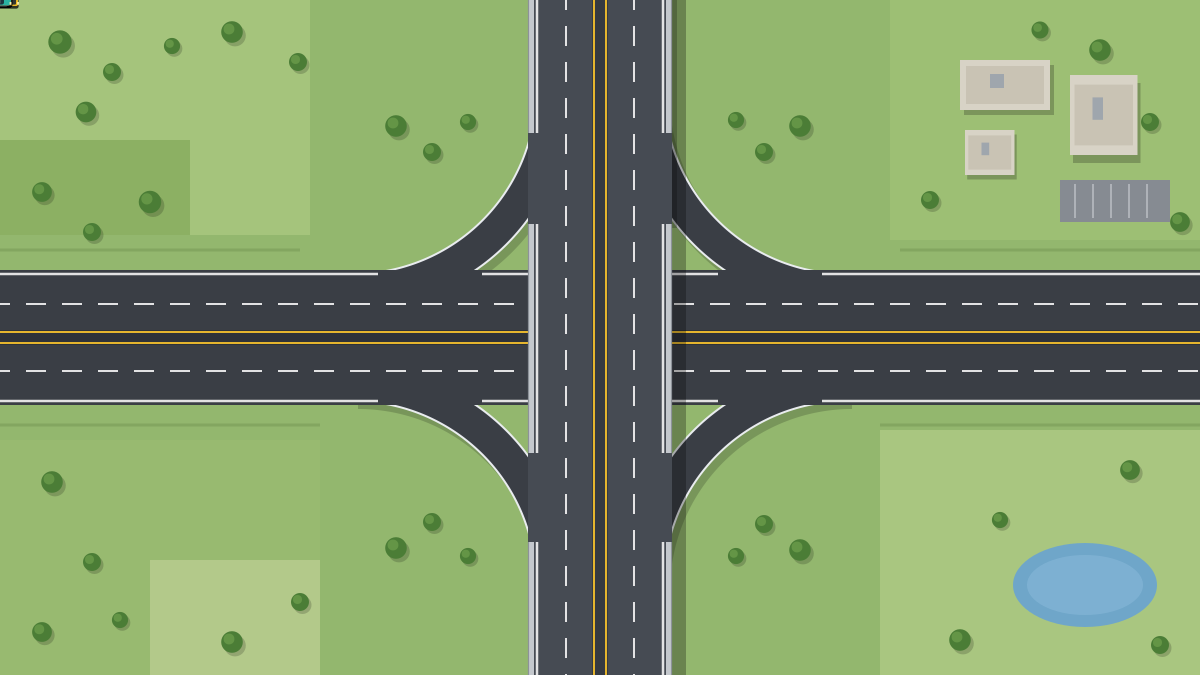
The brief: a top-down view of a busy interchange as one self-contained SVG. Two roads crossing on different levels, connecting ramps, at least twelve vehicles following the curve of the road they are on, and correct layering so traffic on the lower road is hidden by the overpass. It is a brief with two traps that go unstated — whether the ramps genuinely connect the two roads, and whether traffic flows the right way after merging. Both have caught models before.
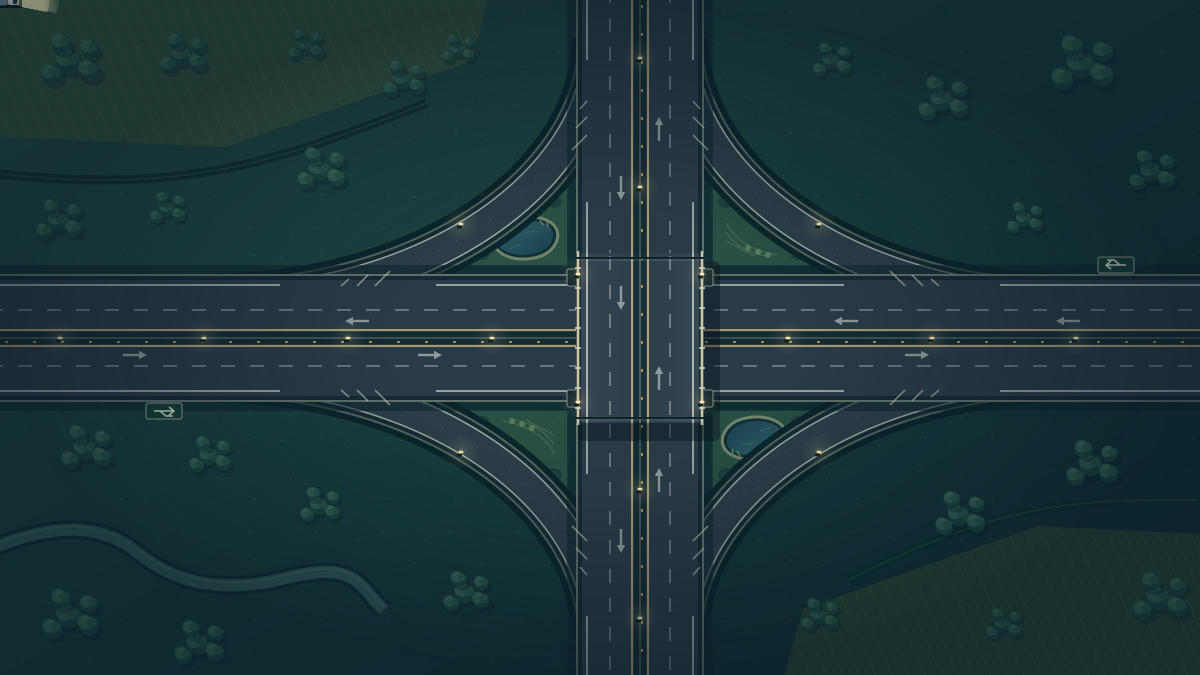
Astra clears both hidden traps. Its bridge is real — a deck with a shadow beneath it, parapets, bearings at all four corners, and lane markings that stop cleanly at the deck edge. We caught an articulated truck entering from the west with its cab already hidden behind the parapet while its trailer was still in the open, which is the occlusion working exactly as it should, mid-crossing. And every one of its vehicle paths begins off-screen, so ramp traffic genuinely arrives from the mainline rather than appearing out of nothing.
It also does things nobody asked for. Every vehicle throws a headlight cone. Direction arrows are painted onto the road surface, which has the pleasing side effect of making the traffic-direction trap visually checkable. There is street lighting along the median, road signage, an articulated lorry and a bus among the traffic.
Its one fault is small and specific: the white shoulder line runs straight through the exit, so the ramp is never visually separated from the road it leaves. That is precisely the mistake Claude Opus 5 made in the four-model Claude run — the same error, from a different lab. Fable 5.1 is the only model that has ever got this detail right.
Round 1 goes to Astra, which wins it 4–2. Faster, denser and more inventive, and its one flaw was too small to hand the round to a plainer entry with none.
Round 2: The fairground
A seaside fairground at dusk, one SVG. A Ferris wheel with at least ten gondolas turning continuously, a spinning carousel with at least six horses rising and falling out of phase, twinkling bulbs, a reflection in the water. The stated trap is the gondolas: each must stay level with the horizon throughout the rotation, which requires a second animation running backwards against the wheel.


Both models clear the gondola trap cleanly. Astra's wheel turns a full circle every 48 seconds and each of its gondolas counter-rotates the same 360 degrees over the same 48 seconds, cancelling it exactly, with a gentle sway layered on top. Watch it for a while and every cabin stays dead level.
Then look at the carousel. Astra's turns, and that is where it goes wrong. The six horses circle the column once every 12 seconds, rising and falling on their poles, but none of them ever turns to face the way it is going: every horse points right for the whole revolution, so across the front of the ride they travel tail-first. The canopy above them turns the opposite way, its stripes sweeping left to right across the front while the horses beneath them move right to left.
That is the thing you notice before you can name it: the horses face the way the roof is turning and travel the other way. The brief asked for a carousel that turns as one machine. It got two halves going in opposite directions.
Round 2 goes to Fable 5.1, which wins it 4–3. Not a cosmetic slip — a missing mechanism.
Round 3: The rocket launch
This is the only brief in the series that does not say how to build. It names no library, does not ask for 3D, and offers exactly one aesthetic instruction: make it look good. When we first ran it in June, both models reached for Three.js and WebGL from a CDN without being told to.
Both launches below start on a countdown and play through on their own.
Astra 6 — 28 minutes
Fable 5.1 — 49 minutes
Neither used a library. Both hand-built the whole thing on a 2D canvas. Counting the four-model Claude run, that is now four models from two different labs, all given explicit permission to pull a 3D engine off a CDN, all declining. In June, on the identical brief, it was two out of two reaching for one. Something has shifted in what these models consider the obvious tool, and it has shifted in the same direction at both companies.
Astra builds the better-looking product. A three-core vehicle rendered with real care, enormous editorial typography, the curvature of the Earth below, a flight-sequence timeline, a zoom control and a playback-speed multiplier that nobody requested. Its physics are sound where they exist: 38.5 km at 1,003 metres per second by T+1:39 tracks a real ascent closely, and the g-load climbing from 2.13 to 3.29 as propellant burns away is correct behaviour rather than a decorative number.
And then it is over. Astra's flight sequence reads countdown, ignition, liftoff, max-Q, ascent — and stops. There is no main-engine cutoff, no stage separation, no second-stage burn, no orbital insertion. Throttle stays pinned at 100% and the vehicle simply keeps climbing until the animation runs out. It is a first act with no second one.
Fable 5.1's is the less striking image and the more complete flight. It carries the staging its rival lacks, and it computes the speed of sound from altitude rather than dividing by a fixed 340 m/s — at 4.54 km it reports Mach 0.73 where the standard atmosphere gives 0.729. It has a real fault of its own: its burn never cuts off either, and the camera judders late in the ascent. But it flies a mission rather than a minute.
Round 3 goes to Fable 5.1, which wins it 4–2.
The clock
| Build | Astra 6 | Fable 5.1 |
|---|---|---|
| Interchange | 16m 15s | 25m 55s |
| Fairground | 26m 33s | 35m 16s |
| Rocket launch | 28m 00s | 49m 07s |
Astra was quicker on every round, and not narrowly — it finished the launch in 57% of the time Fable 5.1 took, and the interchange in 63%, while producing more than twice the traffic on it.
The verdict: 10–9
| Interchange | Fairground | Launch | Total | |
|---|---|---|---|---|
| Fable 5.1 | 2 | 4 | 4 | 10 |
| Astra 6 | 4 | 3 | 2 | 9 |
The pattern held on all three rounds. Astra was faster every time. It was richer on surface detail every time — headlight cones, painted road arrows, jewelled saddle blankets, a zoom control. And all three of its faults were mechanisms rather than decoration: a shoulder line that never separates the ramp, a carousel whose roof and horses turn opposite ways, a launch with no second act.
Set that against how Fable 5.1 lost the round it lost. It was beaten on the interchange for being slower and less spectacular, not for anything being wrong — its interchange remains the only one anyone has built for this series without a visible fault.
Fable 5.1 lost on spectacle. Astra lost on things not working.
None of that makes Astra the weaker model. It cleared both of the interchange's hidden traps, its ascent physics are genuinely modelled, and it produced the most detailed single frame anyone has submitted since this series began in June. Its failures are not failures of capability. They are failures of finishing — a ride that was drawn but never wired to turn, a flight with a timeline and no second stage. Every one of them is the kind of thing a model catches in about four seconds by opening what it just built, which is exactly what neither model was allowed to do.
That constraint is the point of this test, and it keeps producing the same lesson from a new angle. In June it was that whoever checks their own work wins. In August it was that the frontier model treats a correct answer as the middle of the job. Then, across five rounds and four models, the result came down to a single point and a variable declared fourteen lines too late. Now, running the same briefs across two labs for the first time, the fastest model in the test lost by shipping three things that look finished and are not.
One caveat on the scoreline. We scored the finished artefact and nothing else — not what it cost to run, not how long it took. That is a defensible way to judge a build, and it is also the way that flatters the slower model. Weight these same three rounds for cost and speed and the result inverts exactly: 10–9 to Astra. A team shipping to a deadline and paying by the token would be right to read this article backwards.
Every file above is the untouched output of a single run. Scroll back up, watch a carousel whose roof and horses turn opposite ways, and see whether you score it the way we did.
More on Claude
Evergreen coverage we keep current — start here.
Want AI news before everyone else?
The morning's most important AI stories, straight to your inbox. No fluff.