Nemotron 3.5: Nvidia’s Open Agent Models Reach the Laptop
Nemotron 3.5 brings Nvidia two new open-weight agent models: Super VL, a 120B vision-language model for enterprise agents, and Bolt, a 74B model compressed to 2 bits so it fits in 24 GB and runs on an RTX PC. Nvidia’s own tables show Bolt ahead of Qwen and Gemma models of a similar size, while Super VL trades blows with its much larger predecessor.
Nvidia has added two tiers to its Nemotron family of open models, and both are built for AI agents rather than chat. Announced on 15 October, Nemotron 3.5 Super VL is a 120-billion-parameter vision-language model aimed at companies that want to run agents on their own servers, and Nemotron 3.5 Bolt is a 74-billion-parameter model squeezed into 24 GB so it can run the same kind of work on a PC. A third, smaller model, Bolt E4B, is due on 23 October. The weights, training recipes and much of the data are public, under the OpenMDW 1.1 license, which lets anyone use, modify and redistribute the models as long as they keep its notices.
Super VL is a mixture-of-experts model that activates 12 billion of its parameters for each token. Like Nemotron 3, it mixes Mamba-2 layers with attention, and it adds a vision encoder that reads images, video, web pages and PDFs, with Nvidia singling out charts, tables and OCR. According to its model card, it handles up to a million tokens of context, has a reasoning mode that can be switched off or set to a medium budget, and runs on four H100s or two GB200s at full precision. A compressed NVFP4 build is the one Nvidia recommends for deployment. The company calls it “the fastest open agentic model in its class”, up to five times quicker than the next best on throughput, which is a claim about speed rather than accuracy.
On accuracy, Nvidia’s own table is mixed. Super VL beats the far larger Nemotron 3 Ultra on science questions and web browsing and trails it on SWE-bench Verified and instruction following. Against the strongest open models in the same table it often loses outright: on Terminal-Bench 2.1 it scores 60.67, while DeepSeek’s V4 Flash scores 76.8 and Alibaba’s Qwen3.8 Flash Next reaches 85.8.
Post-training is the pitch
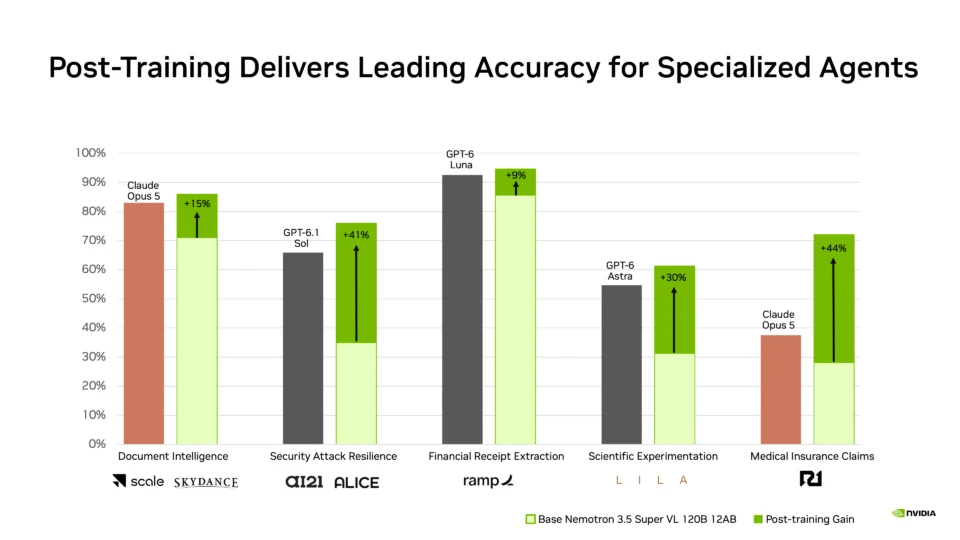
Nvidia’s argument is that a company can close those gaps on its own tasks. Its blog lists partners that post-trained Super VL for specific jobs, from Scale AI building due-diligence agents for EY to AI21 and Alice training for cyber-attack resilience and R1 analysing medical insurance claims. Nvidia says each tuned model beat a closed frontier model on its task. Those figures are Nvidia’s own, and they set models trained for one job against general-purpose ones. TechCrunch lists Skydance, EY, Ramp, CrowdStrike, Perplexity and Salesforce among Super VL’s users. Kari Briski, Nvidia’s vice president for open models, wrote that companies can “post-train Super VL on their own data, deploy it on their own infrastructure” and own what they build.
Bolt: 74 billion parameters in 24 GB
Bolt is the more unusual of the two. Nvidia derived it from Super VL with an architecture search that targets a memory budget, then stored its experts at about two bits per weight, so the packed model weighs 24 GB and fits on a single 24 GB GeForce card, a DGX Spark or one of the new RTX Spark laptops. It keeps 9 billion active parameters, a 256,000-token context and image input, and it is already packaged for Ollama and LM Studio. Its model card compares it with open models that need a similar amount of memory at full precision, and it leads them on most rows, by the widest margin on web browsing. Two-bit compression usually costs accuracy, so Bolt is measured at the precision it ships in.
The release fills a slot the market had left to others: Google’s Gemma 4 and Alibaba’s small Qwen models have owned the consumer-GPU tier, while the large open releases, Meta’s Muse Spark Open among them, need servers or a terabyte of Mac memory. Nvidia has a commercial reason to want that tier: TechCrunch points out that the labs it supplies are buying more chips from Amazon, Cerebras and their own design teams. An open model tuned to run best on Nvidia hardware, from a Nemotron line that has already shown it can compete, gives developers one more reason to stay on that hardware, wherever the agents end up running.
Want AI news before everyone else?
The morning's most important AI stories, straight to your inbox. No fluff.