Claude Opus 5.6? vs Opus 5.5 vs Fable 5.2
Reports say Anthropic is quietly serving an unannounced model to some people who pick Claude Opus 5.5. We gave Opus 5.5 two build briefs it had answered in September, word for word, and what came back thinks longer, builds bigger and looks more like Fable 5.2’s work than its own.
Since October, people using Claude Opus 5.5 have been posting work that looks too good for it. TestingCatalog collected the reports on 12 October: some Opus 5.5 traffic, they suggest, is being routed to an unannounced checkpoint that could ship as Opus 5.6, or as the Fable 5.5 that leaked in early October. Anthropic has not confirmed any of it, and there is no Opus 5.6 in its model list.
We had a way to check. On 22 September, Opus 5.5 answered three build briefs for our build-off series, and we kept the exact prompts. On 24 November we gave it two of them again, word for word: a motorway interchange seen from above and a seaside fairground at dusk, each as a single animated SVG file. The setup was the same as in September: Claude Code, Opus 5.5 at maximum effort, one attempt, no browser and no way to run code to see the result. Every response in both runs came back labelled claude-opus-5-5.
What came back does not look like the Opus 5.5 we tested in September. To our eyes, the two November builds are better than both the September ones and those of Claude Fable 5.2, Anthropic’s top model, which answered the same briefs on 9 November. The interchange has far more elaborate exits than Opus 5.5’s, but it trips in exactly the place Opus 5.5 tripped. The fairground is very close to Fable 5.2’s, with slightly better graphics, and Fable 5.2’s was already ahead of Opus 5.5’s. We think the November builds came from a different model. We cannot prove it, and the reasons are further down.
The interchange
The brief: a busy interchange seen from above, as one self-contained SVG with no text and no script. Two roads cross on different levels, ramps connect them, at least twelve vehicles follow the curves of the roads they drive on in both directions, and the layering hides the lower road’s traffic under the overpass. Two traps go unstated: whether each ramp really joins the roads at both ends, and whether traffic keeps to the right side after it merges.
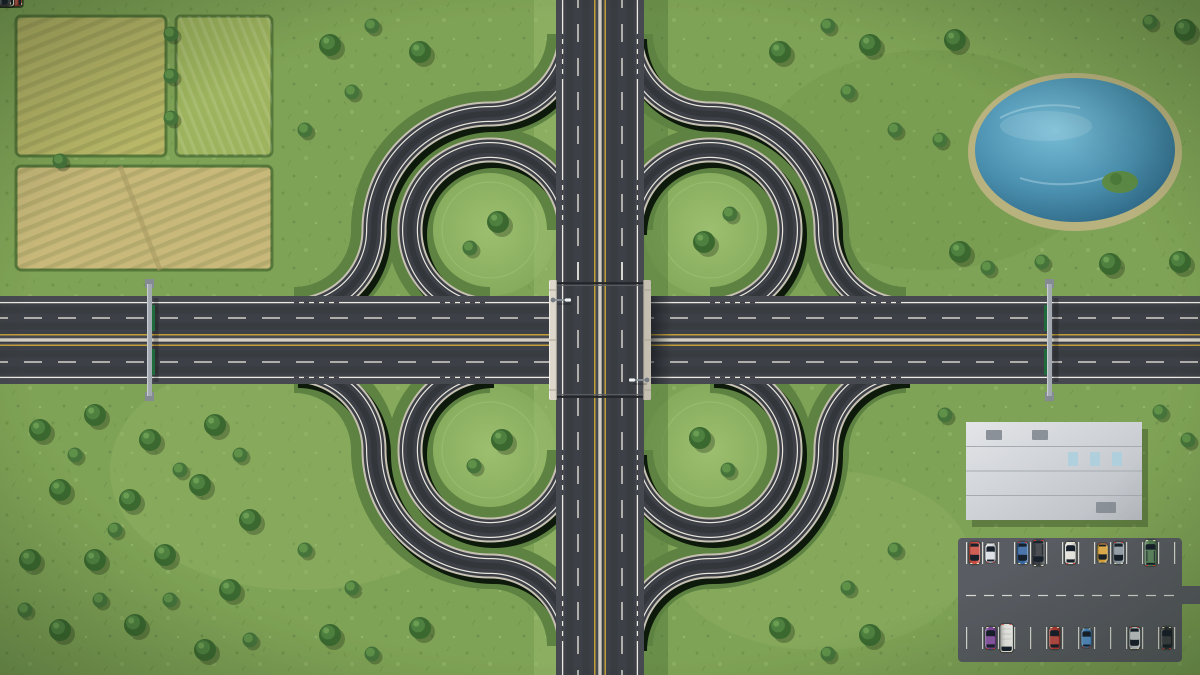
The November build is a full cloverleaf in daylight: two four-lane roads crossing at a bridge, four outer ramps for the right turns and four 270-degree loops for the left. That is the layout Fable 5.2 built and Opus 5.5 did not attempt in September. Twenty-eight vehicles drive on it, hatchbacks, SUVs, vans, three lorries and a bus among them, past farmland, a pond, a stretch of woods and a warehouse with fourteen cars in its car park. Sign gantries span the lower road, lamps stand at the corners of the bridge, and the inside of each loop is laid to lawn and trees.
Its traffic plan follows Fable 5.2’s almost point for point. Through traffic keeps to the inner lane of each carriageway, and the outer lane is left to cars using a ramp. Every ramp and loop route is padded off-screen to exactly the same length, so all ramp traffic moves at one speed and nothing ever closes on the car in front; the whole scene repeats every 18 seconds, and every vehicle enters and leaves outside the frame. A car taking a loop is drawn twice, once under the bridge deck and once over it, and the two copies swap partway round the loop, out on open ground where the change cannot be seen, the same method Fable 5.2 used. Every ramp delivers its traffic to the right side of the road it joins. Measured across two full cycles, no two vehicles in the same lane come closer than 100 pixels, bumper to bumper, and none ever overlap.
It even has the detail Fable 5.2 was praised for: the solid white edge line breaks into dashes at all sixteen ramp openings. That is also where it fails, in the same way Opus 5.5 did in September. The dashes are painted onto a grey shoulder band that runs straight on across every ramp mouth, and the edge of the road is drawn over the ends of the ramps, so each ramp still seems to slide in under the road instead of joining it.
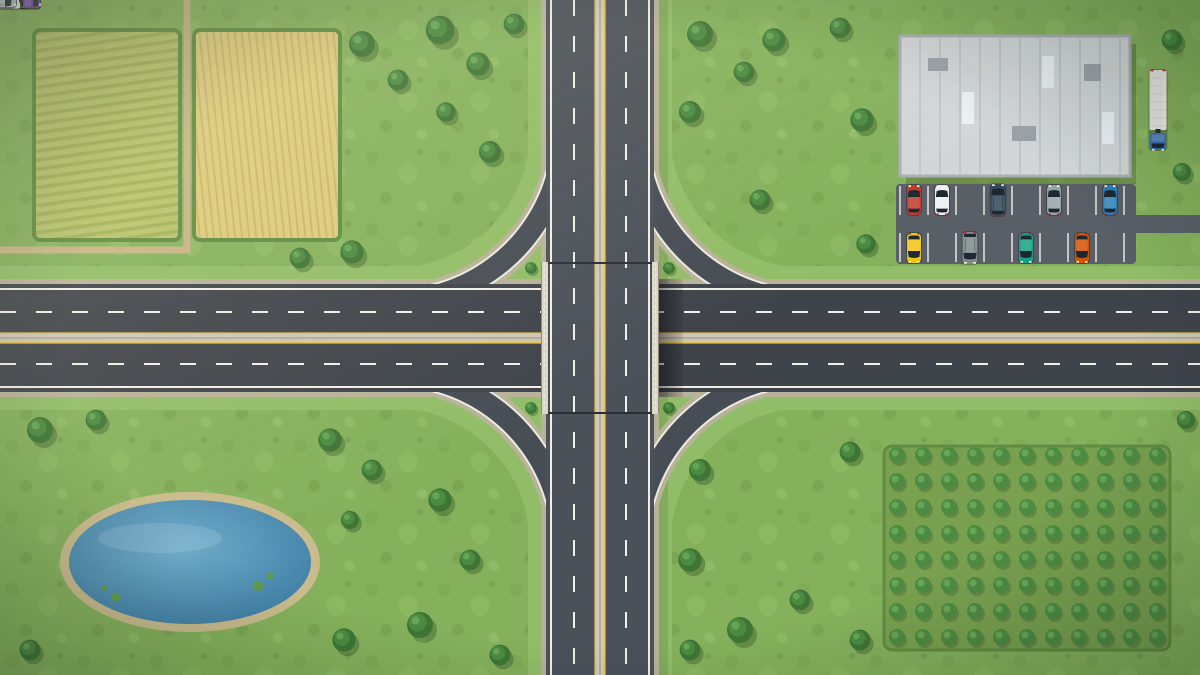
Claude Opus 5.5’s September interchange planned its traffic down to the merge. In 58 minutes 49 seconds it built four right-turn ramps, one in each quadrant, with start times staggered so every merge lands in a gap and a turn signal on every car that takes a ramp. Its bridge has parapets, expansion joints and a shadow on the road beneath. It built no loops, so its interchange offers right turns only, and its solid edge line runs straight across all eight ramp ends.
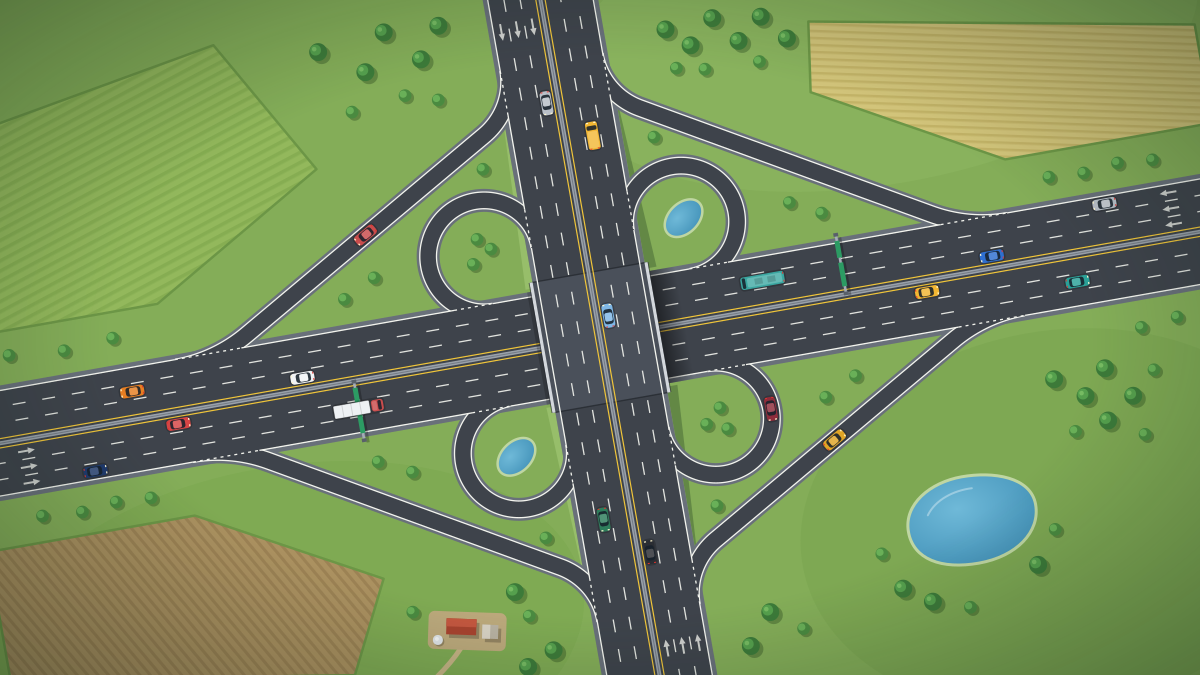
Claude Fable 5.2’s, built in 47 minutes 17 seconds, is a full cloverleaf on two six-lane highways, turned ten degrees off the grid, with fifty vehicles, lane arrows on every approach and sign gantries over the lower road. Its edge line opens properly at all sixteen ramp mouths, and the ramps meet the carriageways in long curves. We could not find a fault in it.
The fairground
A seaside fairground at dusk, one SVG. A Ferris wheel with at least ten gondolas turning continuously and staying level with the horizon all the way round, a spinning carousel with at least six horses rising and falling out of phase, twinkling bulbs, lights chasing the rim of the wheel, and the whole scene reflected in water. The gondolas are the trap the brief states out loud. The carousel is the one it does not.



The November fairground is Fable 5.2’s design, drawn a little better. The sky runs from deep navy through violet and pink to a low sun on the horizon, with stars, drifting cloud, a glitter of light on the sea, a headland pricked with lights and a sailboat riding the swell offshore. Along the boardwalk stand a candy-floss stall, three lamp posts and garlands of red, yellow, green and blue bulbs, each colour twinkling out of step with the others.
The wheel clears the stated trap. Twelve gondolas ride a wheel that turns once every 40 seconds, each counter-rotating to stay level, with a sway of up to five degrees at a period of its own so no two swing together. The rim, the rings and the spokes turn as one, and two rings of lamps chase round it.
The carousel works the way Fable 5.2’s does. Eight horses travel round the ride, each narrowing to nothing at the sides and coming back mirrored, so it always faces the way it is going, and each rises and falls on its own cycle. On the far side they pass behind the mirrored centre column, dimmed for depth, and on the near side in front of it. Above them the canopy’s red gores sweep round at the horses’ pace and in their direction, the bulbs along its rim travel with them, and a pennant flies from the top. The reflection is a live copy of the whole fairground pushed through a moving ripple, so the wheel, the horses and the bulbs all move in the water.
Claude Opus 5.5’s September fairground, built in 62 minutes 41 seconds, set the standard for this brief. Its wheel carries twelve gondolas on a 24-second turn, each counter-rotating with a four-degree sway, and its rim and bulbs turn with the spokes. Its carousel behaves like a solid object in perspective: six horses travel round an ellipse, passing behind and in front of the centre column, while the roof’s stripes slide round the cone at exactly their speed.
Claude Fable 5.2’s, built in 41 minutes 45 seconds, took that design further: twelve gondolas on a 36-second turn, eight horses facing the way they travel under a canopy that turns with them, and the whole fairground mirrored live in the water. It was ahead of Opus 5.5’s when we compared them in November. The new build is very close to it, with slightly better graphics.
Half as much thinking again
| Opus 5.5, 24 Nov | Opus 5.5, 22 Sept | Fable 5.2, 9 Nov | |
|---|---|---|---|
| Interchange: time | 55m 56s | 58m 49s | 47m 17s |
| Interchange: output tokens | 358,696 | 236,945 | 270,715 |
| Interchange: of which reasoning | 341,397 | 223,193 | 252,789 |
| Interchange: file size | 29.6 KB | 23.1 KB | 29.5 KB |
| Fairground: time | 62m 21s | 62m 41s | 41m 45s |
| Fairground: output tokens | 389,203 | 263,984 | 232,458 |
| Fairground: of which reasoning | 360,630 | 241,190 | 201,372 |
| Fairground: file size | 49.2 KB | 39.7 KB | 51.3 KB |
| Responses stopped at the 128,000-token limit | 2 per brief | 1 per brief | 1 per brief |
Under the same name, the November run reasoned about half as much again as the September one: 341,000 and 361,000 tokens against 223,000 and 241,000, more than Fable 5.2 spent on either brief. On both briefs its reasoning ran into Claude Code’s 128,000-token ceiling on two responses in a row, where the September run reached it once, and it wrote files about a quarter larger, almost exactly the size of Fable 5.2’s. It took about as long as it had in September: just under an hour for the interchange and just over an hour for the fairground.
What we can and cannot tell
Every response in both Opus runs names claude-opus-5-5 as its model, ran at standard speed and fell back to nothing else. That label is the name the service reports, though, and a different model served under the same name would not necessarily show up in it. It neither proves nor rules out a swap.
The comparison has limits. Each brief ran once in September and once in November, and two runs of the same model can come out quite differently. Claude Code itself changed between the runs, from version 2.1.280 to 2.1.330. And a new model behind the name is not the only explanation: Anthropic could have updated Opus 5.5 itself. One note on method: the November fairground run made a single shell call, to list its own output folder before it had written anything in it. It ran nothing of the build, and neither run opened a browser or executed its file.
What we can say is that the same prompts, given to the same model name in the same tool at the same settings, came back reasoning far longer and building like Fable 5.2. That fits the reports. We think the November builds came from something other than the Opus 5.5 we tested in September, but only Anthropic can say what.
Fable work at Opus prices
If Anthropic is testing a successor under the Opus 5.5 name, some Claude Code users are already getting work closer to Fable 5.2’s at Opus 5.5’s list price of $4 per million input tokens and $20 per million output, half of what Fable 5.2 costs. On these two briefs it reasoned for longer than either model to get there, and it still missed the detail that cost Opus 5.5 the interchange in September.
Until Anthropic says what it is serving, the six builds above are the clearest evidence we have, untouched and side by side.
More on Claude
Evergreen coverage we keep current — start here.
Want AI news before everyone else?
The morning's most important AI stories, straight to your inbox. No fluff.