Inkling 2 Mini: Thinking Machines’ Laptop-Size Open Model
Thinking Machines Lab has released Inkling 2 Mini, a 26.4-billion-parameter open-weight model that runs its middle layers three times for every token and fits in about 20GB, small enough for a 32GB Mac. By the company’s numbers it leads open models under 100B parameters on DeepSWE and the Vals Index; it ships under Apache 2.0.
Thinking Machines Lab, Mira Murati’s startup, released Inkling 2 Mini on November 20, a small open-weight model built to run on a laptop. It is a mixture-of-experts model with 26.4 billion total parameters and 3.4 billion active, or 5.4 billion weight activations per token once its looping is counted. The weights are on Hugging Face under the Apache 2.0 license, alongside a research variant, TML-d24-varloop-research, that can run a variable number of loops. The model card lists text and image input and a context window of up to 1 million tokens. The model is also available for inference and fine-tuning on the company’s Tinker platform.
The unusual part is the architecture. Inkling 2 Mini is a looped transformer: its 24 layers are split into four blocks of six, and the two middle blocks run three times for every token, giving 48 layer applications from 24 stored layers. Thinking Machines says looping the middle layers beat looping the last twelve on 27 of 28 evaluations, and that a non-looped version, while 7.5% cheaper to train, needed 140% more inference compute to match the looped model’s loss on 512,000-token agentic traces. The model started training with 384 experts per layer, was pruned to the 128 most used ones partway through, and then recovered on 1 trillion tokens distilled from a larger internal Inkling model. It was trained and is shipped in 4-bit NVFP4, with the last four layers in 8-bit MXFP8, so there is no quantization step and the whole model takes about 20GB.
Benchmarks
On the company’s numbers, Inkling 2 Mini leads every open-weight model under 100 billion total parameters on DeepSWE v1.1, at 48.2%, and on the Vals Index v2.2, at 46.5%. Its closest rival in the published table is Alibaba’s Qwen3.8-27B, which it beats on most coding and agentic search tests but trails on Terminal Bench v2.1, at 71.6% against 73.0%.
Thinking Machines is open about the weak spots. The model scores 50.0% on MultiChallenge and 33.4% on ComplexConstraints v1.1, behind Qwen3.8-27B on both, so it is not the best small model for multi-turn chat or instructions with many constraints. Looping also does not help it store facts: knowledge benchmarks stay flat as passes are added, and the company says the model makes up for that by using search and tools. Artificial Analysis puts Inkling 2 Mini at 20 on its Intelligence Index, level with Qwen3.8 27B, and measured $0.59 and 9.0 minutes per index task against $3.53 and 38.2 minutes for the Qwen model, using Thinking Machines’ first-party price of $0.15 per million input tokens and $0.50 per million output tokens.
Thinking without writing it down
Looping raises a safety question the company tackles head on. A model that does more computation inside each token can reason further without putting that reasoning into its visible chain of thought, which is what monitors read. Using the variable-loop model, Thinking Machines found that the length of task it could solve with no chain of thought at all rose from 16 seconds of human time at one pass to 37 seconds at three, then levelled off. Its chains of thought got shorter with more loops, averaging 1,661 tokens at five passes against 3,703 at one on GPQA Diamond questions, but stayed just as readable, and a sabotage test on LinuxArena showed no clear trend as loops were added. The company’s conclusion is that at this scale looping does not meaningfully reduce monitorability, and it has given early access to the interpretability lab Goodfire and is working with the National Deep Inference Fabric to put the models in researchers’ hands.
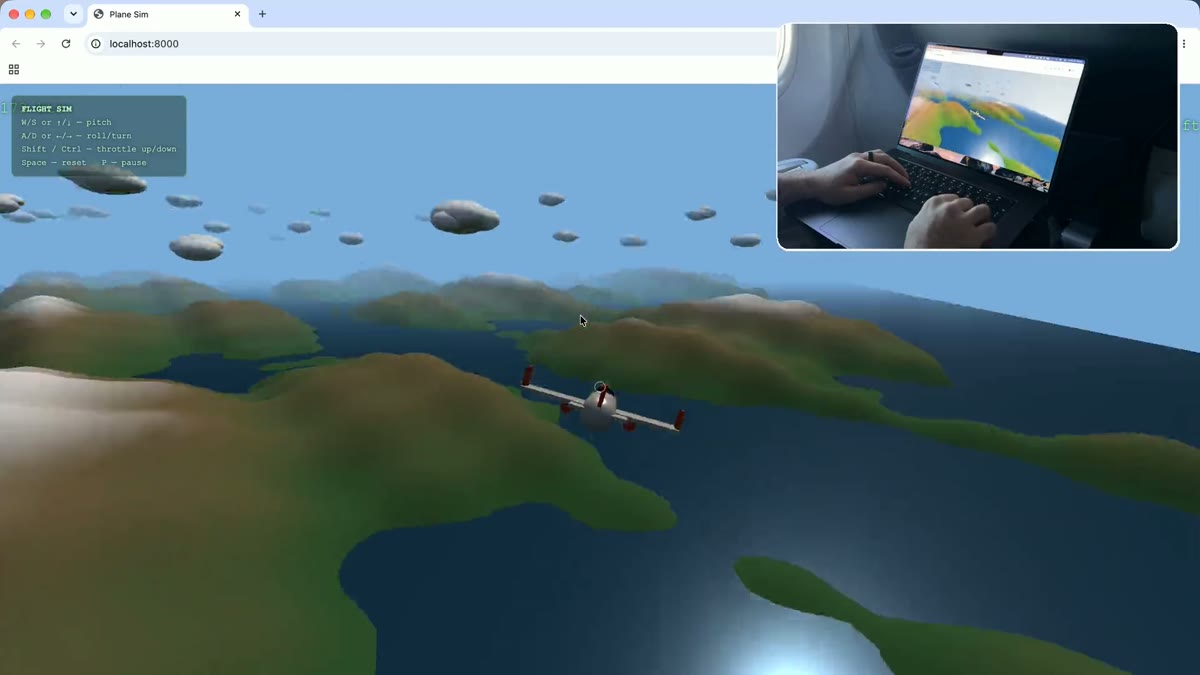
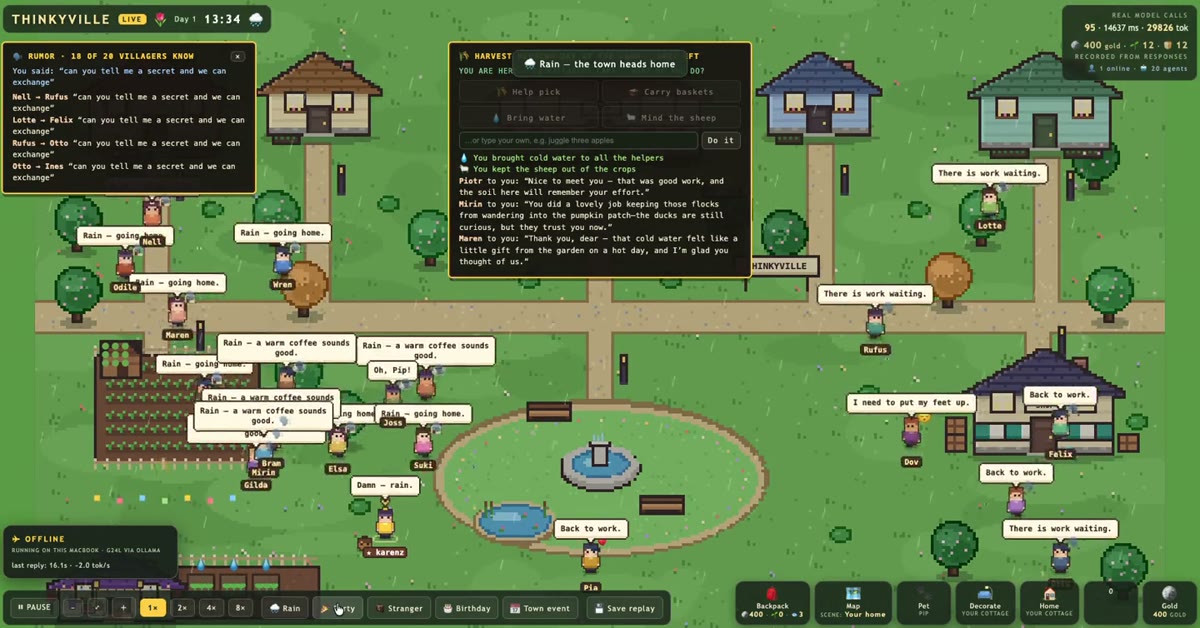
The practical pitch is local use. At launch the model runs on any Mac with at least 32GB of memory through Ollama, on Nvidia’s DGX Spark, and as quantized GGUF files from Unsloth and llama.cpp, with support in vLLM and SGLang. For its demos, the company had Inkling 2 Mini build the flight simulator above on a MacBook Pro in airplane mode, and run all 20 residents of a pixel-art village called Thinkyville on a single offline MacBook.
Inkling 2 Mini is the second member of a new family. The larger Inkling 2 Small, a 594-billion-parameter model with 17 billion active, launched on Tinker on November 5 and had its weights posted on November 12, four months after the lab’s first open model, the original Inkling. Mini trades some of Small’s capability for something the bigger models cannot offer: a frontier lab’s looped architecture that fits on a single laptop and is open for anyone to take apart.
Want AI news before everyone else?
The morning's most important AI stories, straight to your inbox. No fluff.