Gemini 4 Neon vs GPT-6.2 Astra vs Opus 5.5: Hill Climb
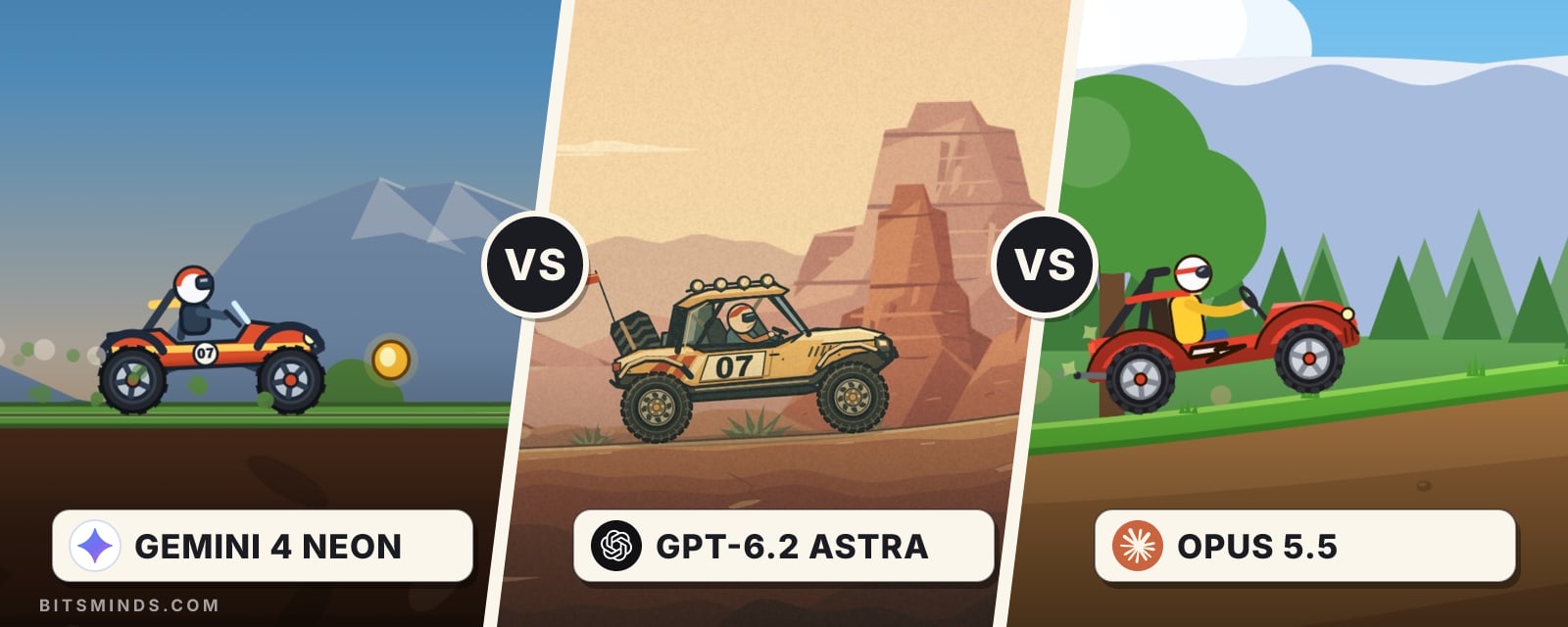
Gemini 4 Neon’s first Lab round banned it from looking at its own work. Hill Climb is the brief where looking is required. We set it against a new GPT-6.2 Astra build and Claude Opus 5.5’s September game, and all three are playable below, exactly as delivered.
BitsMinds LabHow this test was run3 models · 1 brief · one attempt per model: each was required to run, exercise and fix its own build before reporting done, and the report froze the file · Each at the top of its own maker's dial: Gemini 4 Neon in Google Antigravity at XHigh, GPT-6.2 Astra in OpenAI Codex at max, Opus 5.5 in Claude Code at maxShow details
- Models
- Claude Opus 5.5 (Claude Code) · Gemini 4 Neon (Google Antigravity) · GPT-6.2 Astra (OpenAI Codex)
- Attempts
- One attempt per model: each was required to run, exercise and fix its own build before reporting done, and the report froze the file. The three prompts were checked to differ only in the two lines that give the output path.
- Reasoning effort
- Each at the top of its own maker's dial: Gemini 4 Neon in Google Antigravity at XHigh, GPT-6.2 Astra in OpenAI Codex at max, Opus 5.5 in Claude Code at max.
- Tools allowed
- All three were told to verify before reporting done, and each had a shell and a browser in its own maker's coding environment: Neon in Antigravity, Astra in Codex, Opus 5.5 in Claude Code. Neon started in an empty folder.
- Timing
- Working time from prompt to final report: Gemini 4 Neon took 30 minutes on 21 November (by stopwatch); GPT-6.2 Astra took 47 minutes 52 seconds on 18 November; Opus 5.5 took 98 minutes 6 seconds on 23 September.
- Scoring
- Four categories scored out of five: graphics, physics, sound and gameplay. Opus 5.5's build is its 23 September file, scored again alongside the two new ones. Final: Opus 5.5 wins with 16 points, Neon takes 14 and Astra 13. No category for faithfulness to the original game and no credit for the amount of testing a model did.
- Judging
- Scored by BitsMinds from a local side-by-side comparison page of the untouched outputs.
- Published
- November 22, 2026
Result
| Model | Provider | Score |
|---|---|---|
| Claude Opus 5.5 | Anthropic | 16 pts |
| Gemini 4 Neon | 14 pts | |
| GPT-6.2 Astra | OpenAI | 13 pts |
Opus 5.5 wins with 16 points, Neon takes 14 and Astra 13. Both new models tested their engines and shipped games that run and finish, but neither built a course that makes the driver choose a speed; Astra drew the best-looking game and the least demanding one.
The briefs — as described in the article; the exact prompt files were not published
Round 1: Hill Climb Racing (single HTML file)
The brief first run on 19 September, word for word apart from the output path: recreate Hill Climb Racing as one self-contained HTML file — everything inline, no CDN, no network, no images, all art drawn in code — surviving an iframe sandboxed with allow-scripts only. Three screens in a loop with no dead ends, a two-wheeled vehicle with suspension over hilly terrain, touch and keyboard controls, a real fail state, a restart without a reload, and physics not tied to the frame rate. Fuel and coins are deliberately not mentioned.
Result: Opus 5.5 wins with 16 points, Neon takes 14 and Astra 13. All three score the same for graphics and physics; Opus 5.5's course is the only one where coins and fuel ask anything of the driver, while Neon's and Astra's pickups are collected by any car that finishes.
Read with care
- Single run per model — a re-run could land differently.
- Opus 5.5's build was made on 23 September and is carried over rather than re-run. Beside GPT-6 Sol and Grok 4.7 it was scored 5, 5, 4 and 5; it was scored again here beside the two new builds.
- Neon's run was timed by stopwatch; the other two by their logs.
Part of BitsMinds Lab, our series of original hands-on tests.
Gemini 4 Neon’s first test in the Lab was three animation briefs it had to answer blind: write the file, never run it, never look at it. The Hill Climb brief is the opposite. It asks for a playable rebuild of Hill Climb Racing as a single web page, and it requires the model to run what it built, exercise it and fix it before reporting done.
Neon, which Google released on 18 November, takes that brief here for the first time, and so does OpenAI’s GPT-6.2 Astra. Both are set against the game that has led this brief since September: Hill Hopper, by Claude Opus 5.5, the first Hill Climb in this series that was fun to drive.
It still is. Claude Opus 5.5 wins with 16 points out of 20, Gemini 4 Neon takes 14 and GPT-6.2 Astra 13. All three games scored the same for graphics and for physics, and nothing in any of them is broken in a way that stops play. What separates them is sound and, above all, how much the course asks of the driver.
Play all three
The games run below exactly as the models delivered them. On a desktop, click into a game first so it receives the keys, then drive with the arrow keys or WASD. On a phone, use the on-screen pedals. Sound starts with your first key press or tap.
Ridge Rover — Gemini 4 Neon, 30 minutes.
Dust Runner — GPT-6.2 Astra, 47 minutes 52 seconds.
Hill Hopper — Claude Opus 5.5, 98 minutes 6 seconds.
The brief
The game has to be one HTML file with everything inline: no CDN, no network requests, no images, no web fonts, every piece of art drawn in code. It must work inside an iframe sandboxed with allow-scripts only, with no storage and no cookies, because that is how it is embedded on this page. It needs an opening screen, a menu and the game with one level, joined in a loop with no dead ends. The game is a two-wheeled vehicle on suspension over hills, a following camera, throttle and brake on the keyboard and on touch controls, a car that can leave the ground over a crest and flip on a bad landing, a fail state, a restart without a page reload, a HUD, an end-of-run screen, and physics that does not depend on the frame rate. The last line asks for a game someone would actually want to play.
Fuel and coins are not mentioned. They are where earlier entrants have come unstuck, with coins that cost nothing or cannot be reached and fuel that never matters, and they decided this round too.
Ridge Rover, by Gemini 4 Neon
Neon built an alpine climb called Redrock Ridge: 1,000 metres of grass and pine that turns to red rock as it climbs, below a range of snow-flecked peaks. The title screen runs a demonstration drive behind the logo, the menu is a garage, and a run ends on a card with the elevation profile of the course, the distance, the time, coins, flips and a score. It is the largest file of the three, 166 KB, and it took the least time, 30 minutes.
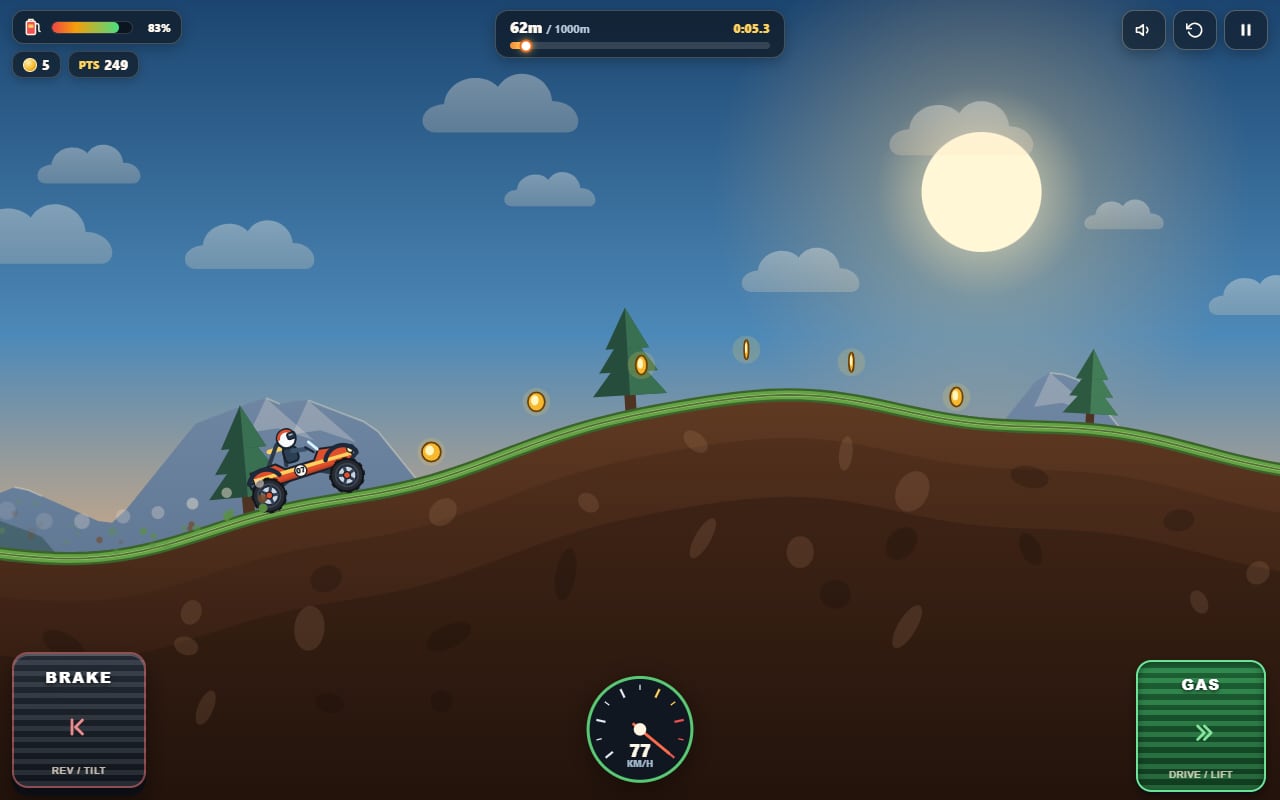
Under the art sits a solid engine. The physics steps at a fixed 120 times a second, the camera pulls back a little with speed and in the air, and there are four fuel cans, at 212, 444, 642 and 834 metres. Neon did test it before handing it in: its folder holds a physics suite that checks the same drive at 30, 60 and 120 frames a second, an 18-metre drop onto a slope and five seconds of idling for jitter, a pair of automatic drivers it used to place the fuel cans, and a browser check with eleven screenshots, among them the game inside a sandboxed iframe and on a phone-sized screen.
We drove the delivered game in Chrome the same way for all three entrants. Holding the gas down from the start flips the buggy onto its helmet 94 metres in, after 7.3 seconds. Pulsing the throttle, a quarter of a second on and a little over a third off, finishes the course in 1:15.7 with 87 of its 97 coins, and the fuel gauge never drops below 64%. The coins are the reason the level is easy to clean up: they are strung in sixteen groups over the crests, three quarters of them less than 1.8 metres above the ground, and a pulsed run that never tries for them still picks up nine in ten.
The mountains carry the one visible fault. The far range is built by sampling its ridge line every 14 pixels across the screen, a grid that stays fixed while the mountains scroll past behind it. The pale snow facets on the peaks are attached to whichever sample happens to be highest, so instead of gliding with the mountain they jump from sample to sample, and the grey triangles change shape from one frame to the next. The engine note has a cause you can read in the code too: a sawtooth at 54 Hz and a triangle an octave below, through a resonant low-pass filter at 220 Hz, which comes out muffled and hollow.
Dust Runner, by GPT-6.2 Astra
Astra built the best-looking game of the three. Dust Runner is a desert rally on a course called Red Mesa Pass, drawn like a grainy travel poster: layered sandstone buttes, a low sun, cactus and scrub, and a heavily detailed buggy with a roll cage, a spare wheel and a pennant on a whip aerial. The menu and HUD carry a brand of their own, Ridgeworks Arcade. It took 47 minutes 52 seconds and 76 KB, the smallest file here.
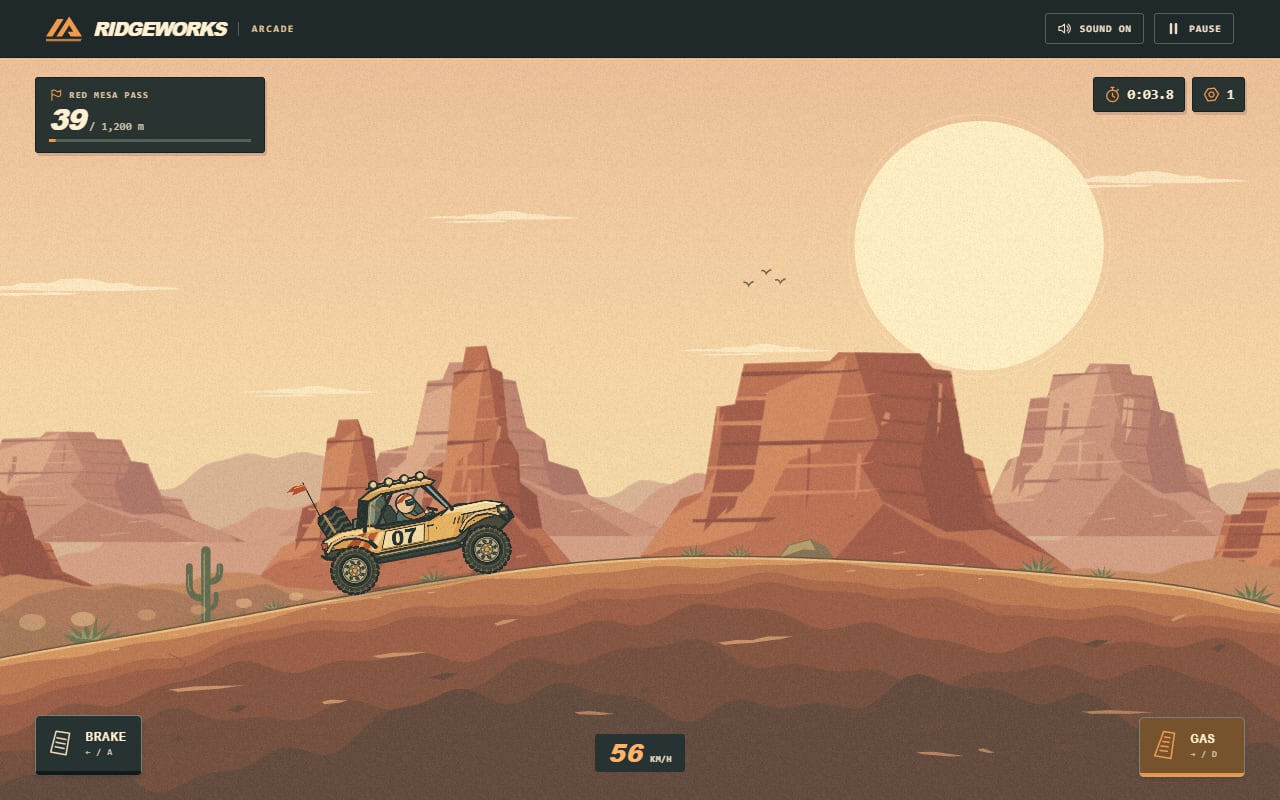
Its camera is the problem with the view. It holds one fixed scale, about 27 metres of course across a landscape screen, whatever the car is doing, so the buggy fills a large part of the frame and the road ahead arrives late. At speed there is no pulling back to show what is coming.
The course is the longest of the three at 1,200 metres, and the emptiest. It has 28 bolts to collect and no fuel. Each bolt hangs 1.38 metres above the ground, every fourth one 2.15 metres, so a car on the track collects them by driving on. Holding the gas all the way rolls the buggy over at 402 metres. Pulsing it, the same rhythm as above, finishes in 1:35.2 with all 28 bolts, and with nothing that can run out, lifting off the throttle now and then is the whole of the skill the level asks for. The sound is well made and very quiet: everything runs through a master level of 0.38, about half of Opus 5.5’s 0.7.
Hill Hopper, by Claude Opus 5.5
Opus 5.5’s game dates from 23 September and is embedded here unchanged. It took 98 minutes 6 seconds and 113 KB. It is a bright cartoon climb, a red buggy and a yellow-jacketed driver across 1,176 metres of meadow, forest and hill in nine named zones, with five fuel cans and coins of two kinds: 154 along the ground and 60 hung in ten arcs over humps and kickers, 3.9 to 5.2 metres up at their highest.
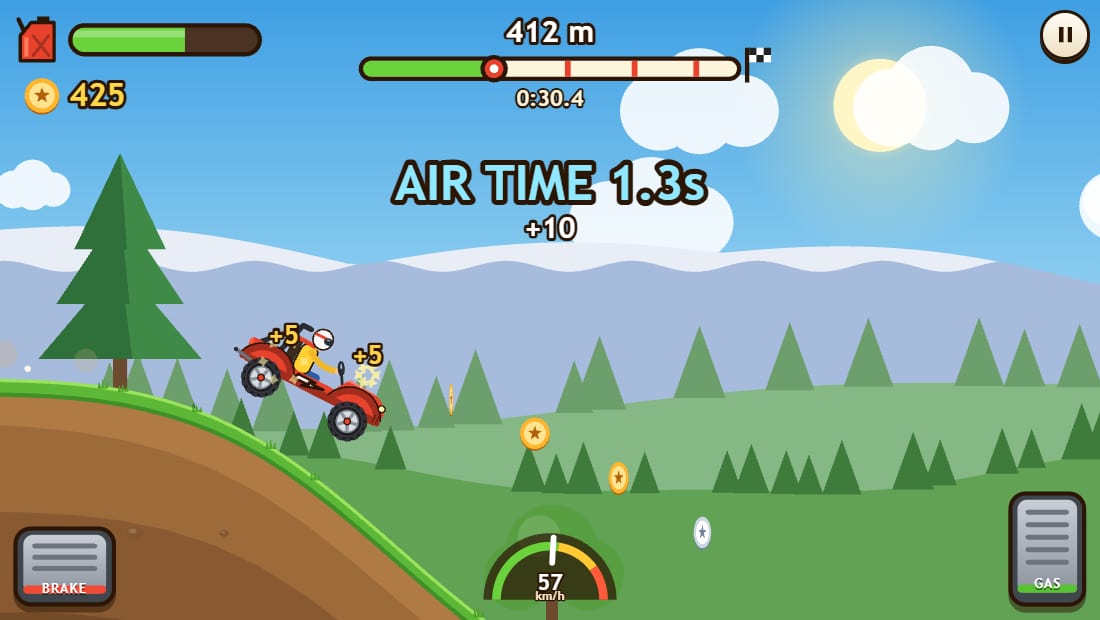
Its course is the only one of the three where a driver has to choose a speed. Holding the gas down from the start ends helmet-first 260 metres in. The arc coins only come to a car moving at the right pace: a driver holding 8 metres a second collects 18 of the 60, one holding 14 collects 56. A driver crawling at 3.5 metres a second runs out of fuel at 190 metres, before the first can. The suspension shifts its weight visibly under throttle and braking, the wheels throw dust and clods when they slip, and the camera pulls back by up to a fifth as the speed builds.
Side by side
| Gemini 4 Neon | GPT-6.2 Astra | Claude Opus 5.5 | |
|---|---|---|---|
| Working time | 30 min | 47m 52s | 98m 06s |
| File size | 166 KB | 76 KB | 113 KB |
| Course | 1,000 m, 4 fuel cans | 1,200 m, no fuel | 1,176 m, 5 fuel cans |
| Pickups | 97 coins | 28 bolts | 214 coins, 60 of them in the air |
| Gas held from the start | flips at 94 m | rolls over at 402 m | crashes at 260 m |
| A careful finishing run | 1:15.7, 87 of 97 coins | 1:35.2, 28 of 28 bolts | 1:25.9, 56 of 60 air coins |
The careful runs are not identical methods: Neon’s and Astra’s were the same pulsed throttle in Chrome, while Opus 5.5’s figure is a driver holding 14 metres a second, measured when its game was first tested. What the table shows is where the coins are. On two of the three courses a car that simply finishes collects nearly everything.
The conditions matched where it mattered. All three received the same prompt, checked to differ only in the two lines that give the output path, and each ran at the top of its own maker’s effort dial in its maker’s own coding environment: Neon in Google Antigravity at XHigh, Astra in OpenAI Codex at max, Opus 5.5 in Claude Code at max. Neon started in an empty folder, and its working time was taken by stopwatch.
Scoring
Graphics is level at 4 for all three, for different reasons. Neon’s game is the cute one, spoiled by the twitching facets on its mountains. Astra’s is the most impressive to look at, held back by a camera that sits too close. Opus 5.5’s is cute as well, and its camera zooms with the speed of the car. Physics is level at 4 too: none of the three vehicles does anything a car on springs should not.
Opus 5.5 takes sound with 4 points, to 3 for each of the others. Neon’s engine sounds hollow; Astra’s sounds right but so faint it is easy to miss. Gameplay is the widest gap. Neon’s course is pleasant to drive but has too few jumps that ask anything, and its coins are hard to miss, which earns it 3. Astra’s is the most monotonous: easing off the gas from time to time is enough to finish it, and every bolt is collected on the way, which earns it 2. Opus 5.5 earns 4 for a game that stays close to the original, fast and bouncy, with coins that have to be earned with a well-judged jump.
In September, beside GPT-6 Sol and Grok 4.7, Opus 5.5’s same file was scored 5, 5, 4 and 5. Scores in this series are set against the field on the page, and this field is stronger. The builds were scored at BitsMinds from a side-by-side page of the untouched files, played in an ordinary browser; the measurements were taken afterwards by driving each delivered game.
Where the challenge went
Both new models checked their own work, and both shipped games that run, finish and look good. Neither checked the thing Opus 5.5 got right in September: whether the course makes the player decide anything. Neon’s and Astra’s coins sit where any car that finishes will collect them, Astra’s course has nothing that can run out, and holding speed is never the question on either.
Neon came closer of the two, in less than a third of the time Opus 5.5 took, and with an engine its own tests had already been through. Astra drew the handsomest desert in this series and then gave the player very little to do in it. Two months on, the September game is still the one to beat on this brief, and the way to beat it is a course worth driving rather than a better-looking one.
More on Gemini
Evergreen coverage we keep current — start here.
Want AI news before everyone else?
The morning's most important AI stories, straight to your inbox. No fluff.