Gemini 4 Neon vs GPT-6.2 Astra, Fable 5.2, Opus 5.5
Gemini 4 Neon is Google’s newest frontier model, so we gave it the build briefs GPT-6.2 Astra, Fable 5.2 and Opus 5.5 have already answered. A motorway interchange, a seaside fairground and a cinematic rocket launch, one attempt each at its highest setting, with no way to see the result. All twelve builds run below, untouched, so you can judge them yourself.
BitsMinds LabHow this test was run4 models · 3 briefs · one attempt per model per brief · Maximum reasoning effort for all four, at the top of each one's own dial: Gemini 4 Neon in Google Antigravity at XHigh, GPT-6.2 Astra in OpenAI Codex at max, Fable 5.2 and Opus 5.5 in Claude Code at maxShow details
- Models
- Claude Fable 5.2 (Claude Code) · Gemini 4 Neon (Google Antigravity) · GPT-6.2 Astra (OpenAI Codex) · Claude Opus 5.5 (Claude Code)
- Attempts
- One attempt per model per brief. No retries, no follow-up notes, no clean-up.
- Reasoning effort
- Maximum reasoning effort for all four, at the top of each one's own dial: Gemini 4 Neon in Google Antigravity at XHigh, GPT-6.2 Astra in OpenAI Codex at max, Fable 5.2 and Opus 5.5 in Claude Code at max.
- Tools allowed
- Each model ran inside its own maker's agentic coding environment and wrote its files to disk: Neon in Antigravity, Astra in Codex, Fable 5.2 and Opus 5.5 in Claude Code. All were told not to open a browser, preview the result or run code. Neon asked for neither; it only wrote its files.
- Timing
- Wall-clock time from prompt to finished file: Gemini 4 Neon took 17, 15 and 12 minutes on 21 November; GPT-6.2 Astra took 19m 40s, 19m 23s and 21m 14s; Fable 5.2 took 47m 17s, 41m 45s and 47m 01s; Opus 5.5 took 58m 49s, 62m 41s and 76m 33s.
- Scoring
- Points out of five, set round by round on the finished artefact. The builds of Astra, Fable 5.2 and Opus 5.5 are the files they were published with, scored again alongside Neon's. Final: Fable 5.2 wins with 11 points; Neon, Astra and Opus 5.5 take 10 each.
- Judging
- Scored by BitsMinds from a local side-by-side comparison page of the untouched outputs.
- Published
- November 21, 2026
Result
| Model | Provider | Score |
|---|---|---|
| Claude Fable 5.2 | Anthropic | 11 pts |
| Gemini 4 Neon | 10 pts | |
| GPT-6.2 Astra | OpenAI | 10 pts |
| Claude Opus 5.5 | Anthropic | 10 pts |
Fable 5.2 wins with 11 points; Gemini 4 Neon, GPT-6.2 Astra and Opus 5.5 take 10 each. Every round went to a different model, Neon taking the fairground, and Fable 5.2 won by never finishing lower than second.
The briefs — as described in the article; the exact prompt files were not published
Round 1: Motorway interchange (SVG)
A top-down view of a busy interchange as one self-contained SVG. Two roads crossing on different levels, connecting ramps, at least twelve vehicles following the curve of the road they are on, and correct layering so traffic on the lower road is hidden by the overpass.
Result: GPT-6.2 Astra wins with 5 points, Fable 5.2 takes 4, Neon and Opus 5.5 take 3 each: Astra marks every ramp the way a real road does; Neon's four loops meet the highway almost at right angles.
Round 2: Seaside fairground (SVG)
A seaside fairground at dusk, one SVG. A Ferris wheel with at least ten gondolas turning continuously, a spinning carousel with at least six horses rising and falling out of phase, twinkling bulbs, a reflection in the water. Each gondola must stay level with the horizon throughout the rotation.
Result: Gemini 4 Neon wins with 4 points, Astra and Fable 5.2 take 3 each, Opus 5.5 takes 2: Neon's gondolas stay level and its eight horses orbit the carousel facing their travel, with nothing in the scene that breaks.
Round 3: Rocket launch (web page)
A self-contained web page that animates a rocket launching — countdown, ignition, liftoff and ascent — with a mission-control HUD. No library named, no 3D requested, one aesthetic instruction: make it look good.
Result: Opus 5.5 wins with 5 points, Fable 5.2 takes 4, Neon takes 3 and Astra 2: three full missions to orbit and one that stops at the ascent; Neon's sky streams sideways while its rocket climbs.
Read with care
- Single run per model — a re-run could land differently.
- The builds of Astra, Fable 5.2 and Opus 5.5 are the files they were published with, scored again here rather than re-run.
- Scored on the finished artefact only. Wall-clock time is reported but carries no points.
Part of BitsMinds Lab, our series of original hands-on tests.
Google released Gemini 4 Neon on 18 November at $3 per million input tokens and $15 per million output. Artificial Analysis puts it at 61 on its Intelligence Index at its XHigh setting, third behind Claude Fable 5.2 at 65 and GPT-6.2 Astra at 62, and two points ahead of Claude Opus 5.5. An index task costs about $6.44 on Neon, against $4.00 on Astra, $10.04 on Opus 5.5 and $26.54 on Fable 5.2. This series tests a model a different way: the same build briefs as its rivals, one attempt, and the result published untouched.
Its three opponents bring the builds they were published with. Claude Fable 5.2, Anthropic’s top model, built its files for its 9 November round; GPT-6.2 Astra, OpenAI’s flagship, built its own for its 18 November round against Fable 5.2; and Claude Opus 5.5 built its in September, for the round it later replayed against GPT-6.2 Sol. The briefs: a motorway interchange seen from above and a seaside fairground at dusk, each as a single animated SVG file, and a cinematic rocket launch as one web page. One attempt each, maximum reasoning effort, and no opening a browser or running code to see the result. Google’s previous model in this series, Gemini 4 Argon, answered the same three briefs in October.
Claude Fable 5.2 wins with 11 points, and Neon, Astra and Opus 5.5 finish level on 10. Each round went to a different model: Astra the interchange, Neon the fairground and Opus 5.5 the launch. Fable 5.2 won none of them and was first or second in all three. Neon built its three files in 44 minutes, faster than any of the other three.
Round 1: The interchange
The brief: a busy interchange seen from above, as one self-contained SVG with no text and no script. Two roads cross on different levels, ramps connect them, at least twelve vehicles follow the curves of the roads they drive on in both directions, and the layering hides the lower road’s traffic under the overpass. Two traps go unstated: whether each ramp really joins the roads at both ends, and whether traffic keeps to the right side after it merges.
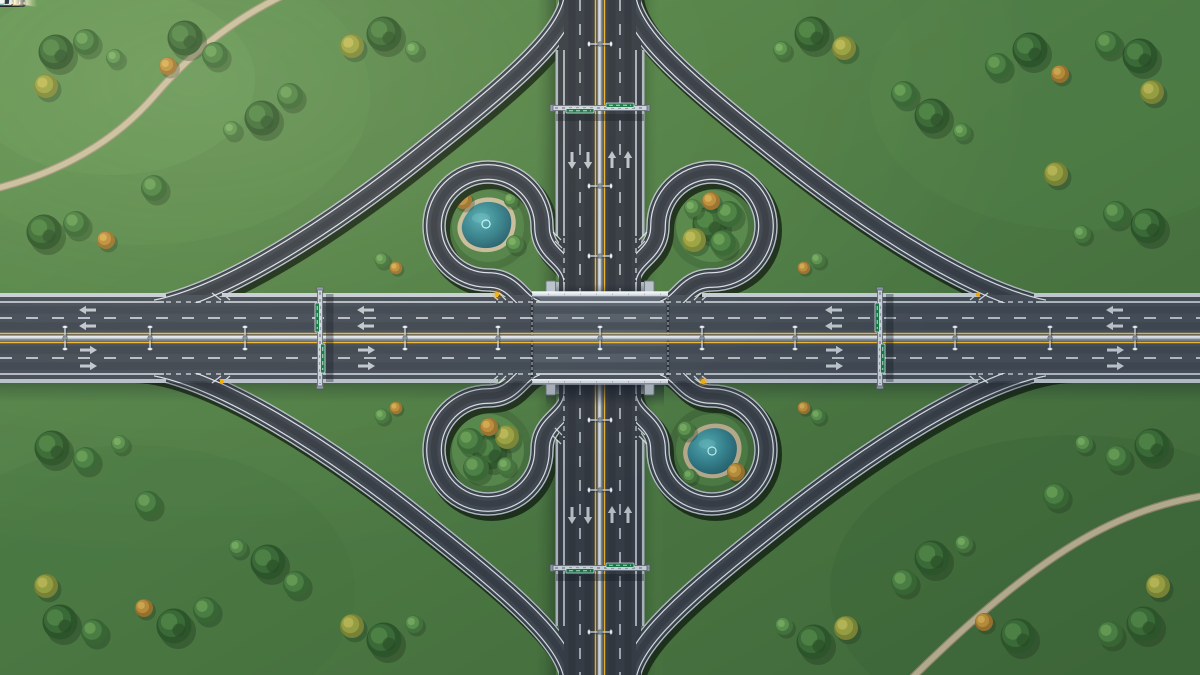
Gemini 4 Neon built the complete junction: two highways crossing at a bridge, four long outer ramps for the right turns and four loops for the left, set in green country with clumps of trees, a footpath curving across the corners and a pond inside two of the loops. Thirty-six vehicles drive on it, with direction arrows painted in every lane. The picture is close in style to Fable 5.2’s.
The geometry gives it away. The outer ramps sweep across hundreds of pixels in smooth curves, but the four loops are small circles tucked right into the corners beside the crossing, and each one joins its highway through an S-bend only about thirty pixels deep. Traffic leaving the highway for a loop, or coming off a loop back onto it, turns almost at a right angle, a manoeuvre no real road would ask of a car at motorway speed.
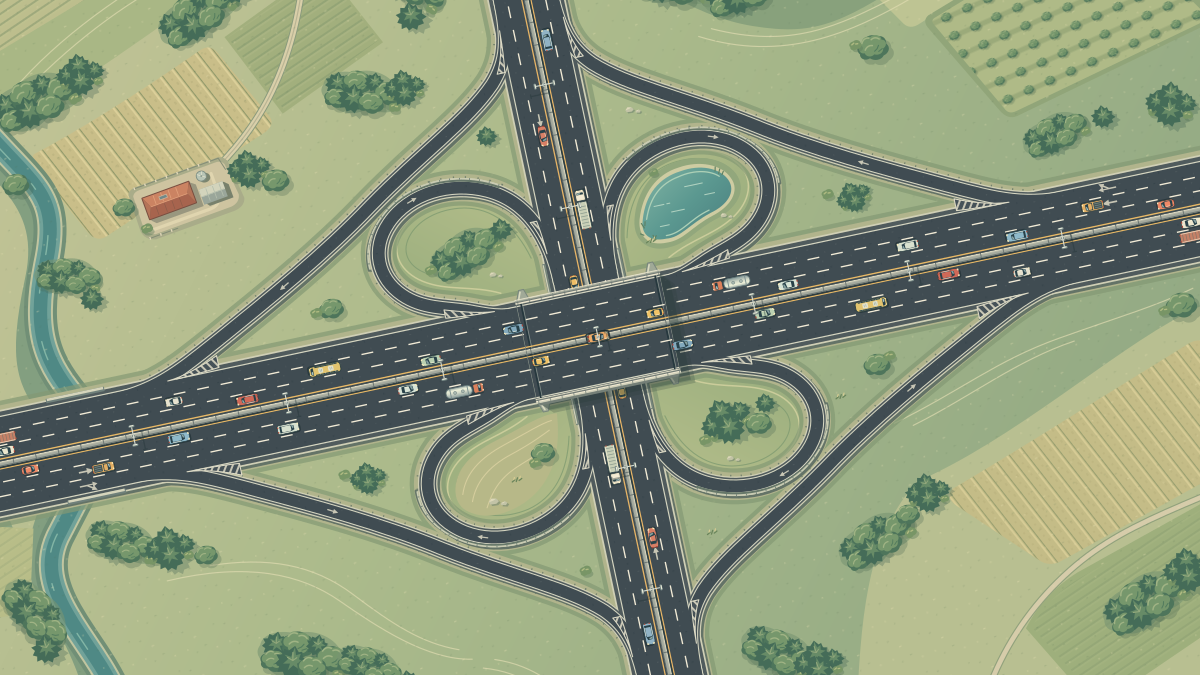
GPT-6.2 Astra built the complete junction too, turned a few degrees off the grid, in late-afternoon light over farmland with a creek, a red-roofed farm and a pond inside one of the loops. Thirty-eight vehicles drive on it. Its markings are right: where each ramp leaves or joins a highway, the edge line breaks and a hatched gore fills the wedge between the two roads, as on a real motorway, and none of its vehicles jumps anywhere in the frame across a full minute.
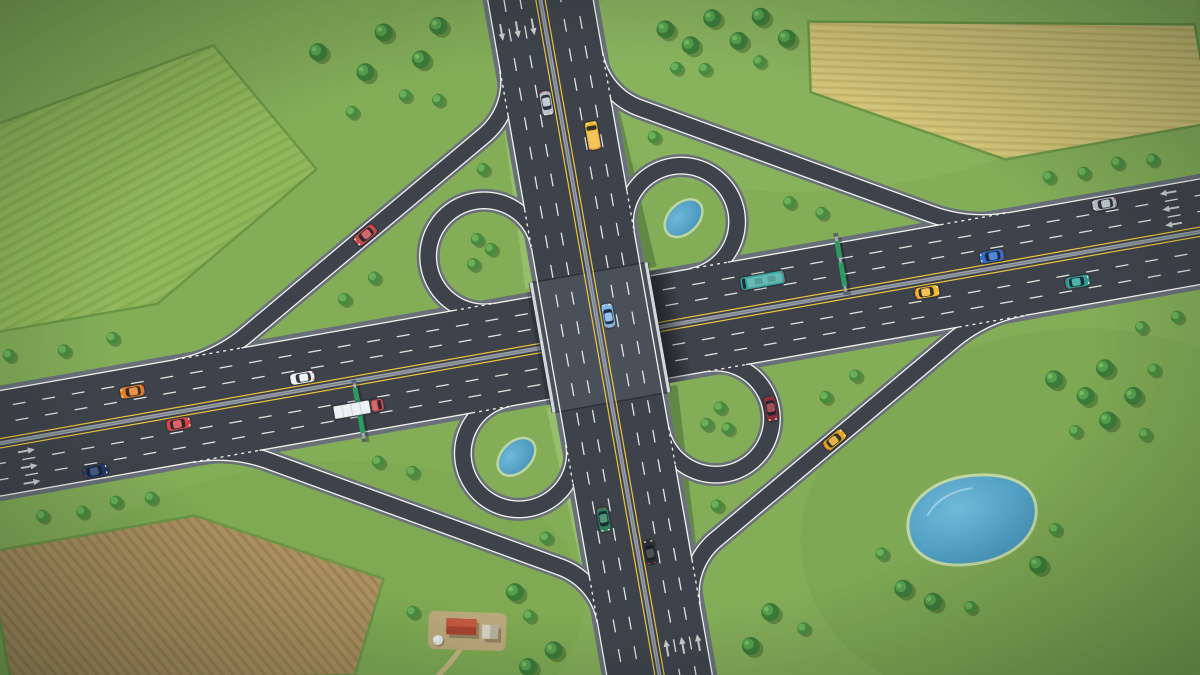
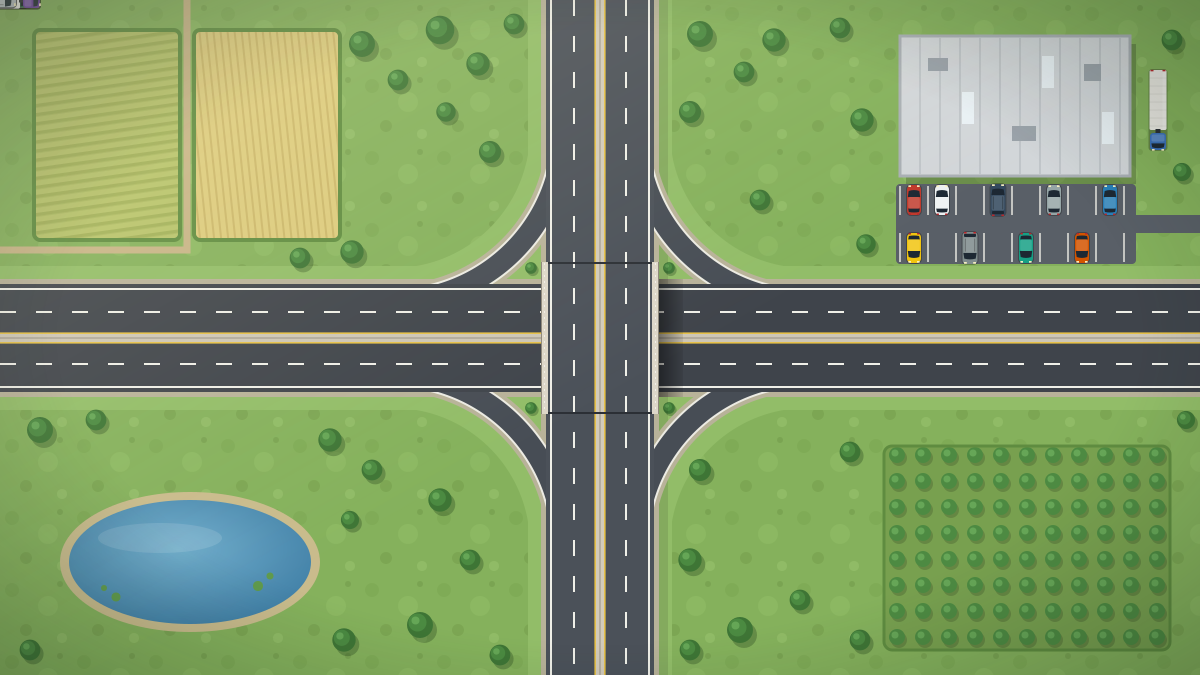
Claude Fable 5.2 built a complete cloverleaf in daylight, turned ten degrees off the grid, with fifty vehicles among them vans, three articulated lorries and two buses. Through traffic keeps to the two inner lanes of each carriageway and the outer lane is left to cars using a ramp, and each highway’s solid edge line becomes a short dashed line at all sixteen ramp openings. Claude Opus 5.5 built four right-turn ramps and no loops, with merges staggered so every car lands in a gap and a turn signal on every car that takes a ramp; its fault is a painted line, the solid edge line running straight across all eight ramp ends, so each ramp appears to slide out from under the road.
Round 1 goes to GPT-6.2 Astra, which takes 5 points. Fable 5.2 takes 4, and Neon and Opus 5.5 take 3 each.
Round 2: The fairground
A seaside fairground at dusk, one SVG. A Ferris wheel with at least ten gondolas turning continuously and staying level with the horizon all the way round, a spinning carousel with at least six horses rising and falling out of phase, twinkling bulbs, lights chasing the rim of the wheel, and the whole scene reflected in water. The gondolas are the trap the brief states out loud. The carousel is the one it does not.




Neon’s fair stands on a pier under a violet dusk, with the sun setting into the sea on the left, a lighthouse beam sweeping the far shore, two striped booths and strings of warm bulbs. Its wheel carries twelve gondolas in four colours; each counter-rotates once every 24 seconds against the wheel and sways about four degrees on its own slower rhythm, so it hangs level the whole way round. The reflection is a live copy of the entire scene, so everything that moves above the water moves in it.
Its carousel works the way the best ones in this series do. Eight horses, each painted differently, travel round an ellipse once every twelve seconds. Each is drawn twice, once passing behind the centre column and once in front of it, with the two copies swapping at the side, and each narrows as it swings round the edge and comes back mirrored, so it always faces the way it is going, while it rides its pole up and down on a three-second cycle of its own. We found no fault in it.
Astra’s fair is the richer picture: a copper Ferris wheel and a striped carousel trimmed with shells on a long pier, sailboats, a lighthouse, a ticket kiosk and small figures strolling along the boards. Its wheel and carousel work, but in playback one of the canopy’s red and white stripes flicks across from right to left for an instant and back, about twice in fifteen seconds. Fable 5.2’s fair has twelve gondolas on a 36-second wheel and eight horses that face their travel, under a canopy whose gores sweep round at the horses’ speed. Opus 5.5’s carousel behaves like a solid object in perspective with six horses that turn to face their travel, and its wheel carries twelve gondolas on a 24-second turn.
Round 2 goes to Gemini 4 Neon, which takes 4 points: a less ornate scene than Astra’s, with nothing in it that breaks. Astra and Fable 5.2 take 3 each, and Opus 5.5 takes 2.
Round 3: The rocket launch
This brief leaves the method open. It names no library, asks for no 3D, and its only instruction on style is to make it look good. It wants a countdown, ignition, liftoff and a sustained ascent, with a mission-control HUD reporting the state of the flight.
HELIOS-9 — Gemini 4 Neon, 12 minutes. The whole flight plays in under two minutes; watch the stars near the end.
Nightfall 01 — GPT-6.2 Astra, 21 minutes 14 seconds.
AETHER-1 — Claude Fable 5.2, 47 minutes 1 second. From the terminal count to orbit in about two minutes.
HALCYON-3 — Claude Opus 5.5, 76 minutes 33 seconds. The whole flight takes about two minutes and ten seconds to play; stay for orbit.
Neon’s HELIOS-9 flies the whole mission, from a pad at night with a glass mission-control panel of altitude, velocity, Mach number, g-load and dynamic pressure. The count opens at T−10, the sound-suppression deluge starts at T−6, the engines light at T−2.2, the vehicle clears the tower at T+6.5, passes maximum dynamic pressure around T+32, cuts its main engines at T+56.5, separates at T+59 and lights the second stage at T+61.5. The fairing comes off at T+68 and the second stage shuts down at T+88 at 215 km and 7,778 m/s. The flight is compressed into a mission clock that runs at real time, so the whole thing takes under two minutes. An automatic camera pushes in for ignition and staging and pulls back for the climb, and three fixed views can be picked by hand.
The sky behind it is where it breaks. The star field is shifted sideways in step with the distance the rocket has flown downrange, but the rocket is drawn climbing straight up the screen, so the stars drift steadily to the left while the vehicle rises. In the last thirty seconds the downrange distance jumps from 490 km to 1,180 km, about fifty screen widths of star movement in ten seconds, and the stars stream wildly across the frame. The trajectory behind it does not add up either: 1,180 km downrange in 88 seconds is more than the rocket’s own speed figures allow. And the vapour effect at maximum dynamic pressure, two faint cones each edged with a thin chevron, reads on screen as two lines drawn across the rocket.
Astra’s Nightfall 01 is a handsome page with a pad camera, running charts and a four-step timeline, but its flight ends where the brief’s words end, at the ascent: no engine cuts off, the side boosters never separate, and there is no second stage and no orbit. Fable 5.2’s AETHER-1 flies the whole mission to a 203 by 205 km orbit, with a launch director’s poll, a throttle-down through maximum dynamic pressure and staging, its mission time running up to eight times faster than real time through the long burns. Opus 5.5’s HALCYON-3 flies the whole mission to a 203 by 207 km orbit and cuts between camera angles, pushing in on the engines at ignition and pulling back as the vehicle climbs, like a broadcast with a director.
Round 3 goes to Opus 5.5, which takes 5 points for the full mission and the drama it is shot with. Fable 5.2 takes 4, Neon takes 3 for a complete mission that is less impressive to watch and breaks in its sky, and Astra takes 2.
The fastest of the four
| Build | Gemini 4 Neon | GPT-6.2 Astra | Fable 5.2 | Opus 5.5 |
|---|---|---|---|---|
| Interchange | 17m | 19m 40s | 47m 17s | 58m 49s |
| Fairground | 15m | 19m 23s | 41m 45s | 62m 41s |
| Rocket launch | 12m | 21m 14s | 47m 01s | 76m 33s |
| All three | 44m | 60m 17s | 136m 03s | 198m 03s |
| List price per 1M tokens (in / out) | $3 / $15 | $8 / $40 | $8 / $40 | $4 / $20 |
| Intelligence Index v5.0.1 | 61 | 62 | 65 | 59 |
| Cost per index task | $6.44 | $4.00 | $26.54 | $10.04 |
Neon was the quickest on every brief, a quarter faster than Astra over the three and a third of Fable 5.2’s time. It is also the cheapest of the four per token, though not per index task: Artificial Analysis, running each model at its maximum setting, finds Astra gets through an index task for less.
The conditions matched where it mattered. Neon received the other three models’ prompts word for word apart from the save path, and ran in Google’s Antigravity at XHigh, the highest setting it offers for Neon, all three briefs at once, under the same ban on opening a browser or running code. It asked for neither in any of the three conversations; it only wrote its files. Astra ran in OpenAI’s Codex at max, and Fable 5.2 and Opus 5.5 in Claude Code at maximum effort.
The verdict: Fable 5.2 wins with 11 points, a three-way tie on 10
| Interchange | Fairground | Launch | Total | |
|---|---|---|---|---|
| Claude Fable 5.2 | 4 | 3 | 4 | 11 |
| Gemini 4 Neon | 3 | 4 | 3 | 10 |
| GPT-6.2 Astra | 5 | 3 | 2 | 10 |
| Claude Opus 5.5 | 3 | 2 | 5 | 10 |
Points were set round by round on the finished artefact alone, out of five. The builds of Astra, Fable 5.2 and Opus 5.5 are the files they were published with, scored again here alongside Neon’s, so their points differ in places from their earlier rounds. The builds were scored at BitsMinds from a local side-by-side page of the untouched outputs.
Consistent wins
Every model here won a round, and three of them won only one. Astra drew the best interchange and flew the weakest launch; Opus 5.5 flew the best launch and drew the weakest fair. Fable 5.2 took no round and finished ahead of all three, because it was never worse than second.
Neon is the most even of the challengers. It drew a fairground with nothing in it that breaks, it read the launch brief as a mission to orbit rather than stopping at the ascent, and it was the only one of the four to answer all three briefs in under twenty minutes each. Where it lost points was on things it would have seen in a few seconds of playback: loops that meet the road at right angles and a sky that runs away from the rocket. Against Argon’s showing in October, with a carousel whose horses only bobbed in place, it is a clear step up.
More on Gemini
Evergreen coverage we keep current — start here.
Want AI news before everyone else?
The morning's most important AI stories, straight to your inbox. No fluff.