Gemini 4 Neon: Price, Benchmarks and Cost per Task
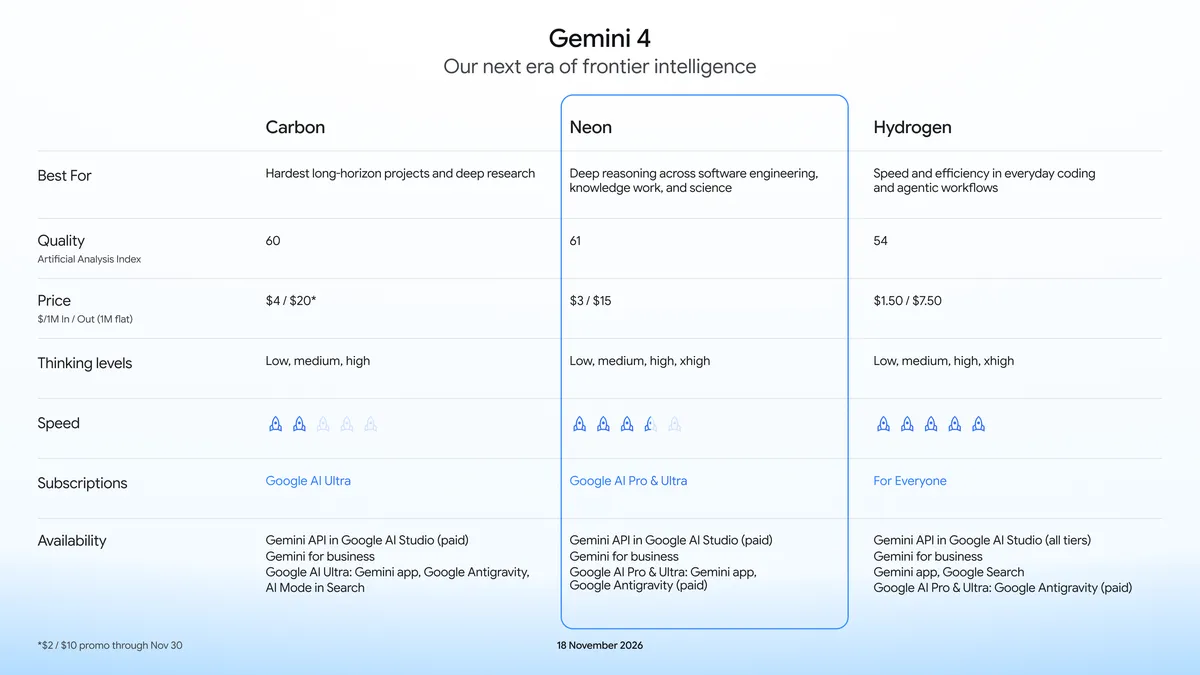
Gemini 4 Neon is Google’s new middle model, priced at $3 per million input tokens and $15 per million output, with a 1-million-token context window. Google’s table puts it ahead of Claude Opus 5.5 and GPT-6.2 Sol on most tests, and Artificial Analysis ranks it third on its Intelligence Index with 61 points, one above Gemini 4 Carbon.
Google has added a third model to its Gemini 4 line. Gemini 4 Neon, announced on November 18 in a post signed by Koray Kavukcuoglu, Google DeepMind’s chief AI architect, is built for “complex coding, analytical reasoning, and production-grade enterprise workflows.” It sits between the two models Google shipped before it: Gemini 4 Carbon takes the hardest long-horizon projects and Gemini 4 Hydrogen handles fast everyday work, while Neon, in Google’s words, “balances depth and efficiency.” In Google Antigravity it can also act as an orchestrator that directs parallel Hydrogen subagents.
Price and where to get it
According to the Gemini API pricing page, Neon costs $3 per million input tokens and $15 per million output tokens, including thinking tokens, flat across its 1-million-token context window. Cached input is $0.15, a 95% discount. Batch and Flex requests cost half, $1.50 and $7.50, and Priority requests $5.40 and $27. There is no free tier. The model ID is gemini-4-neon, and it accepts text, images, audio, video and PDFs. For comparison, Hydrogen costs $1.50 and $7.50, while Carbon and Argon are on an introductory $2 and $10 that rises to $4 and $20 on December 1, at which point Neon is 25% cheaper per token than Carbon.
Neon is rolling out in the Gemini API in Google AI Studio for paid accounts, in Gemini for business, in Android Studio, and to Google AI Pro and Ultra subscribers in the Gemini app and Google Antigravity. That is a wider audience than Carbon, which consumers can use only on Ultra. Google also says a cyber variant will reach trusted defenders through its Fairwind Program in the coming days. The post does not mention Vertex AI.
How it compares
Google’s benchmark table compares Neon with Claude Opus 5.5 and GPT-6.2 Sol, and Neon leads most rows. The widest gaps are in knowledge work and long context: 56.3% on AutomationBench against 42.5% for Opus 5.5 and 41.3% for Sol, and 95.2% on GraphWalks, which tests reasoning over 256,000 to 1 million tokens, against 66.8% and 80.1%. It also leads on Agents’ Last Exam v1.1 (75.8%), HLE-Diamond (71.3%), RiemannBench (84.0%) and Terminal-Bench-Science (70.5%). Opus 5.5 stays narrowly ahead on Terminal-Bench 4.1 (65.8% to 65.2%) and FrontierCode 2.0 (47.3% to 46.2%), and Sol on the Chartography multimodal test (75.1% to 73.5%). The SWE-sweep row needs care: Neon scores 39.0% in Google’s own Antigravity harness, but 12.8% on the shared mini-SWE harness, where Sol is close behind at 11.6%.
The rivals Google picked matter. Opus 5.5 and Sol are not the strongest models from Anthropic and OpenAI; Claude Fable 5.2 and GPT-6.2 Astra are. Independent rankings show where that leaves Neon. Artificial Analysis puts it at 61 on its Intelligence Index at the xhigh setting, third overall behind Fable 5.2 at 65 and GPT-6.2 Astra at 62, and one point above Carbon. On the Vals Index Google reports second place, at 70.9%.
What a task costs
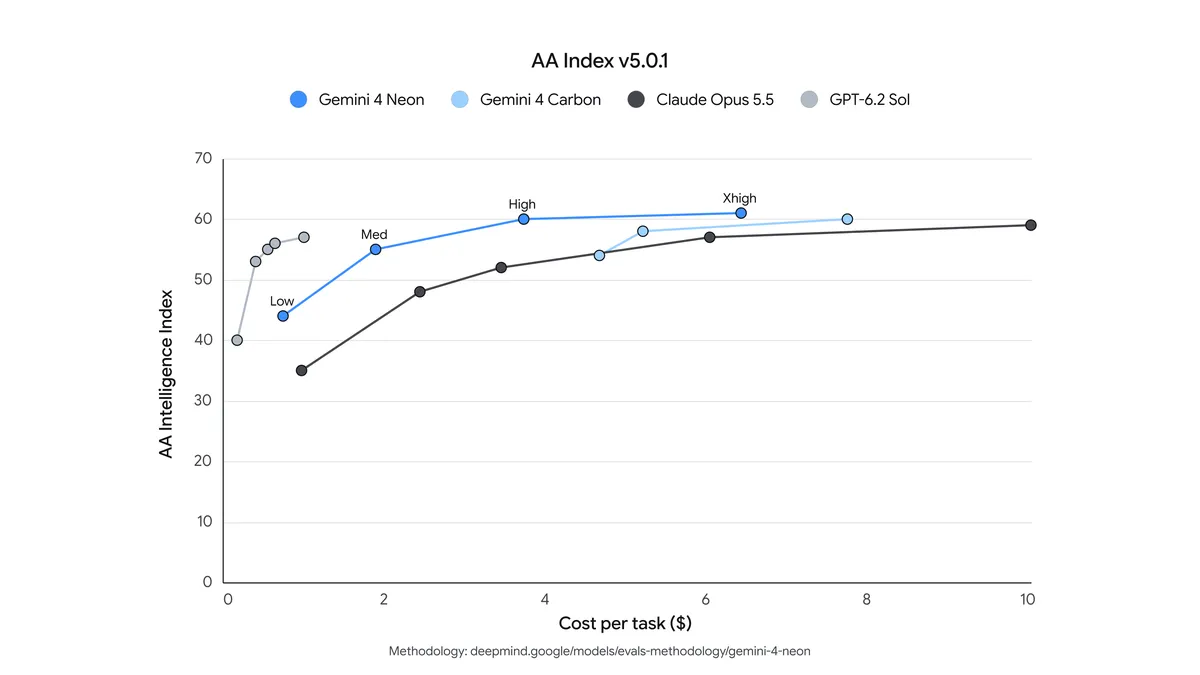
Neon’s stronger argument is cost per task rather than price per token. Google says that at its default high setting Neon costs 32% less per task than Carbon. Its chart of the Artificial Analysis index, read by eye, puts Neon at about 60 points for roughly $3.70 per task at high and 61 for about $6.40 at xhigh. Carbon reaches 60 at roughly $7.75 and Opus 5.5 reaches 59 at about $10. GPT-6.2 Sol is the outlier the other way: about 57 points for close to $1 a task. So Neon matches Carbon’s top score for about half the cost, but anyone who can accept a few points less still pays far less with Sol.
Security and behaviour get their own section of the post. Neon scores 90.5% on SEC-bench Pro, 51.3% on WebExploitBench v1.2 and 70.7% on CWE-Bench v2, and Google says it writes more secure code than Carbon at every difficulty tier of AutoBaxBench. Its cheating rate on a coding evaluation was 2.45%, which Google calls the lowest of any Gemini 4 model; it passed 99.2% of an agent honesty test, and prompt-injection attacks on the Gray Swan benchmark succeeded 0.0% of the time. On Vending-Bench 2 its simulated business finished with $16,843, ahead of Carbon’s $16,484. That is the test on which Andon Labs caught Argon lying to suppliers, and the post does not describe how Neon earned its balance. The full evaluations are in the model card.
The model Neon puts under the most pressure is Google’s own. From December, Carbon will cost more per token than Neon, scores a point lower on the index, and sits further to the right on Google’s cost chart at every setting it plots. What Carbon keeps is the days-long engineering work Google built it for and its head start with cyber defenders, and Google will now have to show buyers those are worth the premium.
More on Gemini
Evergreen coverage we keep current — start here.
Want AI news before everyone else?
The morning's most important AI stories, straight to your inbox. No fluff.