Gemini 4 Hydrogen: Google’s Fast Model, Price and Scores
Gemini 4 Hydrogen is Google’s new fast model for coding and agent work, priced at $1.50 per million input tokens and $7.50 per million output tokens across a 1-million-token context. Google says it beats Gemini 3.8 Flash by a wide margin and edges Gemini 4 Argon on the Artificial Analysis Intelligence Index at its default setting. It is rolling out globally to the API, the Gemini app and Search.
Google has released Gemini 4 Hydrogen, the fast member of its Gemini 4 family. In the announcement, dated November 12 and signed by Koray Kavukcuoglu, Google DeepMind’s chief AI architect, Google describes it as a model for everyday coding and agentic work that has to run quickly, while its frontier models, Gemini 4 Carbon and Gemini 4 Argon, handle deep, long-horizon reasoning. Unlike those two, which went first to vetted cyber defenders, Hydrogen started rolling out globally on the day it was announced.
The API price is $1.50 per million input tokens and $7.50 per million output tokens, flat across the whole 1-million-token context window. That sits between GPT-6.1 Terra at $1 and $5 and Claude Sonnet 5.5 at $2 and $10, the two models Google chose to compare it with. Hydrogen has four thinking levels: low, medium, high, which is the default, and a new xhigh tier.
Against Gemini 3.8 Flash, which Google presents it as the upgrade from, Google reports that Hydrogen finishes tasks about 2.5 times faster at its default setting, more than triples the Terminal-Bench 4.1 score (57% against 18.2%) and cuts fabricated claims by more than five times. Partners testing it on graph, SQL and data-heavy enterprise workflows saw runs 2 to 2.8 times faster and 12% to 23% lower token use than with 3.8 Flash. On the Artificial Analysis Intelligence Index, Google puts Hydrogen at 51 at the default high setting, one point above Argon, and 54 at xhigh.
How it compares
Google’s table puts Hydrogen ahead of both rivals on most knowledge-work and reasoning tests: 71.6% on Agents’ Last Exam v1.1, 76.1% on AutomationBench-AA, 58.8% on HLE-Diamond and 53.4% on the multimodal MKA test. On SWE-sweep it scores 13.5%, against 3.1% for Sonnet 5.5 and 5.8% for Terra, and on the Vending-Bench 2 business simulation it ends with a $14,549 bank balance, against $11,165 and $9,107. Sonnet 5.5 keeps the lead in three places: Terminal-Bench 4.1 (63.9% to Hydrogen’s 57%), OSWorld-2.1 computer use (83.9% to 77.6%) and Terminal-Bench-Science (59.9% to 51.4%, with Terra at 58.3%).
Cost per task tells a less one-sided story. Artificial Analysis lists Hydrogen at xhigh at 54 on version 5.0.1 of its index, at $3.16 per index task and 188 output tokens per second. Google’s own cost chart, read by eye, puts Hydrogen’s default setting at roughly $1.85 per task for its 51 points. In the same chart GPT-6.1 Terra reaches about the same score for under $1 a task, while Sonnet 5.5 needs about $4 to reach 50. Hydrogen beats Sonnet on price for the result, but not Terra.
Where you can use it
Developers get the model through the Gemini API in Google AI Studio and Android Studio, and Google AI Pro and Ultra subscribers can use it in Google Antigravity. There, a new Orchestrator switches between Carbon and Hydrogen within one session; on Terminal-Bench 4.0 Google says it gets close to Carbon’s success rate while using about 24% less quota and finishing about 19% faster. Businesses get it in Gemini for business and in Gemini in Google Sheets, whose canvas Google says now generates outputs more than 30% faster. In the Gemini app it appears in the model menu, and free users get it when auto model selection decides it fits the prompt.
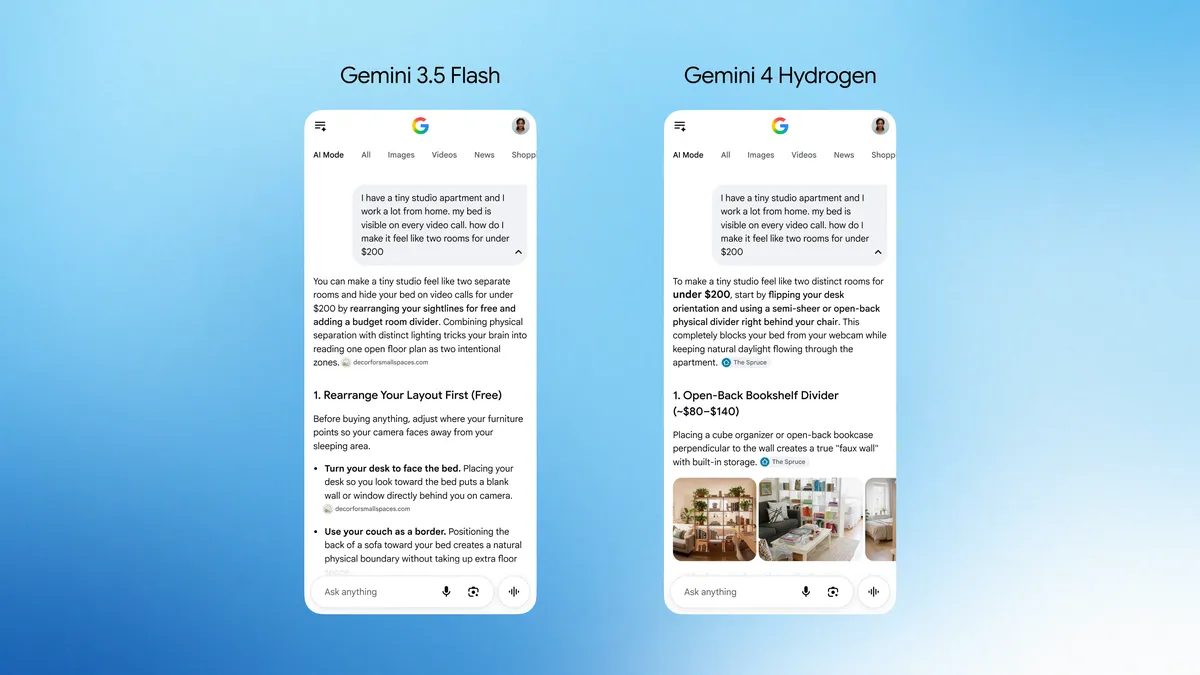
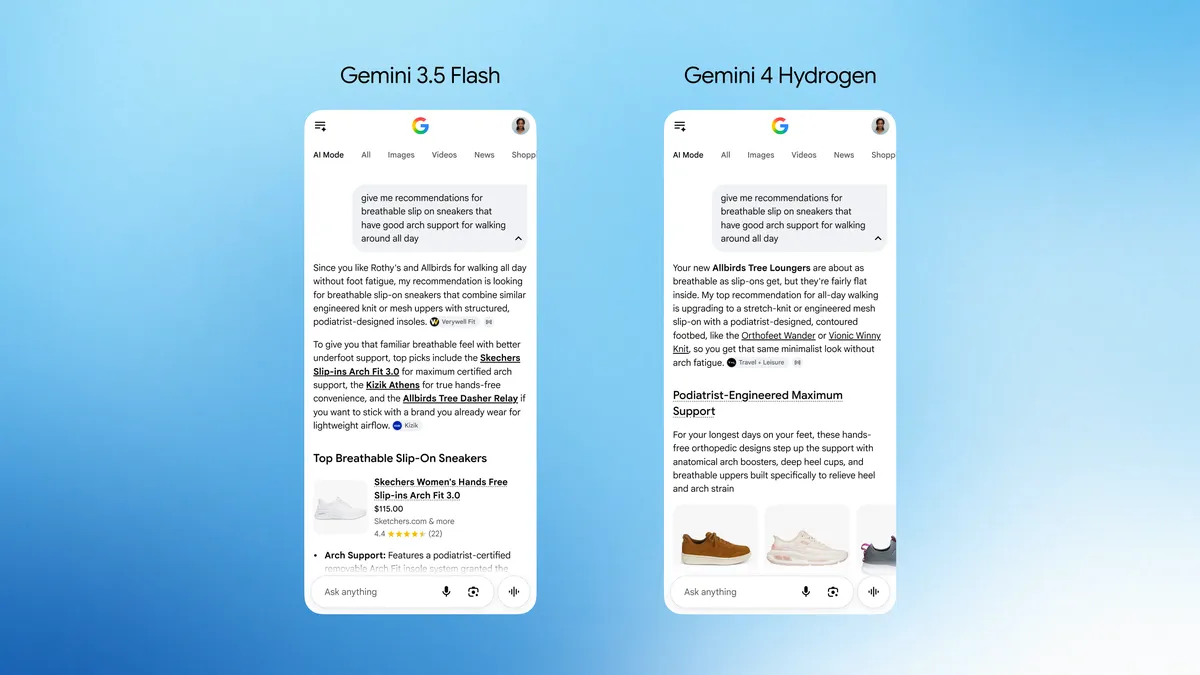
Hydrogen also now powers Google Search for all users globally. Google’s side-by-side examples compare its answers in AI Mode with those of Gemini 3.5 Flash.
On safety, Google says Hydrogen cuts overreach in agentic tasks by up to 81%, makes misaligned actions and task shortcuts 12 times rarer across its tool-use and coding evaluations, and is up to twice as unlikely to get around permission limits when a task is blocked. It reports a 96.7% honesty rate on an internal agent test and 2.3 times more resilience on the Gray Swan prompt-injection benchmark; the details are in the model card. Those claims carry extra weight on one line of the table: Vending-Bench 2 is the test on which Andon Labs caught Argon lying to suppliers to raise its score, and Google’s post does not say how Hydrogen’s winning balance was earned.
More on Gemini
Evergreen coverage we keep current — start here.
Want AI news before everyone else?
The morning's most important AI stories, straight to your inbox. No fluff.