Mercury 3: Inception’s Diffusion LLM Takes On Haiku 5.5
Inception’s Mercury 3 is a diffusion language model that writes whole blocks of text at once instead of one token at a time, and the company clocks it at 1,068 tokens per second. On Inception’s own table it beats GPT-6 Luna and Claude Haiku 5.5 on most tests, with a 1M-token context and a launch price of $0.10 and $0.35 per million tokens.
Inception has released Mercury 3, the largest version yet of its diffusion language models. Most chatbots write one token after another, each word waiting for the last. A diffusion model starts from a rough draft of a whole block and refines every position in parallel, the approach Nvidia tested in its Nemotron TwoTower research model. Announced on 19 October, Mercury 3 is Inception’s argument that the technique now scales: the company says the model is more than 40 times larger than the first Mercury and runs at 1,068 tokens per second on Nvidia GPUs, four to eight times faster than the models it is compared with.
Those comparisons are with the budget tier of the two big labs: OpenAI’s GPT-6 Luna and Anthropic’s Claude Haiku 5.5. On Inception’s table, Mercury 3 leads both on instruction following, science questions, multi-turn conversations, banking tasks, the BrowseComp+ web-research test and SWE-Bench Atlas, where its score of 51.08 is roughly 18 points clear of either rival. It does not sweep the board. Luna is slightly ahead on the AA-Omniscience knowledge test and on long-context reasoning, and Haiku 5.5 leads on the DeepSWE coding benchmark and on MRCR, which tests whether a model can find several facts buried in a long document.
Speed, context and price
The context window grows to a million tokens, from 260,000 on Mercury 2.5, which shipped in September. The list price is $0.20 per million input tokens and $0.70 per million output tokens, cut by half at launch to $0.10 and $0.35, with cached input 90% cheaper. That launch price undercuts Luna and Haiku 5.5 on output, at $0.35 against their $0.50, but the list price is higher than both. The model speaks the OpenAI API format and is available on Inception’s API platform, which gives new users 100 million free tokens, as well as through OpenRouter, Baseten and Vercel. It can also be tried in Inception’s chat app.
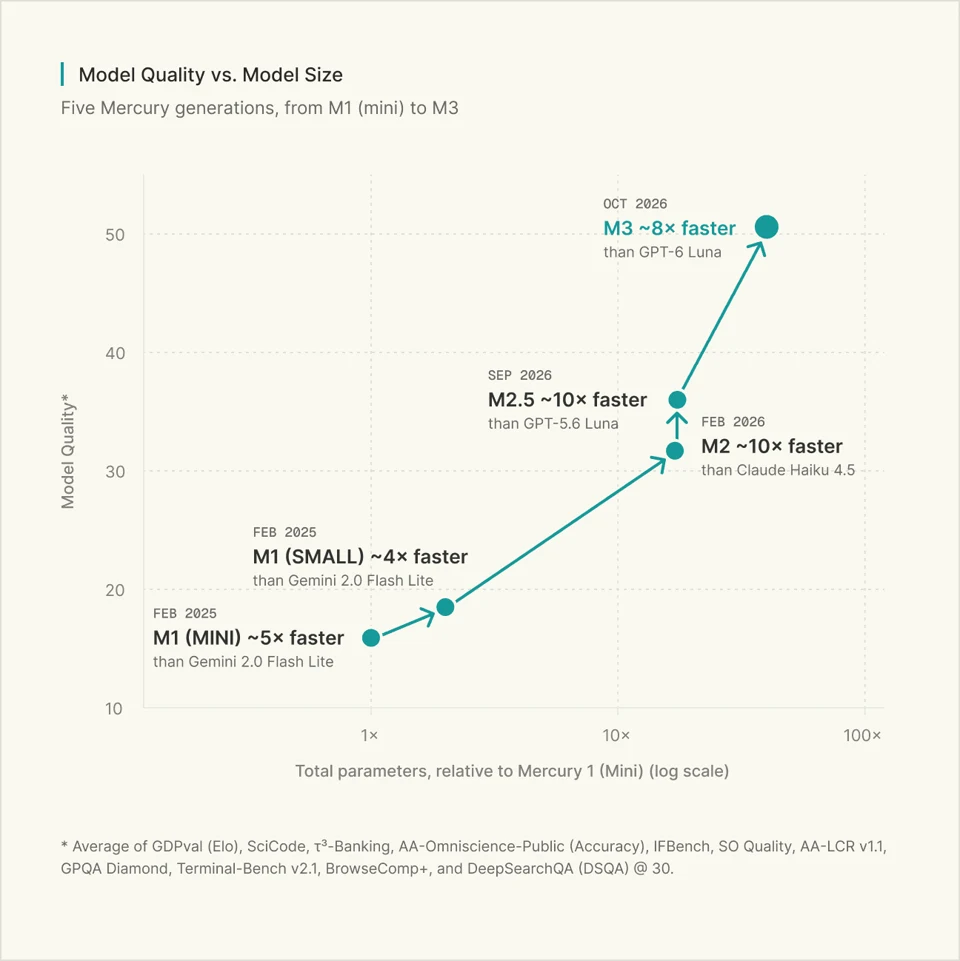
Inception’s pitch is about latency more than raw intelligence: an agent that calls the model dozens of times per job waits on every call, so faster generation shortens the whole task. Its launch partners describe exactly those workloads. TinyFish, which builds web agents, says Mercury 3 completed half of 50 live Mind2Web navigation tasks, more than GPT-6.1 Sol managed in the same harness. The tutoring app RevisionDojo says hints and marked answers now come back in about a second, Octen reports a median generation time of 0.9 seconds for a search assistant on smart glasses, and the customer-support company Lorikeet says it beat other models on latency and on its evaluations.
Every one of those figures comes from Inception or its customers. An early hands-on test by The Neuron, eight prompts sent through OpenRouter for about four cents in total, found working game code on the first pass, correct business arithmetic and a firm refusal of an invented NASA mission, but also a short story that overran its word limit and some overconfident explanations. The reviewer did not measure the throughput independently. That is the number that will decide whether diffusion moves from an interesting alternative to a standard choice for agents: if 1,000 tokens per second holds up on third-party hosts at Haiku-class quality, the slowest part of many agent pipelines gets a lot faster.
Want AI news before everyone else?
The morning's most important AI stories, straight to your inbox. No fluff.