Claude Opus 5 vs Fable 5 vs Sonnet 5: One Prompt Each
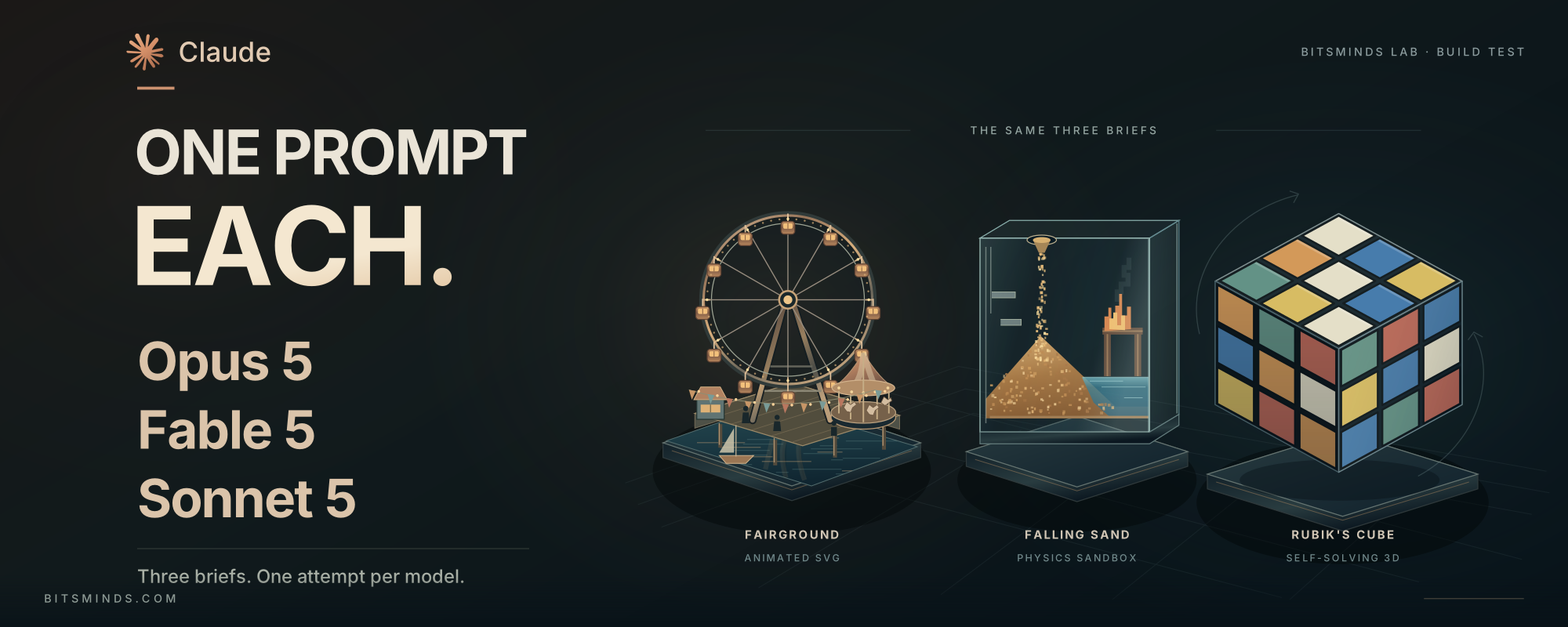
We gave Claude Opus 5, Fable 5 and Sonnet 5 the same three build briefs — an animated SVG fairground, a falling-sand physics sandbox and a self-solving Rubik’s cube — one run each, no retries, no browser. All nine builds run live inside the article. Opus 5 takes it 8–6–3, and the biggest surprise is the clock: the largest model was the fastest on every round, by a factor of nearly three.
BitsMinds LabHow this test was run3 models · 3 briefs · one run per model per brief · Maximum reasoning effort for every modelShow details
- Models
- Claude Opus 5 · Claude Fable 5 · Claude Sonnet 5
- Attempts
- One run per model per brief. No retries, no follow-up notes, no cleanup; every file is served untouched.
- Reasoning effort
- Maximum reasoning effort for every model.
- Tools allowed
- No browser: none of the three could open its own output to check it.
- Timing
- Wall-clock time from prompt to finished file, measured for every round (Opus 5 was fastest on all three).
- Scoring
- 3 points for a round win, 2 for second, 1 for third; round two shared. Final: Opus 5 wins with 8 points, Fable 5 takes 6, Sonnet 5 takes 3.
- Judging
- Scored by BitsMinds from a local side-by-side comparison page of the untouched outputs. No blind scoring, no automated grading.
- Published
- August 14, 2026
Result
| Model | Provider | Score |
|---|---|---|
| Claude Opus 5 | Anthropic | 8 pts |
| Claude Fable 5 | Anthropic | 6 pts |
| Claude Sonnet 5 | Anthropic | 3 pts |
Opus 5 wins with 8 points, Fable 5 takes 6 and Sonnet 5 takes 3; Opus 5 was also the fastest model on every round.
The briefs — as described in the article; the exact prompt files were not published
Round 1: Seaside fairground (SVG)
A seaside fairground at dusk as a single self-contained SVG. A Ferris wheel with at least ten gondolas turning continuously, a carousel with at least six horses rising and falling out of phase, twinkling bulb strings, chasing lights around the wheel's rim, a dusk gradient with a low sun or moon, the whole scene reflected in the water, and a seamless loop. No scripts, no images, no fonts. Each gondola must stay upright, level with the horizon, throughout the rotation.
Result: Opus 5 first, Fable 5 second, Sonnet 5 third — Sonnet passed the gondola trap and broke the carousel.
Round 2: Falling-sand sandbox (single HTML file)
A complete falling-sand physics sandbox in a single self-contained HTML file, no libraries and no network. Sand, water, stone, wood, fire, smoke and an eraser, on a grid at least 200 cells wide running near 60fps, paintable by mouse and by touch. Water must level out, sand must sink through water and settle beneath it, fire must eat wood and die when the wood runs out.
Result: Shared between Opus 5 and Fable 5; Sonnet 5 third. No correctness gap at all.
Round 3: Self-solving Rubik's cube (WebGL)
A 3x3x3 Rubik's cube in WebGL, Three.js from a CDN, 27 rounded cubies that read as one solid object. It scrambles itself with about twenty animated face turns, pauses, then solves itself back, showing each move in standard notation. When the solve finishes, every one of the six faces must actually be a single colour — make sure your rotation logic really returns the cube to solved.
Result: Opus 5 first, Fable 5 second, Sonnet 5 third. All three solved; only two verified that they had.
Read with care
- Single run per model — a re-run could land differently.
- The judge scored the finished artefact only; cost to run was not weighed.
Part of BitsMinds Lab, our series of original hands-on tests.
Benchmarks rank models. They do not tell you what happens when you hand three of them the same creative brief and watch what comes back. So we ran our own: Anthropic's Claude Opus 5, Claude Fable 5 and Claude Sonnet 5, three build tasks, the same prompt pasted to each, one run apiece — no retries, no follow-up notes, no cleanup afterwards. None of the three could open a browser to check its own work. Everything below is exactly the file each model wrote, served untouched.
We picked the tasks to be visual, so you can judge them yourself rather than take our word for it, and we built a hidden trap into each one. All nine builds run live in this article.
Test 1: A seaside fairground, in pure SVG
The brief: a seaside fairground at dusk as a single self-contained SVG. A Ferris wheel with at least ten gondolas turning continuously, a carousel with at least six horses rising and falling out of phase, twinkling bulb strings, chasing lights around the wheel's rim, a dusk gradient with a low sun or moon, the whole scene reflected in the water, and a seamless loop. No scripts, no images, no fonts.
The trap is one clause: each gondola must stay upright, level with the horizon, throughout the rotation. It is the thing that separates a Ferris wheel from a windmill, and it takes a second animation running backwards against the first. Get it wrong and your passengers ride the loop upside down.

Opus 5 built the fullest picture by a distance. The wheel hub turns a full circle every 28 seconds and every gondola counter-rotates the same 360 degrees over the same 28 seconds, cancelling it exactly, with a separate five-second sway of about four degrees layered on top. The frame is busy in the way a real seafront is busy — ticket booths, a lit food stall, bunting, a crowd, a boat.

Fable 5 solved the same problem more elegantly than Opus did. Each of its gondolas counter-rotates from its own angular offset, and each also sways on an eased spline with a staggered start time, so no two gondolas swing in phase — where Opus gave all of its cars the same sway. It is the better piece of animation engineering in a file a quarter the size. It is also the emptier picture: the bottom third is undifferentiated water, there is nobody at the fair, and the carousel canopy reads as a flat triangle of cardboard rather than a cone.
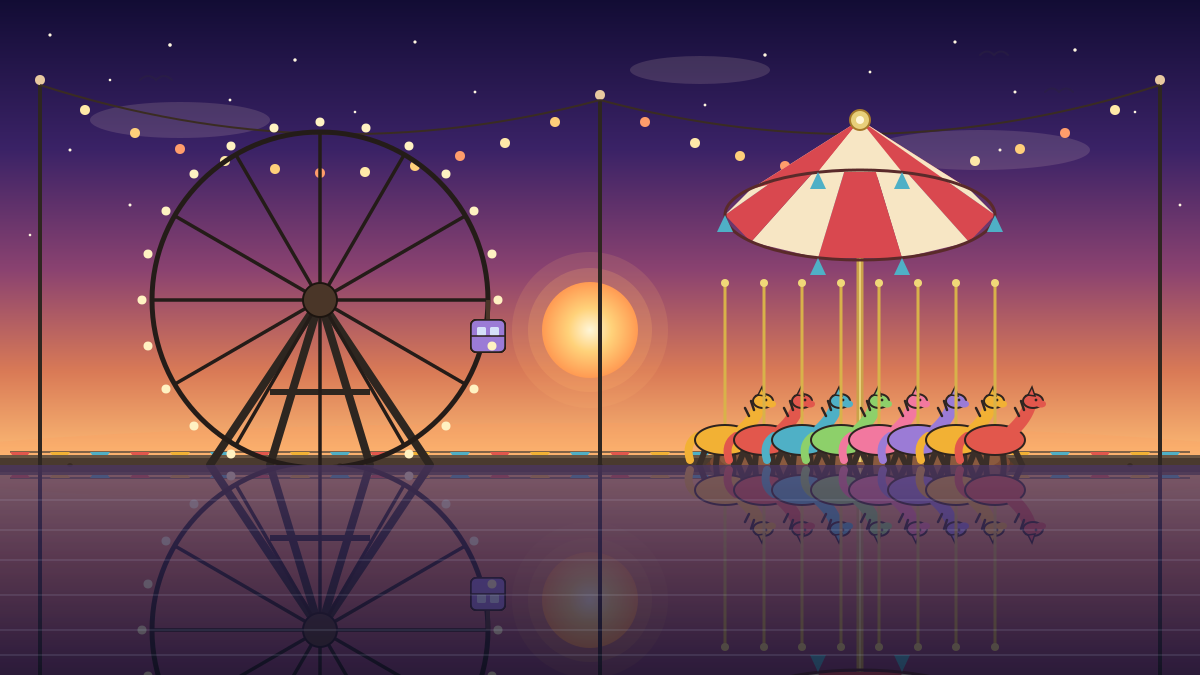
Sonnet 5 passed the trap and then failed the easy half. Its Ferris wheel is right — ten gondolas, evenly spaced, each counter-rotating from its own offset, each swaying on its own phase. Its carousel has come apart. The canopy is a flat ellipse spun in the plane of the picture, so instead of turning it lurches around like a plate being waved and drifts off the ride entirely. The horses are bunched into a single overlapping row at ground level rather than spaced around the platform, and the poles hang down from where the canopy ought to be and end in mid-air above their backs, connecting to nothing.
One thing none of the three quite delivered: a spinning canopy. Opus and Fable both left theirs stationary and revolved the horses underneath, which looks right and dodges the clause. Sonnet was the only one to animate the canopy itself, and that is precisely what broke.
Round 1: Opus 5 takes it, Fable 5 second, Sonnet 5 third. Opus and Fable both met every mechanical requirement, and the gap between them is composition — one drew a fairground with people at it. Sonnet built half a fairground beautifully and abandoned the other half.
Test 2: A falling-sand sandbox, one HTML file
The brief: a complete falling-sand physics sandbox in a single self-contained HTML file, no libraries and no network. Sand, water, stone, wood, fire, smoke and an eraser, on a grid at least 200 cells wide running near 60fps, paintable by mouse and by touch. Water must level out, sand must sink through water and settle beneath it, fire must eat wood and die when the wood runs out.
All three are live and paintable below — click a toolbar material and drag on the canvas. Try setting the wood alight, then pouring water on it.
Opus 5 — 13 minutes 14 seconds
The fastest build of the entire test, on the largest grid, and it opens on a scene nobody asked for: a house on stilts, two shelves of sand mid-pour, a crate, a pond. It ships a live frame counter and a running count of active cells, keyboard shortcuts for all seven materials, and a footer that spells out the three interactions in plain English. Set the house alight and the fire runs along the beams, eats them, and throws smoke; pour water on it and the fire dies and the water runs downhill.
Fable 5 — 19 minutes 48 seconds
Fable's opens on the scene best chosen to show the physics off: a stone-walled reservoir already full of water, a timber frame to burn, and a dune of sand. It has the nicest input handling anyone produced — the scroll wheel resizes the brush, a right-drag erases — and a faint noise texture on the canvas that the other two skipped. Physically it is every bit as correct as Opus's.
Sonnet 5 — 37 minutes 39 seconds
Sonnet's physics are correct too, and that deserves saying plainly: sand piles at a proper angle of repose, water finds its level, fire consumes wood and dies, and sand dropped into water sinks through it and settles underneath without breaking the surface. What it does not do is anything beyond that. The canvas sits inset in a bordered box so the playfield is smaller, the opening scene is a test bed of dropped blocks rather than a picture, and it ships precisely the three controls the brief listed where both larger models added a fourth button to regenerate the scene.
Round 2: honours even between Opus 5 and Fable 5, Sonnet 5 third. There is no correctness gap here at all — three working sandboxes, three sets of right answers. Opus was six minutes faster on a bigger grid; Fable had the better ideas about the mouse. Neither edge is worth a round.
Test 3: A Rubik's cube that solves itself
The brief: a 3x3x3 Rubik's cube in WebGL, Three.js from a CDN, 27 rounded cubies that read as one solid object. It scrambles itself with about twenty animated face turns, pauses, then solves itself back, showing each move in standard notation. The pass mark was stated outright: when the solve finishes, every one of the six faces must actually be a single colour — make sure your rotation logic really returns the cube to solved.
Each cube scrambles and solves on load. Drag to orbit it.
Opus 5 — 15 minutes 41 seconds
Fable 5 — 15 minutes 58 seconds
Sonnet 5 — 42 minutes 28 seconds
All three cubes genuinely end solved. We orbited every one of them to check the faces you cannot see from the front. On the stated pass mark, this round is a three-way pass.
The difference is that only two of them knew it. Opus wrote a function that walks all 54 stickers, buckets them by face and asserts that each face holds nine of one colour, then reports "all six faces uniform" on screen and logs the verdict to the console. Fable wrote a stricter check still: it confirms that all 27 cubies are back in their home positions and that each one's rotation is the identity — which would catch a twisted centre piece that a face-colour test waves through. Sonnet wrote this:
if(phase === 'scrambling') phaseLabel.textContent = 'Scrambling';
else if(phase === 'solving') phaseLabel.textContent = 'Solving';
else phaseLabel.textContent = history.length === 0 ? 'Solved' : 'Idle';
Sonnet's cube declares victory because its move queue emptied. It never reads a sticker or a cubie. Had its rotation logic been subtly wrong — the single most likely failure in this task — it would have printed "Solved" over a scrambled cube with exactly the same confidence. It got the right answer with no way of knowing that it had, in a task whose brief had asked it, in so many words, to make sure.
The cubes differ as objects, too. Opus and Fable both build a black plastic body with the colours recessed into it as stickers, which is what makes a Rubik's cube read as one solid thing; Fable's uses the exact canonical face colours and has the best-lit surfaces of the three. Sonnet's 27 cubies are separate glossy blocks with wide black voids between them and no body holding them together, so the object reads as a stack of loose gel sweets.
Round 3: Opus 5 takes it, Fable 5 second, Sonnet 5 third. This is the closest call in the test, and Fable has the better claim on two counts — the better-looking cube and the more rigorous check. Opus takes it on the whole package: the move ribbon laying out the entire sequence, the verification surfaced to the reader rather than kept in the source, and a scramble you can actually follow.
The clock was the real surprise
The intuition about model tiers is that the big one is slow and careful and the small one is quick and rough. This test inverted that completely. Opus 5 was the fastest model on every single round, and it was not close.
| Build | Opus 5 | Fable 5 | Sonnet 5 |
|---|---|---|---|
| Fairground (SVG) | 23m 39s | 38m 49s | 68m 34s |
| Sandbox (HTML) | 13m 14s | 19m 48s | 37m 39s |
| Rubik's cube (WebGL) | 15m 41s | 15m 58s | 42m 28s |
Sonnet 5 took nearly three times as long as Opus on the fairground and the cube, and produced less in both. That is worth holding onto if you are choosing a model on price: the cheaper model was not the cheaper build here once you count the clock, and it was the only one that shipped something broken.
The verdict: Opus 5 wins with 8 points, Fable 5 takes 6, Sonnet 5 takes 3
Scoring three points for a round win, two for second, one for third, with round two shared: Opus 5 finishes on 8, Fable 5 on 6, Sonnet 5 on 3.
The most interesting line in that table is Fable's. It never won a round and it never lost one — second place, three times out of three. On the individual pieces of craft it was frequently the best thing on the page: the staggered gondola sway, the canonical cube colours, the scroll-wheel brush, the best-looking object anyone built. What it did not do was fill a frame or finish a product. Fable 5 makes the nicest components; Opus 5 ships the thing.
Sonnet 5's three straight third places are less damning than the number looks. Its physics were correct, its cube solved, its Ferris wheel obeyed the one clause designed to catch models out. It simply did the brief and stopped, took two to three times as long doing it, and was the only one to leave a wreck behind — a carousel whose canopy has floated off the ride, in a scene it spent 68 minutes on.
Which points at the thing that actually separated these three, because it was not correctness. All three sandboxes obey the same physics. All three cubes solve. The separation was in what each model does after it has the right answer: whether it fills the frame, whether it adds the button you did not ask for, and whether it goes back and checks. On this evidence the frontier model is not the one that gets more answers right. It is the one that treats a finished answer as the middle of the job rather than the end of it.
Our previous run of this test, Opus 4.8 against Fable 5 over four builds, ended dead level at 2–2 and concluded that whoever checks their own work wins. Three models and three builds later, that still holds — and the model that checked hardest also happened to be the quickest. If you want the numbers behind these three rather than the pictures, our benchmark comparison of Opus 5, Fable 5 and Sonnet 5 covers the same line-up on the standard evaluations.
Every file above is the untouched output of a single run. Scroll back up, set fire to a wooden house, and see whether you score it the way we did.
More on Claude
Evergreen coverage we keep current — start here.
Want AI news before everyone else?
The morning's most important AI stories, straight to your inbox. No fluff.