OpenAI's Agents API Ships the Codex Harness
The harness behind Codex is now a public-beta API. OpenAI runs the agent loop, context compaction and subagent orchestration; developers supply the tools and pick where code executes — an OpenAI sandbox, their own VPC, or one of nine partners.
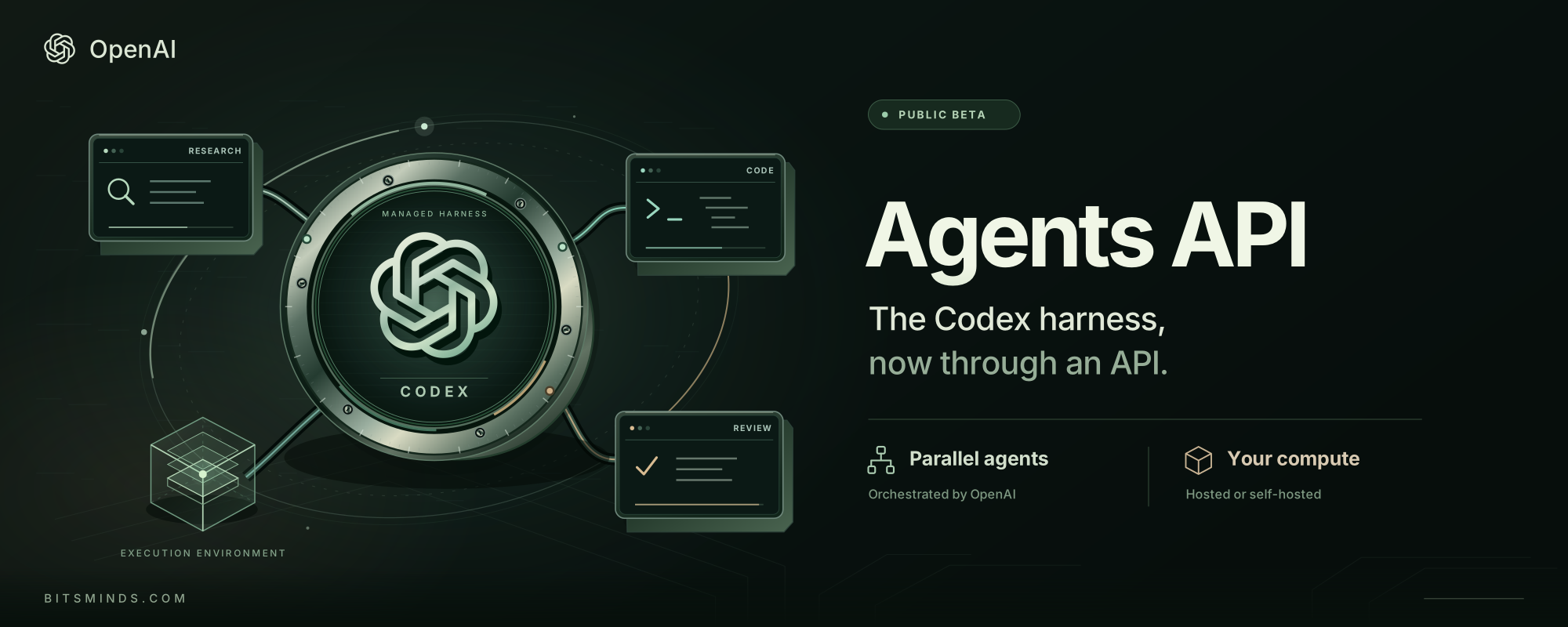
OpenAI released the Agents API in public beta on 10 September, opening the same harness and infrastructure that runs Codex and ChatGPT for Work to any developer. The pitch is narrow and specific: you describe a task, a model, a set of tools and an execution environment in one call, and OpenAI operates everything between the model and the machine.
That single call is client.beta.agents.sessions.create. OpenAI's own example points a gpt-6-astra agent at an observability MCP server, switches on multi_agent with three concurrent subagents, hands it a secrets vault and a capability directory, and asks it to investigate an elevated 5xx rate over the last 30 minutes, delegate the deployment, error and dependency analysis, and write its findings to a workspace directory. The company's framing of the split is blunt — OpenAI hosts and maintains the harness, and the developer chooses the compute.
The features underneath are the ones every team building long-running agents has had to write itself. Context management compacts earlier turns automatically as a session nears its context limit, which lets a workflow span multiple context windows without bespoke compaction logic. Tool search loads tool definitions only as they become relevant, cutting token spend while leaving the prompt cache intact. Programmatic tool calling lets the agent run calls in parallel, chain related operations, and filter or combine results in code, so it can grind through large volumes of data and return only what matters to its context. MCP servers, custom functions and built-in tools such as web search are all supported.
Multi-agent support is the part OpenAI leans on hardest. The harness breaks a task into independent pieces and hands them to subagents that run in parallel, each holding its own context while the primary agent coordinates and reassembles the results. OpenAI argues this is what makes research, analysis and coding workloads faster without the developer writing an orchestration layer — a layer that, until now, was the price of admission.
Where the code actually runs is a menu rather than a mandate. Agents can execute in an OpenAI-managed sandbox, on the developer's own infrastructure, or inside one of nine partner environments: Blaxel, Cloudflare, Daytona, DigitalOcean, E2B, Modal, Oracle, Runloop and Vercel. The differences OpenAI expects developers to care about are VPC deployment, file and secret storage mechanisms, and CPU, GPU and memory configurations with different cold-start and cost profiles. For teams that want none of that decision, the new OpenAI hosted sandbox runs on the same infrastructure behind Codex and ChatGPT, configurable with files, packages, skills and plugins.
Two commitments in the announcement are aimed squarely at the people who have been burned by harness churn. OpenAI says the Agents API gives versioned access to harness capabilities with each model launch, maintained alongside the models — an answer to the tax of reworking your own scaffolding every time a new model lands. And the harness itself is the open-source Codex harness, so developers can read the logic coordinating model calls, tools and context even though OpenAI is the one running it.
OpenAI put eight named customers behind the launch, including SafetyKit, Dwelly, Hypha, deepsense.ai and Nash.ai. The most concrete number came from Jack Weissenberger, CTO of Ciridae, who said his team's evaluation score moved from 0.71 to 0.85 and that the subagent support delivered a 4x latency reduction: "Previously it was pretty cumbersome to observe and orchestrate subagents in our old setup," he said, calling the parallel flows "a huge out-of-the-box lift."
There is no surcharge. Developers pay for the tokens and tools their agents consume, with hosted sandboxes billed at standard container rates — a detail worth reading twice, because a managed agent that can run for days is a meter that keeps running too. OpenAI says it will iterate through the beta on developer feedback before general availability.
The shape of this is familiar from the acquisition side of the business: OpenAI bought Ona in June specifically to run Codex agents inside a customer's own cloud, and has been metering Codex through Oracle Cloud credits since the same month. What is new is the admission embedded in the product. For two years the frontier labs sold models and left the scaffolding to everyone else; the Agents API concedes that the scaffolding was most of the work, and that OpenAI would rather own it than watch a dozen orchestration frameworks stand between its models and the people paying for them.
Want AI news before everyone else?
The morning's most important AI stories, straight to your inbox. No fluff.