
Claude Code Review 2026: Pricing, Limits, Verdict
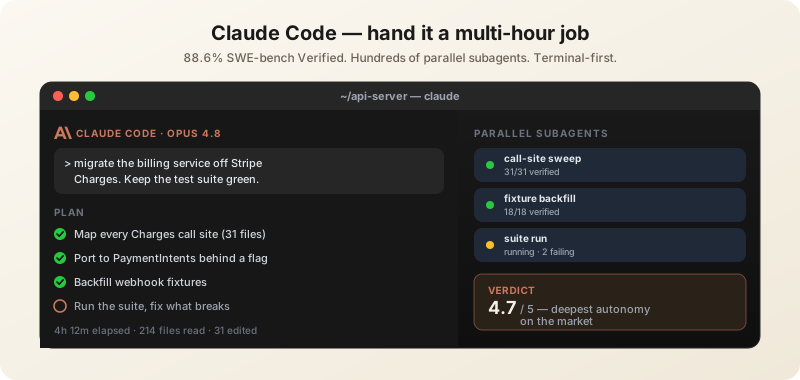
Claude Code is the deepest autonomous coding agent available, running Opus 4.8 at 88.6% on SWE-bench Verified with up to 1000 parallel subagents. Here is what it costs and where it falls short.
Pros
- Deepest autonomy of any coding agent
- Up to 1000 parallel subagents with verification
- Opus 4.8 posts 88.6% on SWE-bench Verified
- Runs on macOS and Linux and Windows at GA
- MCP support plus CI integration
- Publishable sessions and iOS simulator verification
- Included with a $20 Claude Pro subscription
- Five permission modes for control
Cons
- Least predictable cost in the category
- Barely competes on autocomplete
- Terminal-first shape does not suit everyone
- Auto mode now acts without asking by default
- Autonomous execution is a real security surface
- Heavy use effectively requires the $100+ Max tier
The Bottom Line (August 2026)
Claude Code is the deepest autonomous coding agent available, and it is the only one built around the assumption that you will hand it a job and walk away. It lives in your terminal, reads your repo, runs your tests, and on a large task will spin up hundreds of parallel subagents, verify their work, and report back. Its default model, Opus 4.8, posts 88.6% on SWE-bench Verified and 83.4% on OSWorld computer-use.
What you are trading for that depth is predictability. Cost scales with how hard you push it, the terminal-first shape does not suit everyone, and as of August 14 it decides for itself when to act unless you tell it otherwise. Claude Code alone now clears $2.5 billion in annualized revenue, so plenty of people have decided the trade is worth it.
Score: 4.7/5. The most capable tool in the category, with the least predictable bill.
This is the buying-decision review. For installation, session mechanics, CLAUDE.md memory and customisation, read our complete Claude Code guide. For scheduling agents to run themselves, see how to use Claude Code routines.
Is Claude Code Worth It?
Yes, if your work contains jobs you would rather delegate than do — repo-scale migrations, large refactors, test backfills, multi-hour cleanups. That is the specific thing Claude Code is better at than anything else, and if you have that work, nothing else comes close.
It is the wrong purchase if:
- You want autocomplete. Claude Code barely competes here. Cursor's Tab is a different product solving a different problem.
- You need a predictable monthly bill. On the API tier the meter runs; on subscription tiers you hit rate limits instead. Either way, heavy use costs more than a flat seat licence.
- You are uncomfortable in a terminal. There are thin IDE extensions and a desktop app, but the tool's centre of gravity is the shell.
Claude Code Pricing (August 2026)
| Access route | Price | Who it fits |
|---|---|---|
| Claude Pro | $20/mo | Individual developers with occasional agent jobs. Rate-limited. |
| Claude Max | $100+/mo | Daily heavy use. The tier most working developers end up on. |
| Metered API | $5 in / $25 out per million tokens (Opus 4.8) | Teams and CI, where usage is lumpy and a seat price does not fit. |
The honest framing: Pro is where you discover whether you like it, Max is where you actually work. A single large migration handled by a fleet of subagents can consume a meaningful share of a monthly allowance, and the API route makes that visible as a dollar figure rather than a throttle.
Anthropic has also moved limits upward more than once — it raised Claude Code weekly limits by 50% the same day OpenAI offered two months of free Codex, and doubled rate limits at its developer conference. Useful to know, but do not budget on the assumption it keeps happening.
What Makes It Different: Autonomy at Scale
Most coding tools help you write the next few lines. Claude Code is built to own a whole task. Its Dynamic Workflows feature lets Claude plan the work, spin up parallel subagents — capped at 1,000 total with 16 running concurrently — and verify their output before it reports anything back to you.
The benchmark position behind that:
| Benchmark | Opus 4.8 (Claude Code default) |
|---|---|
| SWE-bench Verified | 88.6% |
| OSWorld (computer use) | 83.4% |
Anthropic also describes Opus 4.8 as tuned to be its "most honest" model at self-review — which matters more than it sounds for an agent working unattended. An agent that quietly reports success on work it did not finish is worse than one that fails loudly.
At its 2026 developer conference Anthropic added overnight self-improving "dreaming" agents, scheduled Routines, multi-agent orchestration, automated code review and CI auto-fix. The direction is unambiguous: less supervision, longer runs.
Auto Mode Is Now the Default
On August 14, 2026, Anthropic made auto mode the Claude Code default. This is the single biggest change to how the tool behaves this year, and the reasoning is worth reading carefully.
Anthropic's own trial found that auto mode caught 89% of harmful actions, against 13.6% for manual review — because users were rubber-stamping 97% of permission prompts. In other words: the human-in-the-loop safeguard was not working, because humans do not read the twentieth confirmation dialog of the afternoon.
You still have five permission modes — Ask permissions, Accept edits, Plan, Auto and Bypass permissions — reachable from one menu. If you want the old behaviour, it is one setting away.
Our read: the data supports the change, and it is also a real shift in what you are agreeing to. An agent that decides when to act is a different product from one that asks. Know which one you have running.
What Shipped Recently
Three additions in July changed what the tool produces and where it runs:
- Publishable sessions — a session can be published as a live, shareable page that calls MCP connectors using each viewer's own credentials.
- iOS verification — it can build an iOS app and check it in the simulator without leaving the session.
- Linux desktop — the desktop app is in beta for Ubuntu and Debian. The CLI already runs on macOS, Linux and Windows at GA.
There is also "ultracode" mode, reachable with /effort ultracode, for tasks where you want maximum reasoning effort rather than speed.
The Security Surface You Are Accepting
This belongs in a review rather than a footnote, because it is a genuine cost of the autonomy.
In June, researchers disclosed an attack called agentjacking: public Sentry keys plus MCP can be used to feed a coding agent fake bug reports that trick it into running attacker code. They found 2,388 exposed organisations and an 85% success rate.
This is not a Claude Code defect specifically — it is the structural risk of any agent that reads untrusted input and can execute. But an agent with broad permissions and auto mode on is exactly the configuration the attack wants. Treat MCP connectors as supply chain, and do not point an autonomous agent at an untrusted issue tracker.
Worth noting on the corporate side: Meta barred its own engineers from using Claude Code and Codex in June — but over fears that rival model outputs would contaminate its training data, not over security. That is a competitive concern, not a verdict on the tool.
Claude Code vs Cursor vs Codex
| Claude Code | Cursor | OpenAI Codex | |
|---|---|---|---|
| Form factor | Terminal-first, plus thin IDE extensions and CI | VS Code fork | Everywhere — IDE, cloud, mobile app |
| Built for | Long unattended jobs | Active editing | Breadth of access |
| Wins on | Deepest autonomy, parallel subagents, verification | Best autocomplete, fastest iteration | Ubiquity |
| Weakest at | Autocomplete, cost predictability | Non-VS-Code editors, long autonomous runs | Depth on very large tasks |
| Billing | $20 / $100+ subscription or metered API | $20/mo flat | Subscription |
Our full three-way comparison lands on: Claude Code owns deep terminal autonomy, Codex wins ubiquity, and Google's Antigravity is the open, free, multi-agent option. The most common professional setup is Cursor plus Claude Code — Cursor for the code you are writing now, Claude Code for the job running in another window.
Competition is arriving. xAI's Grok Build pairs a 2-million-token context window with up to 8 parallel subagents, aimed squarely here. It is the most serious structural answer so far, though 8 subagents against Claude Code's 1,000 is a different order of ambition.
Compare these side by side
Put Claude Code, Codex and Antigravity against each other on autonomy, model choice and price in our interactive comparison.
Who Should Buy Claude Code
Buy it if: you have repo-scale work you would rather delegate; you are comfortable in a terminal; you want an agent that verifies its own output; or you need CI-integrated automation rather than an editor plugin.
Skip it if: autocomplete is what you actually want — buy Cursor; you need a fixed predictable monthly cost; or your organisation cannot accept an autonomous agent with execution rights.
Which tier: start on Claude Pro at $20 to find out whether the workflow suits you, expect to move to Max at $100+ if it does, and use the metered API when usage is lumpy or lives in CI rather than on a developer's laptop.
Verdict
Claude Code is the most capable coding agent available and the only one whose design premise is genuine delegation rather than assistance. The subagent fleet, the verification pass and Opus 4.8's benchmark position add up to something no competitor matches on depth — and $2.5 billion in annualized revenue is the market agreeing.
Three things keep it at 4.7 rather than higher. Cost is the least predictable in the category, whether you meet it as a meter or as a throttle. Auto-by-default is well-evidenced but is still a meaningful change in what you are consenting to. And the agentjacking research is a reminder that an autonomous agent with execution rights is a security surface, not just a productivity tool. None of these are reasons not to buy it. All of them are reasons to buy it deliberately. Score: 4.7/5.
Reviewed August 2026 against Claude Code with Opus 4.8. Pricing and benchmark figures as published by Anthropic.
Frequently Asked Questions
How much does Claude Code cost?
Claude Code is included with Claude subscriptions: Claude Pro at $20 per month for occasional use, and Claude Max at $100 or more per month for daily heavy use. It is also available through the metered API at $5 per million input tokens and $25 per million output tokens for Opus 4.8, which suits teams and CI where usage is lumpy.
Is Claude Code worth it?
Yes if your work includes jobs you would rather delegate than do — repo-scale migrations, large refactors, test backfills, multi-hour cleanups. No if what you actually want is autocomplete, where Cursor is far better, or if you need a fixed predictable monthly bill.
What are Claude Code's limits?
On subscription tiers you hit rate limits rather than a bill; Claude Pro is more restrictive than Max. On parallelism, Dynamic Workflows caps subagents at 1,000 total with 16 running concurrently. Anthropic has raised weekly limits more than once, including a 50% increase in May 2026, but do not budget assuming that continues.
Claude Code vs Cursor: which should I use?
They solve different problems. Claude Code is terminal-first and built for long unattended jobs; Cursor is a VS Code fork built for active editing with the best autocomplete available. Many developers run both — Cursor for code they are writing now, Claude Code for a job running in another window.
Does Claude Code run on Windows and Linux?
Yes. The CLI is generally available on macOS, Linux and Windows. The desktop app reached beta for Ubuntu and Debian in July 2026, alongside the existing macOS and Windows builds.
What model does Claude Code use?
Opus 4.8 by default, which posts 88.6% on SWE-bench Verified and 83.4% on OSWorld computer-use, and which Anthropic describes as tuned to be its most honest model at self-review — relevant for an agent working unattended.
Is auto mode safe in Claude Code?
Anthropic's own trial found auto mode caught 89% of harmful actions against 13.6% for manual review, because users were approving 97% of permission prompts without reading them. Auto became the default on August 14, 2026. Five permission modes remain available — Ask permissions, Accept edits, Plan, Auto and Bypass permissions — so the stricter behaviour is one setting away.
What is agentjacking and does it affect Claude Code?
Agentjacking is an attack disclosed in June 2026 that uses public Sentry keys and MCP to feed coding agents fake bug reports which trick them into running attacker code, with a reported 85% success rate across 2,388 exposed organisations. It is a structural risk for any agent that reads untrusted input and can execute, not a Claude Code defect — but treat MCP connectors as supply chain and avoid pointing an autonomous agent at an untrusted issue tracker.
About the score. 4.7/ 5 is BitsMinds' editorial verdict from our own testing and research — not an average of user ratings, which we do not collect. Prices and plan tiers are as published by the vendor on the fact-check date shown above. How we rate →
Related Reviews

Cursor IDE Review 2026: Worth $20 a Month?
Cursor Pro is $20 a month and Composer 2.5 now draws with Claude Opus 4.7 on coding benchmarks at roughly a tenth of the per-token cost. But SpaceX is buying Cursor, and that is now part of the decision.

GLM-5.2 Review: Open Weights That Out-Code GPT-5.5
GLM-5.2 is the strongest open-weight coding model yet: MIT-licensed, 744B MoE, 1M context. It beats GPT-5.5 on SWE-bench Pro and trails Opus 4.8 by a point on FrontierSWE — at a fraction of the cost. Our review, with benchmark charts.

GitHub Copilot Review 2026: Is It Still Worth It?
GitHub Copilot is the broadest AI coding assistant and the only real option for JetBrains, Visual Studio, Neovim and Xcode, with completions still free. But June's move to metered AI Credits changed the maths, and Claude Code took developer ground.
Want AI news before everyone else?
The morning's most important AI stories, straight to your inbox. No fluff.