Gemini Robotics 2.5 Hits 96% on a Mercedes-Benz Line
Google DeepMind’s Gemini Robotics 2.5 ran Apptronik’s Apollo 2 humanoids on Mercedes-Benz production lines in Hungary and Germany, picking and packing car parts with a 96% success rate. Across more than 200 lab tasks, DeepMind reports 30% to 100% higher success than the previous model and 20% to 30% faster completion. The model is going to robotics partners only, with no public API.
Google DeepMind has introduced Gemini Robotics 2.5, which it calls its most capable vision-language-action (VLA) model to date. A VLA model takes what a robot’s cameras see and an instruction in plain language, and turns them into movements of its arms and hands. In the announcement, dated November 10 and written by Carolina Parada, DeepMind says the new version widens the range of skills a robot can learn and speeds up how fast it learns them. It is rolling out to DeepMind’s robotics partners. There is no public API, price or download.
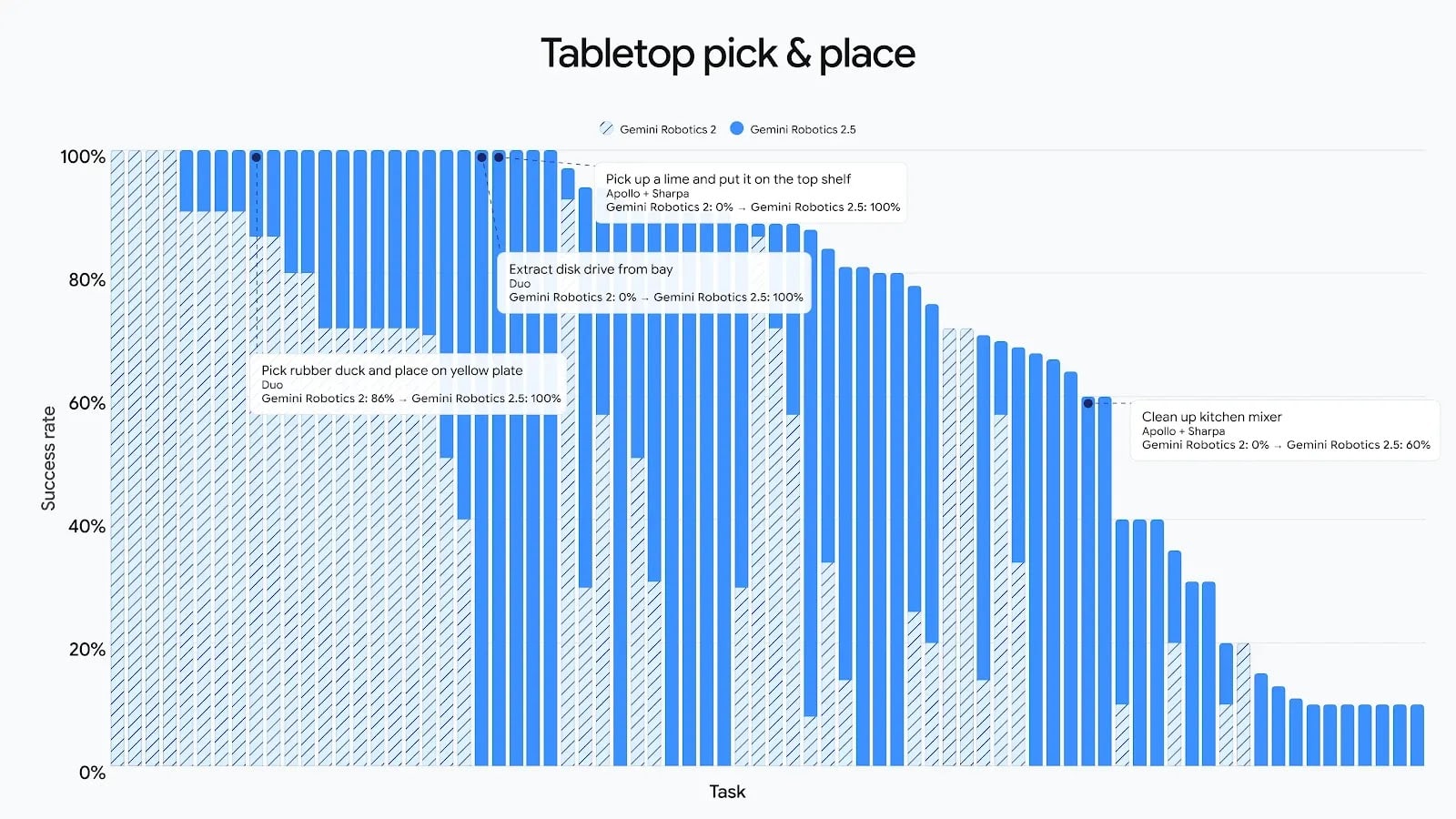
DeepMind tested the model on more than 200 distinct tasks, such as serving food with tongs, tying a bow on a gift box and pipetting a liquid. Compared with its previous baselines, it reports a 30% to 100% higher success rate depending on the type of task, and tasks finished 20% to 30% faster. Like earlier Gemini Robotics models, it works with different kinds of robot: Apptronik’s Apollo 2 humanoid, fitted with the five-finger SharpaWave hand (22 degrees of freedom), and the Franka Duo platform with two-fingered parallel grippers.
A pilot on two Mercedes-Benz lines
The headline result comes from outside the lab. With Apptronik and Mercedes-Benz, DeepMind put Apollo 2 humanoids on active production lines in Kecskemét, Hungary, and Sindelfingen, Germany. The job was automotive kitting: sorting individual parts from bulk bins into trays, in the exact order each car on the line needs them. A second model, Gemini Robotics ER, tracked the workflow while Gemini Robotics 2.5 drove the hands and arms. The robots reached into supply bins, picked up metal brackets and placed them in sequencing containers, correcting for gaps as they went. DeepMind reports a 96% success rate.
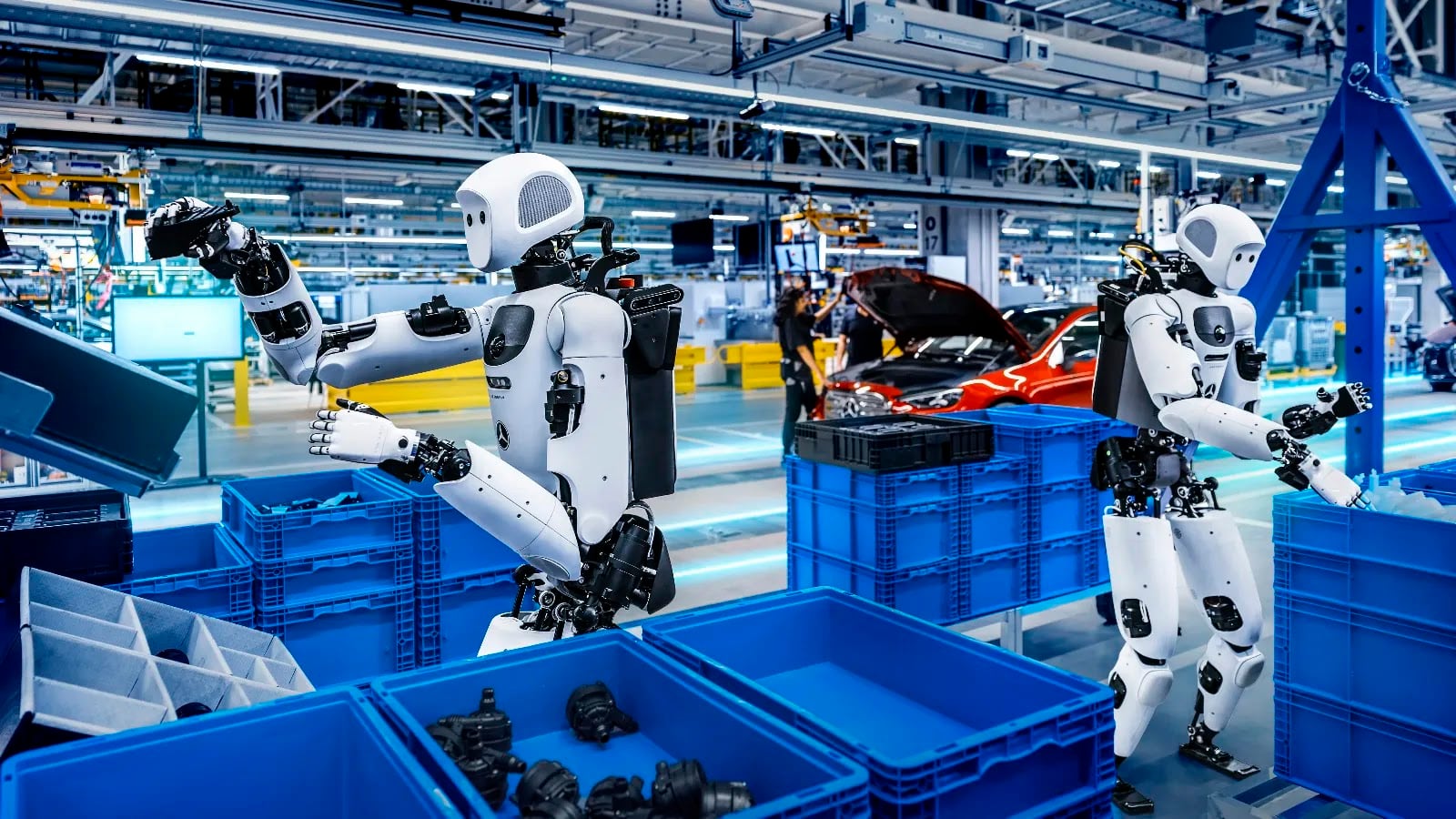
Jeff Cardenas, Apptronik’s co-founder and chief executive, says in the post that the models improved over a few weeks of post-training and would “carry over to Mercedes-Benz production with very little drop-off.” DeepMind calls the work a proof of concept. It did not say how many picks the 96% figure covers, how long the pilot ran, or how the robots’ pace compared with a human worker’s.
Safety, and a new jailbreak benchmark
For physical safety, Gemini Robotics 2.5 uses what DeepMind calls inference-time reasoning guidance to steer around hazards as it works, a layer the company compares to the safety classifiers around Gemini’s text answers. In DeepMind’s evaluations it raised safe task completion by 33% around obstacles and by 43% around nearby people. The lab is also releasing ASIMOV-Jailbreak, an open-source benchmark of hundreds of prompts that disguise unsafe requests across dozens of scenes. On it, Gemini 4 Argon resisted 99.5% of jailbreaks, against 82% for the earlier Gemini Robotics ER 2. The wider agentic robotics evaluations sit in the Gemini 4 safety report.
Argon also did much of the groundwork. DeepMind says Gemini 4 Argon acted as a simulation engine for the project: from one real camera scene it can generate thousands of varied simulated practice runs and build a realistic digital twin, which, mixed with real demonstrations, helps the robot generalize to new scenes and objects. Researchers also used it to guess from video why a task failed, then test fixes in simulation and on real robots. Google described those abilities in October in Gemini 4 Argon for Robotics.
The comparison to watch is with Nvidia, which pitches its own Cosmos and GR00T stack as the foundation for humanoid robots. DeepMind’s answer puts the Gemini family on every side of the machine: Argon to help train it and test its safety, ER to plan the work, 2.5 to move the hands. The 96% comes from a pilot on two lines; whether it holds across a shift, a season and a whole plant is the number Mercedes-Benz will care about, and DeepMind has not published it.
More on Gemini
Evergreen coverage we keep current — start here.
Want AI news before everyone else?
The morning's most important AI stories, straight to your inbox. No fluff.