Meta Drops the Camera From a $349 Pair of AI Glasses
At Connect 2026 Meta unveiled Ray-Ban Meta Audio, its first smart glasses with no camera, alongside a third-generation Ray-Ban Meta, $1,299 VR glasses for next spring and Muse Charm, a pocket device for its AI agent. Muse itself is coming to the glasses in the coming months.
Meta’s most talked-about product at Connect 2026 is the one that does less. Ray-Ban Meta Audio are the company’s first AI glasses without a camera: open-ear speakers, microphones and an assistant built into a Ray-Ban frame, and nothing that can take a photo of the person across the table. Pre-orders opened on 23 September at $349 and the glasses ship on 13 October, according to Engadget. They weigh 43 grams, which Meta says makes them its slimmest and lightest frames yet, and they last up to 12 hours on a charge, with the case adding up to 48 more.
They come in two new shapes, the retro Clubmaster and a rectangular Burbank, in 23 colour and lens combinations, and take a wide range of prescription lenses. The pitch is earbuds you never take out: music, podcasts, calls, live speech translation and a voice assistant, in glasses you might wear all day anyway. TechCrunch reads the design as a response to the complaint that has dogged Meta’s camera glasses from the start, that they make covert recording too easy. Mark Zuckerberg framed it more simply: once you get used to good audio, "it’s just a thing that you want all the time."

The bigger software story is that Muse, the AI agent Meta launched only weeks ago, is coming to the glasses. In the coming months, wearers will be able to call their agent by name and, on camera-equipped models, ask it to act on what they are looking at — a product on a shelf, a flier on a wall, a school supply list. Muse is also getting its own email address, computer use on the Mac so it can drive any app while you step away, a real-time voice you can design by describing it, and a batch of new shopping connectors including Walmart, Best Buy, Sephora, Wayfair and PayPal, with Expedia and Instacart to follow. Amazon, which blocked Muse’s shopping agent days earlier, is not on the list.

For people who do not want glasses at all, there is Muse Charm, a palm-sized device that clips onto a keychain and carries the agent in your pocket. It has a small screen showing an animated avatar, speakers, microphones and a fingerprint sensor: "you just go ahead and tap here," Zuckerberg said, "and you can start talking without having to unlock a phone or open an app." Meta has not given a price, and says only that it will have more to share later this year. TechCrunch expects it in December. It echoes the AI pendant a leaked Meta memo described back in June.
The camera glasses were refreshed too. The third-generation Ray-Ban Meta is slimmer, adds an action button for the assistant, runs nine hours instead of eight, and uses a six-microphone array Meta says removes more than 90% of background noise. It keeps a 12MP camera with 3K video, adds Aviator and cat-eye Zena frames, and is on sale now from $449. Across the range, Meta is adding an FDA-cleared hearing-enhancement feature for adults with mild to moderate hearing loss, due in the US later this year for $149.99 or as part of a Meta One subscription, along with guided workouts, nutrition tracking and landmark-based walking directions. The Meta Ray-Ban Display, the model with a screen in the lens, can now be ordered online in the US for $799.
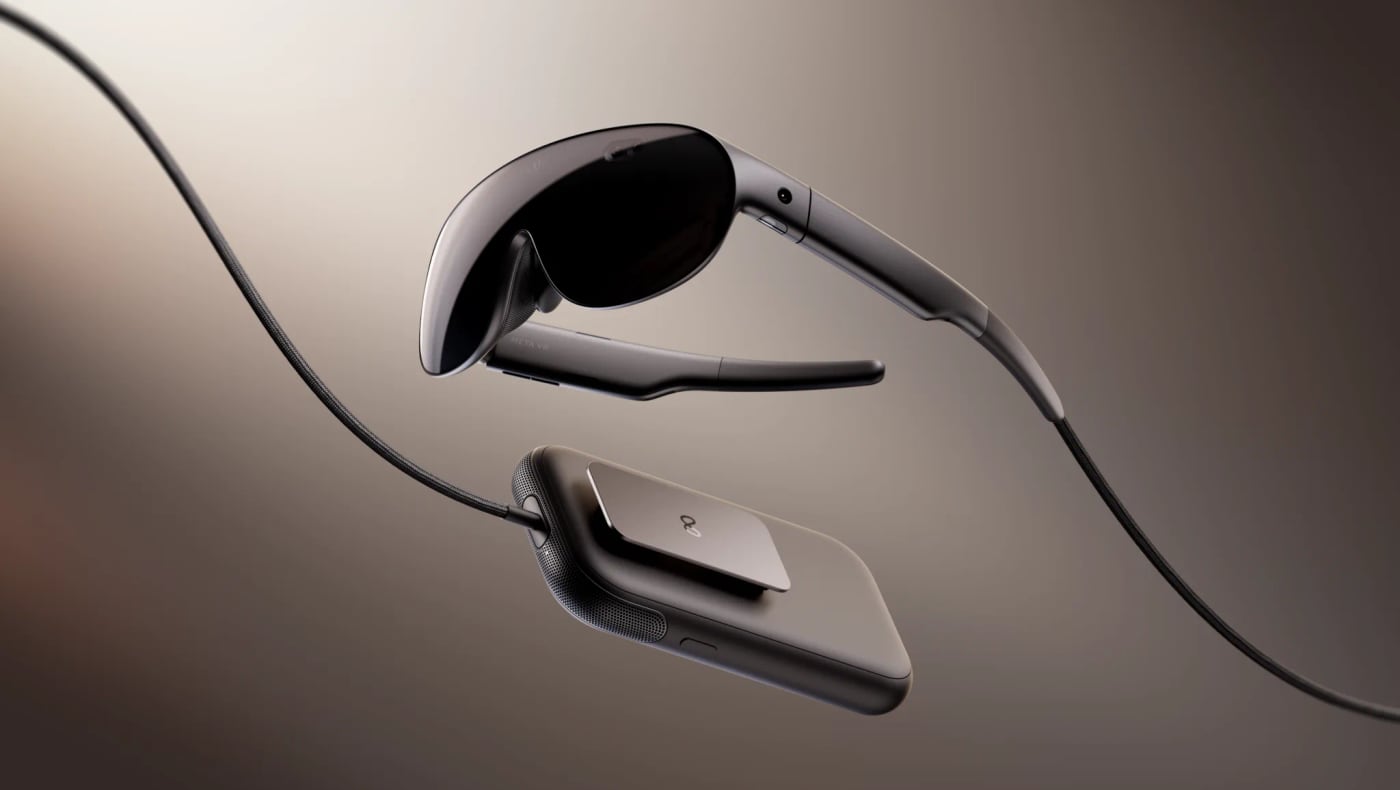
At the top of the range, Meta gave a date and a price for the device it had been hinting at for a year. Meta VR Glasses weigh about 100 grams, five times less than a Quest 3, because the battery, processors and storage live in a tethered puck. They use a 5K micro-OLED display, track your eyes and hands instead of needing controllers, and can turn a desk into a keyboard and touchpad for a wall of virtual screens. They will be available in spring 2027 for $1,299.99.
Taken together, the lineup shows a company hedging on what people will actually wear. Meta is selling glasses with a camera, without one, with a screen and with a full VR display, plus a keychain for people who want none of those, and it is betting the same agent can sit behind all of them. That rival glasses from Google and its eyewear partners are arriving this fall makes the breadth look deliberate. The $349 pair with no camera is the cheapest way into that system, and the one least likely to make the people around you nervous.
Want AI news before everyone else?
The morning's most important AI stories, straight to your inbox. No fluff.