Salesforce Gives Its AI Agents Names and Jobs
Four days before Dreamforce, Salesforce shipped seven named Agentforce agents — Casey, Paige, Carter, Marshall, Piper, Fin and Hunter — six generally available and one in pilot. The pilot is the interesting one: Hunter runs on a new long-horizon runtime built to chase a goal for weeks rather than a chat.
Salesforce announced seven named AI agents on 11 September, four days before Dreamforce opens in San Francisco, and the naming is the part worth noticing. The company is no longer selling a platform on which customers assemble agents. It is selling staff: Casey, Paige, Carter, Marshall, Piper, Fin and Hunter, each scoped to a job title rather than a capability, each wired into Customer 360 so it inherits the accounts, records and processes a company already keeps in Salesforce.
Six are generally available now. Casey handles customer service across voice, SMS, WhatsApp and web chat, with prebuilt flows for FAQs, returns, account management and escalation to a human. Paige takes IT and HR requests where employees already are — Slack, internal portals. Carter works the storefront, helping shoppers find and compare products and closing with in-chat checkout. Marshall runs back-office supply-chain processes with deterministic execution and an audit record of every action, which is the detail enterprise buyers actually ask about. Piper qualifies inbound leads across websites and inboxes for B2B teams. Fin resolves the more tangled customer-experience workflows across channels.
The seventh, Hunter, is in pilot with general availability planned for November — and it is the one that signals where the product is going. Hunter is an outbound sales agent, and outbound sales is not a task that finishes inside a conversation. So Salesforce built it on a new long-horizon runtime: an agent that pursues a goal across days and weeks instead of a single session. Three mechanisms hold that together — memory that survives between sessions, durable execution that keeps a plan alive and course-corrects when it breaks, and dynamic steering that adjusts behaviour from user feedback. Hunter is the first agent to run on it.
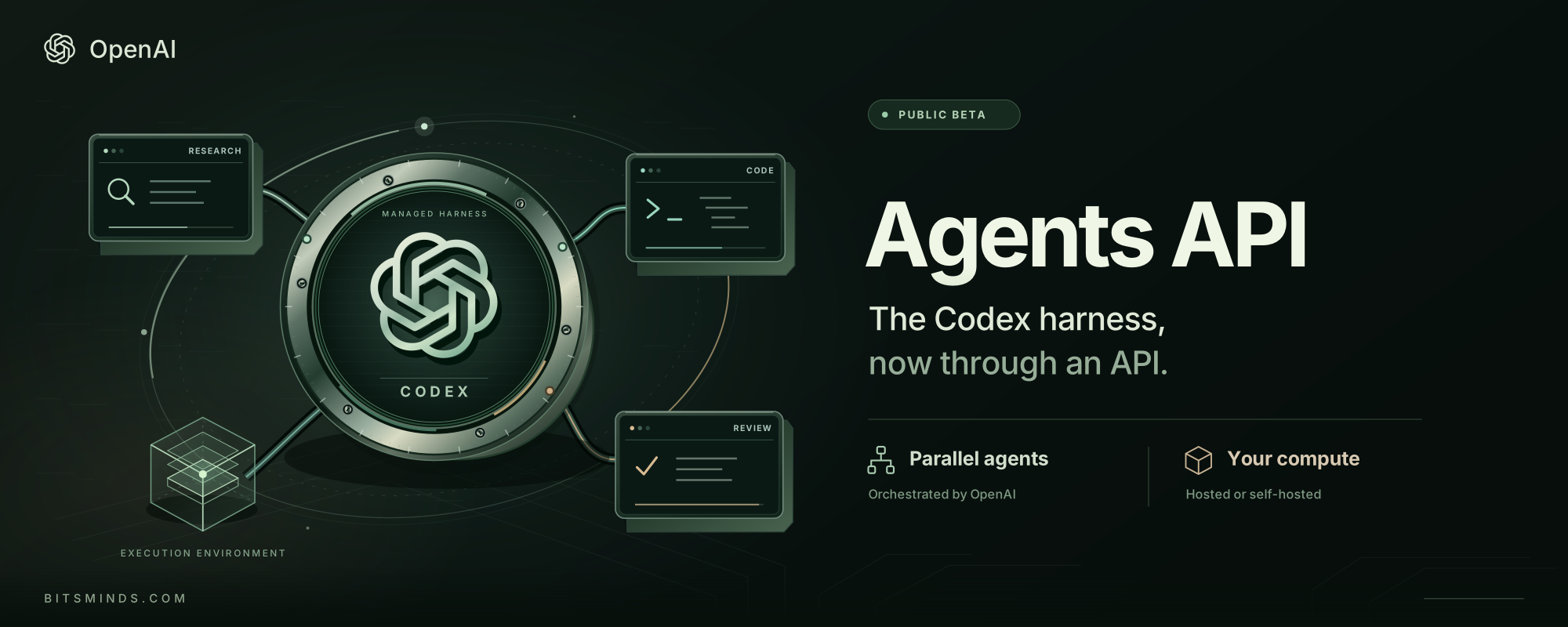
That is a meaningfully harder engineering problem than a chat agent, and it is the same problem the rest of the industry hit this year. OpenAI's Agents API shipped the Codex harness for much the same reason: once an agent works for longer than one exchange, state, retries and recovery stop being implementation details and become the product. Salesforce's version of the answer is more conservative than most — Marshall's deterministic execution and audit trail exist precisely so that a back-office agent cannot improvise — which is the right instinct for software that touches invoices.
The customer numbers Salesforce chose to publish are the usual mix of impressive and unaudited. Travel platform Engine says its help agent resolves 50% of chat inquiries outright; Perk credits its outbound agent with 60% of pipeline built; Autism Queensland puts employee-request resolution at 70%; retailer Hibbett says 90% of shopper journeys are handled by an agent it deployed in six weeks; Asana reports a 4× increase in conversation volume through Piper. Salesforce also cites Anthropic as a Fin customer with a 79% autonomous resolution rate — a frontier lab outsourcing its own support queue to someone else's agent, which is either a strong reference or a small joke, depending on the day.
Around the agents, Salesforce shipped the plumbing. Multi-Agent Orchestration is generally available now, letting several agents hand work between each other rather than running as isolated bots. AI Skills inside Coworker are in pilot with general availability in October, as is Agent Optimizer. And the company put a headline metric behind the whole line: 7 billion Agentic Work Units delivered across Agentforce and Slack, where one unit is defined as a single discrete task completed by an agent — 3.2 billion of them in Q2 alone, which is the number that tells you how much of that total is recent.
The timing is not accidental. Dreamforce runs 15–17 September, and Salesforce has spent a year being asked whether Agentforce is a product or a positioning exercise. Shipping six agents into general availability the week before the keynote is an answer of sorts — as is the choice to give them human first names, which quietly reframes the buying decision from "which model do we license" to "which role do we fill." Whether Hunter can actually hold a plan together for six weeks of outbound prospecting is the question November will settle, and it is a harder one than any of the six agents shipping today have to answer.
Want AI news before everyone else?
The morning's most important AI stories, straight to your inbox. No fluff.